In 1885, a worker at an Austrian foundry split a block of Tertiary coal and found inside a strange iron cube. Estimated to be 60 million years old, this 785-gram object has a perfectly cubic shape and a central groove that completely surrounds it. Since then, the Wolfsegg Cube has been the subject of debate among geologists, archaeologists, and ufologists, with no consensus reached on its origin.
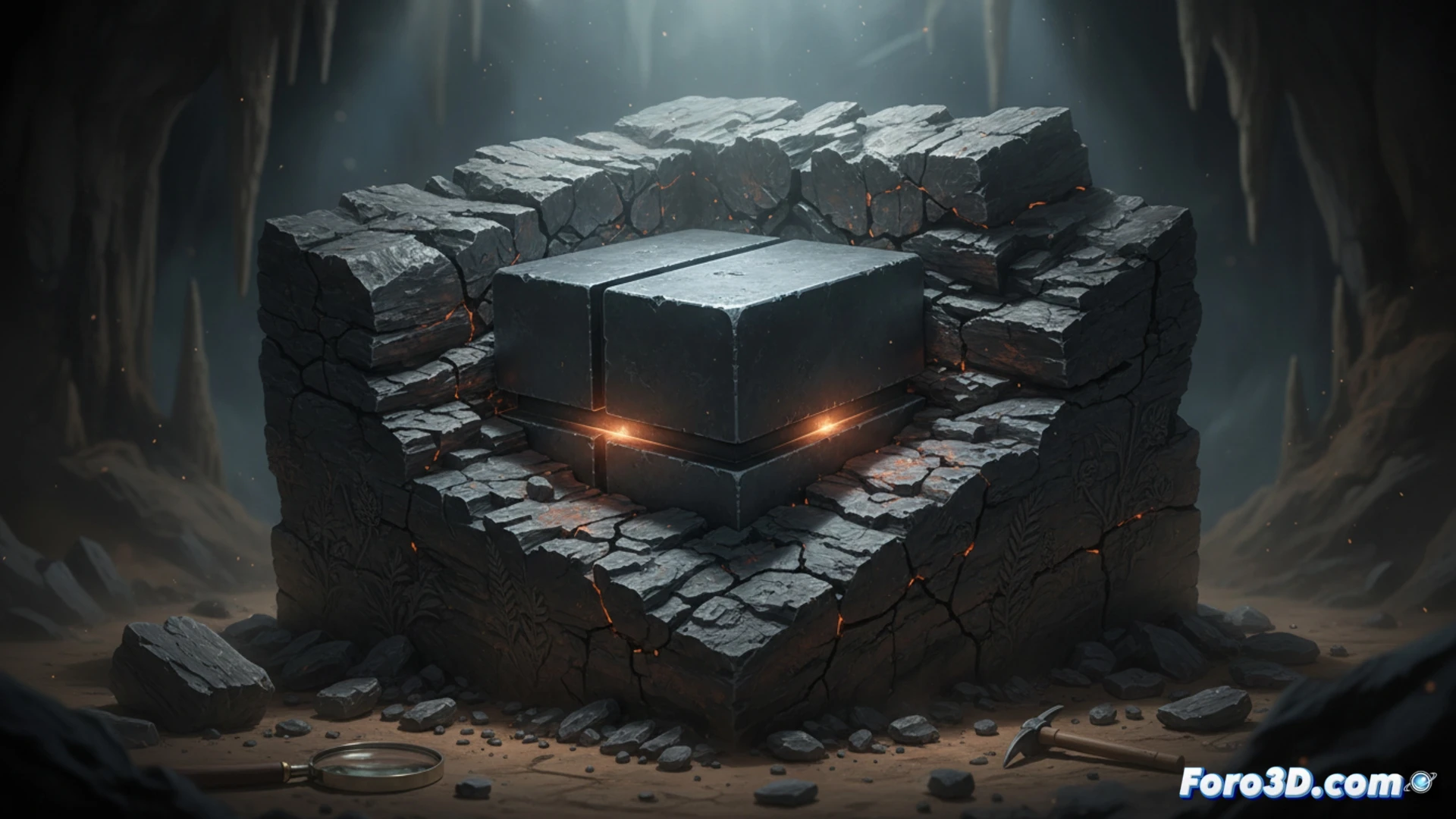
Digital reconstruction and symmetry analysis through virtual photogrammetry 🧊
To approach its study from a digital forensic perspective, we have generated a 3D model of the cube based on the scarce historical photographs and 19th-century metric descriptions. The virtual photogrammetry simulation reveals near-perfect symmetry on all six faces, with a tolerance of just 0.2 millimeters on its edges. The central groove, 3 millimeters deep, shows uniform wear incompatible with natural geological processes. When comparing its surface texture with databases of metallic meteorites (such as Campo del Cielo), a total absence of typical Widmanstätten patterns is observed. The simulation of its burial in bituminous coal suggests that, if natural, the cube should show pyrite inclusions or compression marks that it does not possess.
Lost artifact or 19th-century hoax? The paradox of artificial iron 🔍
The greatest dilemma is not whether the cube fell from the sky or was forged, but that both options are uncomfortable. If it is a meteorite, its cubic shape defies all laws of natural crystallization. If it is artificial, it implies that an unknown civilization mastered iron metallurgy 60 million years ago. Our 3D model allows rotating the object in real-time and observing that the central groove is not a simple furrow, but a precision guide, similar to industrial machining marks. Until a non-destructive metallographic analysis is performed, the Wolfsegg Cube will remain the silent witness to a past we still do not know how to interpret.
Could the geological dating of the coal that contained the Wolfsegg Cube be verified using modern isotopic analysis techniques, and what implications would this have for the study of potential out-of-place artifacts in digital archaeology?
(PS: and remember: if you can't find a bone, you can always model it yourself)