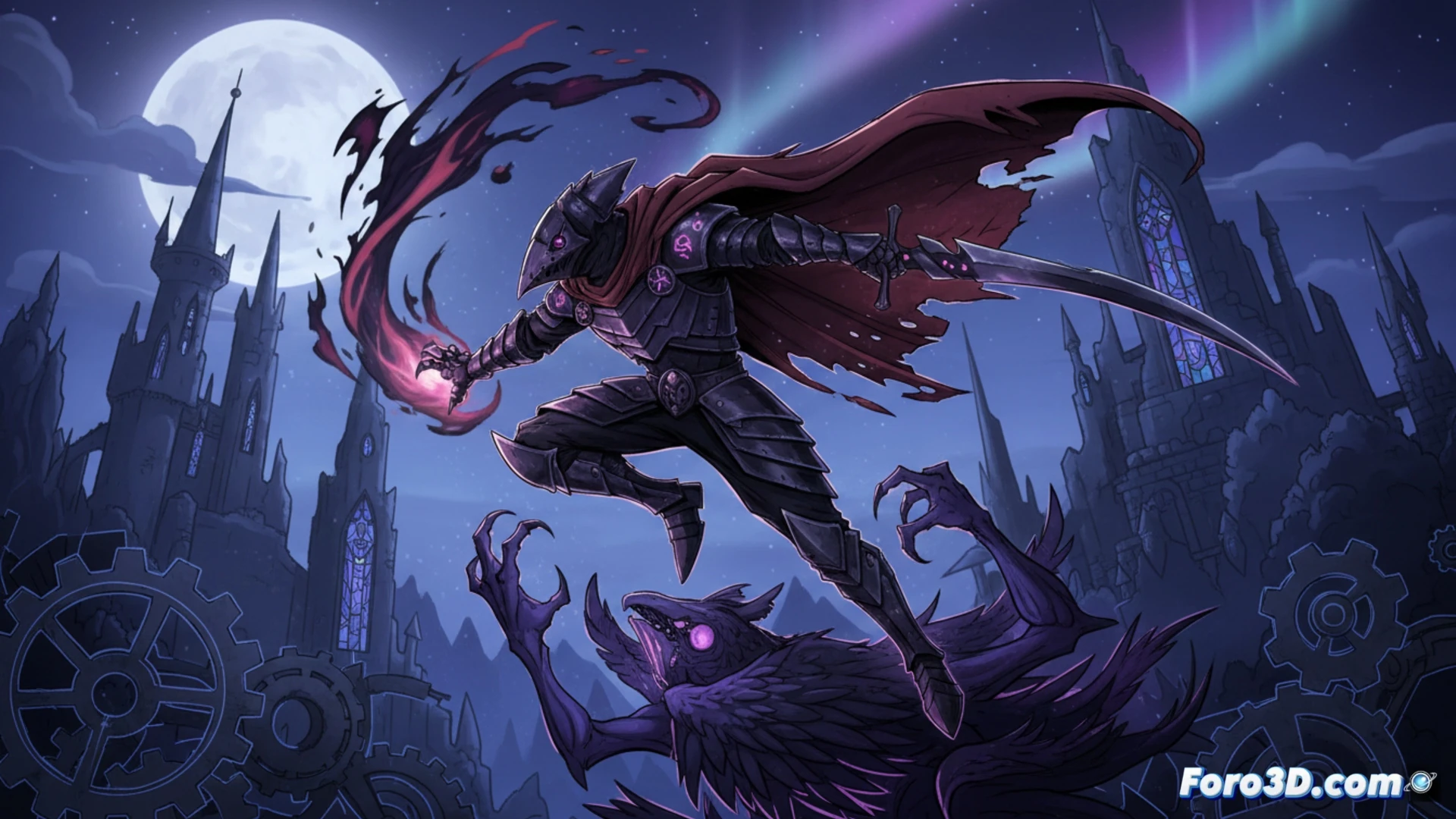
Crowsworn is shaping up to be one of the most promising independent titles in the metroidvania genre, standing out for its dark atmosphere and hand-drawn animations. Behind its impressive visual section lies a meticulous technical pipeline that combines the Unity engine with rigging tools like DragonBones or Esoteric Software Spine. This article breaks down how the team achieves frame-by-frame fluidity and gothic parallax backgrounds, offering practical lessons for developers looking to emulate this artistic style without sacrificing performance.
Artistic pipeline: From drawing to real-time animation 🎨
The creative process of Crowsworn begins in Adobe Photoshop, where each sprite is drawn and digitally painted to capture the gothic and melancholic aesthetic. Subsequently, the animations are exported to Spine or DragonBones, where skeletal rigging is performed, allowing smooth transitions between attacks, jumps, and movements. This hybrid approach (traditional frame-by-frame animation combined with bone deformation) reduces asset weight without losing the organic feel of motion. In Unity, developers implement a parallax layer system with multiple backgrounds rendered in depth, bringing the gothic scenarios to life. To optimize performance, it is recommended to use compressed texture atlases and limit the number of active bones per character, always prioritizing visual coherence over superfluous detail.
Lessons for independent studios 🛠️
Crowsworn demonstrates that a small team can achieve AAA quality levels in 2D if they master the right combination of tools. Using Spine for rigging allows for rapid iteration on complex animations, while Unity offers a robust ecosystem for handling physics, particles, and lighting effects. For those seeking a similar style, it is crucial to invest time in designing the basic animation cycles (walking, attacking, taking damage) before expanding the moveset. Additionally, parallax should be planned from the concept art phase, separating each background element into independent layers to facilitate its implementation in the engine. Crowsworn is not only a promising game but a living manual on how technique and art can merge in the independent industry.
What 2D animation techniques with Spine and Unity does Crowsworn use to achieve smooth transitions between character movement and combat attacks, and how do they optimize performance in complex scenarios with multiple layers of lighting and visual effects?
(PS: 90% of development time is polishing, the other 90% is fixing bugs)