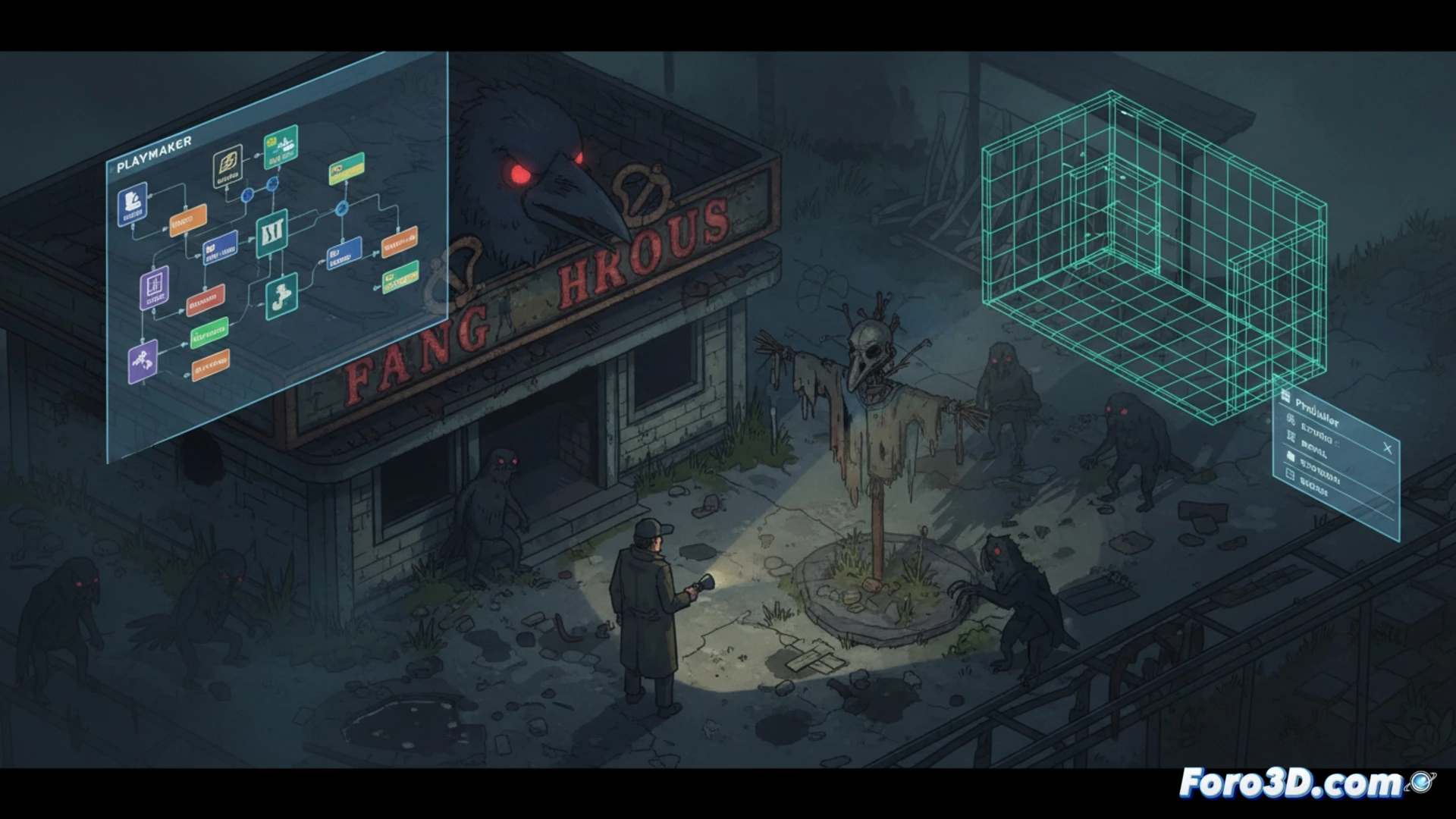
Crow Country is not only a visual homage to 90s survival horror, but a masterclass in technical efficiency. Developed in Unity, the game achieves its 32-bit aesthetic through two key tools: Playmaker for visual scripting and Probuilder for level modeling. This combination allows indie developers to replicate the feel of fifth-generation consoles without needing to code from scratch or use complex external software.
Playmaker and Probuilder: The Dynamic Duo of Indie Development 🎮
Playmaker acts as the game's brain, managing puzzle logic, fixed camera transitions, and enemy behavior through visual state diagrams. Instead of writing complex C# code, developers drag and connect actions like Send Event or Set Position, speeding up prototype iteration. In parallel, Probuilder allows sculpting and modifying geometry directly in Unity's scene view. Crow Country exploits this tool to create rooms with that characteristic blocky look of titles like Resident Evil or Silent Hill, where each room is a cube intentionally deformed to maximize the claustrophobic atmosphere.
Technical Limitations as a Creative Advantage 🧩
The decision to use these tools was not only pragmatic but also aesthetic. By limiting polygonal detail with Probuilder, the team avoids the trap of photorealism and forces a stylized art direction. For the indie developer, this workflow offers a valuable lesson: you don't need a cutting-edge graphics engine to generate tension. Using Playmaker to orchestrate sound events and simple animations, combined with low-resolution textured Probuilder levels, can result in horror that is more effective and authentic than many modern AAA titles.
Can a workflow based on Playmaker and Probuilder replicate the oppressive atmosphere of classic survival horror without sacrificing performance in modern engines?
(PS: a game developer is someone who spends 1000 hours making a game that people complete in 2)