The release of Age of Wonders 4 has reignited interest in proprietary engines within the 4X genre. Triumph Studios has bet on its Creator Engine to manage a particular technical challenge: dynamic terrain deformation and genetic customization of races. In this article, we break down the production pipeline that combines Autodesk Maya for high-polygon modeling and Substance Designer for procedural materials, analyzing how these integrate into an engine that prioritizes strategic readability without sacrificing visual detail.
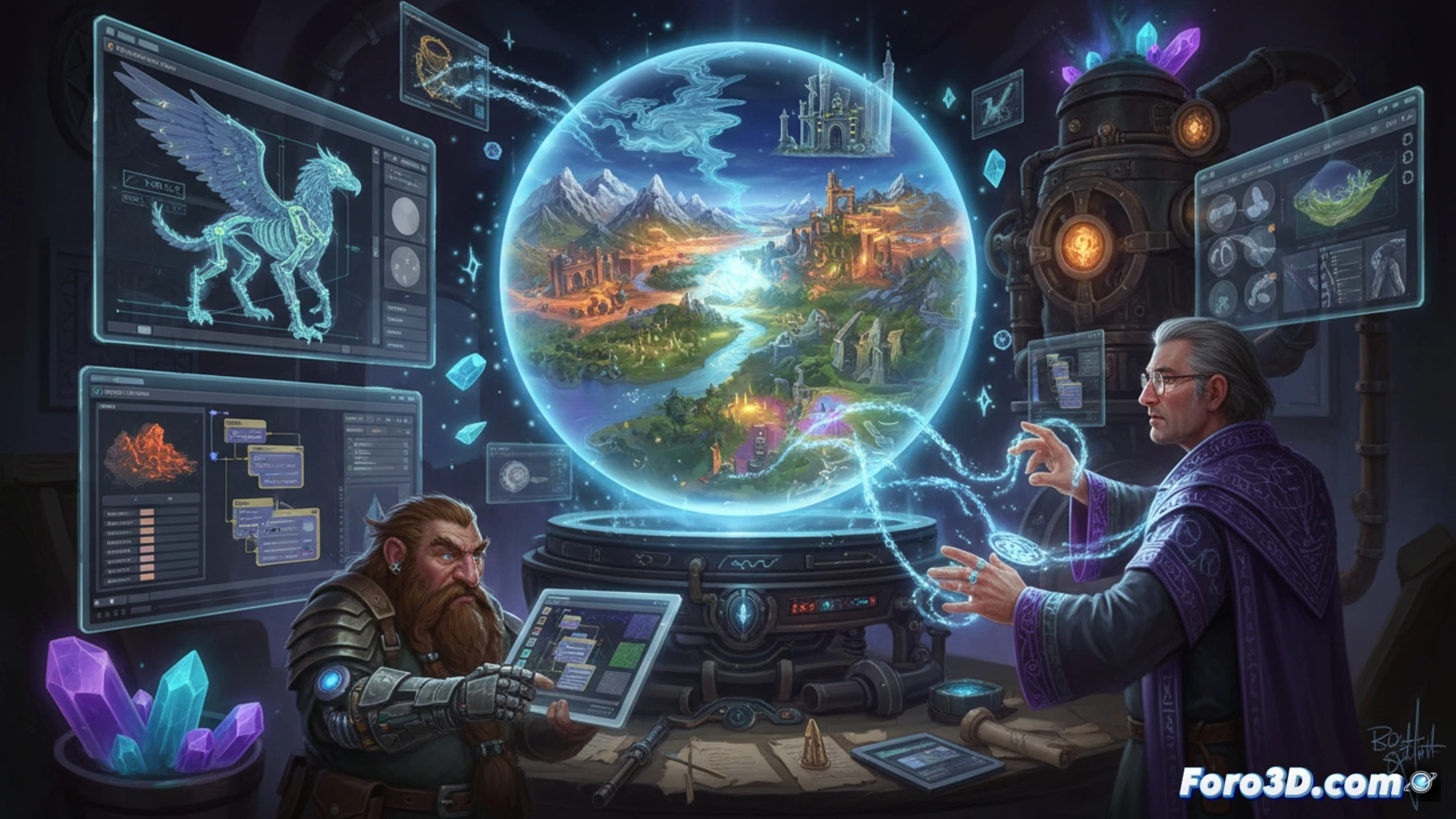
Asset pipeline: from Maya to Creator Engine with dynamic materials 🛠️
The workflow begins in Autodesk Maya, where artists model units with a level of detail that allows for close zoom without loss of quality. The key lies in modularity: each race shares a base skeleton, but armor, weapon, and facial feature assets are swapped using a socket system. These models are exported to the Creator Engine, which handles asynchronous LOD loading to maintain 60 fps on maps with hundreds of units. For terrain deformation effects, such as meteor craters or earthquake fissures, Substance Designer generates height textures in real-time that the engine uses to displace map geometry in a tessellation shader. This allows the terrain to remember elevation changes after a spell, a detail that demands a precise balance between GPU memory and computational latency.
Lessons for developers: customization without combinatorial explosion 💡
The biggest technical challenge of Age of Wonders 4 is race customization. Each combination of physical traits (skin, eyes, horns) and cultural traits (armor, banners) generates thousands of visual permutations. Triumph Studios avoids memory overload by using a layer system in Substance Designer: base materials are neutral, and details are applied as color and normal masks in real-time. For the indie developer, the lesson is clear: prioritize a procedural material system from the project's inception. The Creator Engine demonstrates that, with a well-planned shader architecture, one can offer an aesthetic depth typical of an RPG in a massive strategy game.
What technical advantages does using the Creator Engine offer compared to commercial engines like Unreal or Unity for managing the real-time magic effects pipeline in a 4X game like Age of Wonders 4?
(PS: 90% of development time is polishing, the other 90% is fixing bugs)