The release of Eiyuden Chronicle: Rising not only served as a narrative prologue for Hundred Heroes but also as a fundamental technical testing ground. Developed in Unity, this action RPG implements a 2.5D aesthetic that combines detailed three-dimensional backgrounds with high-resolution 2D character sprites. This article breaks down the workflow between Unity, Blender, and Photoshop that made it possible to achieve that characteristic visual depth, analyzing the lighting and composition decisions that define the game's visual style.
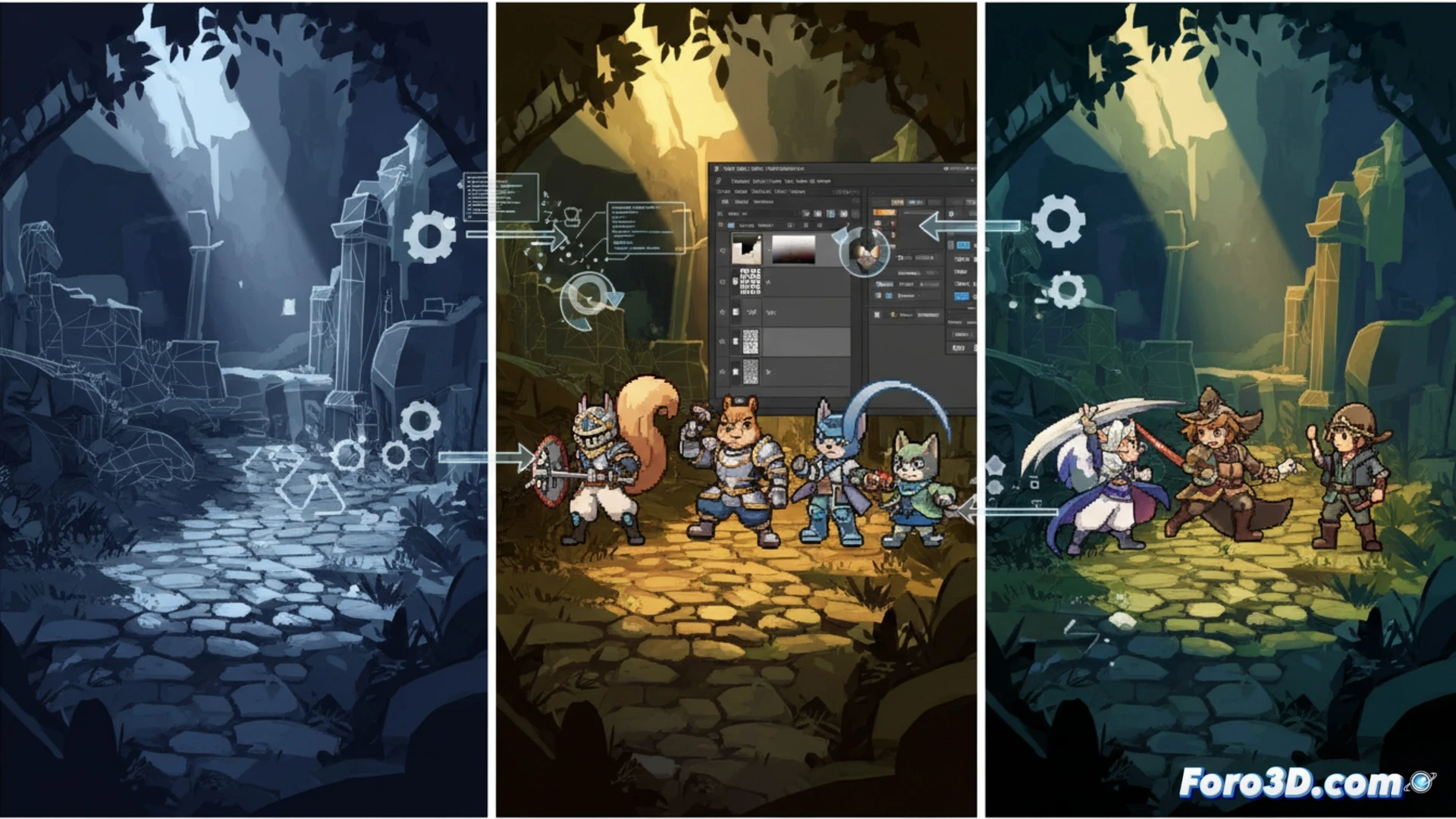
3D Modeling for Backgrounds and 2D Rendering for Sprites 🎨
The asset pipeline was divided into two clear branches. On one hand, the backgrounds were modeled in Blender as complete 3D scenes. The technical key was dynamic time-of-day lighting: directional light systems were applied within Unity that cast soft shadows on the geometry, creating the feeling of a living world. On the other hand, the characters were drawn and animated in Photoshop at a significantly higher resolution than the genre average, exported as sprite sheets. In Unity, a billboarding system (camera-oriented sprites) was used, but with fine-tuning on the Z-axis so that the 2D characters correctly interacted with the platforms and shadows of the 3D environment, avoiding clipping effects and maintaining visual coherence.
Lessons Learned for the Leap to Hundred Heroes 🚀
Rising's hybrid approach was not a mere aesthetic whim, but a technical validation. By separating the complexity of the backgrounds (3D in Blender) from the character art (2D in Photoshop), the team was able to optimize performance in Unity without sacrificing detail. The management of depth of field and the layering of parallax backgrounds in the 3D environments allowed for creating an illusion of volume that the 2D sprites complemented. This architecture, tested and refined in Rising, laid the groundwork for the larger scale of Hundred Heroes, demonstrating that a well-executed 2.5D pipeline is a viable solution for action RPGs with mid-range budgets.
How does the technical pipeline of Eiyuden Chronicle Rising manage the integration of 2D sprites into 3D environments to maintain visual coherence and the 2.5D illusion during dynamic lighting and camera changes?
(PS: a game developer is someone who spends 1000 hours making a game that people complete in 2)