A recent study has revealed that dozens of enormous craters on the seabed off Greenland were formed thousands of years ago, when natural climate change destabilized underground methane deposits. This gas, trapped in the form of hydrates or fire ice, was abruptly released after the melting of the ice sheet. Now, scientists warn that current global warming could trigger a similar process, with catastrophic consequences for the planet's climate.
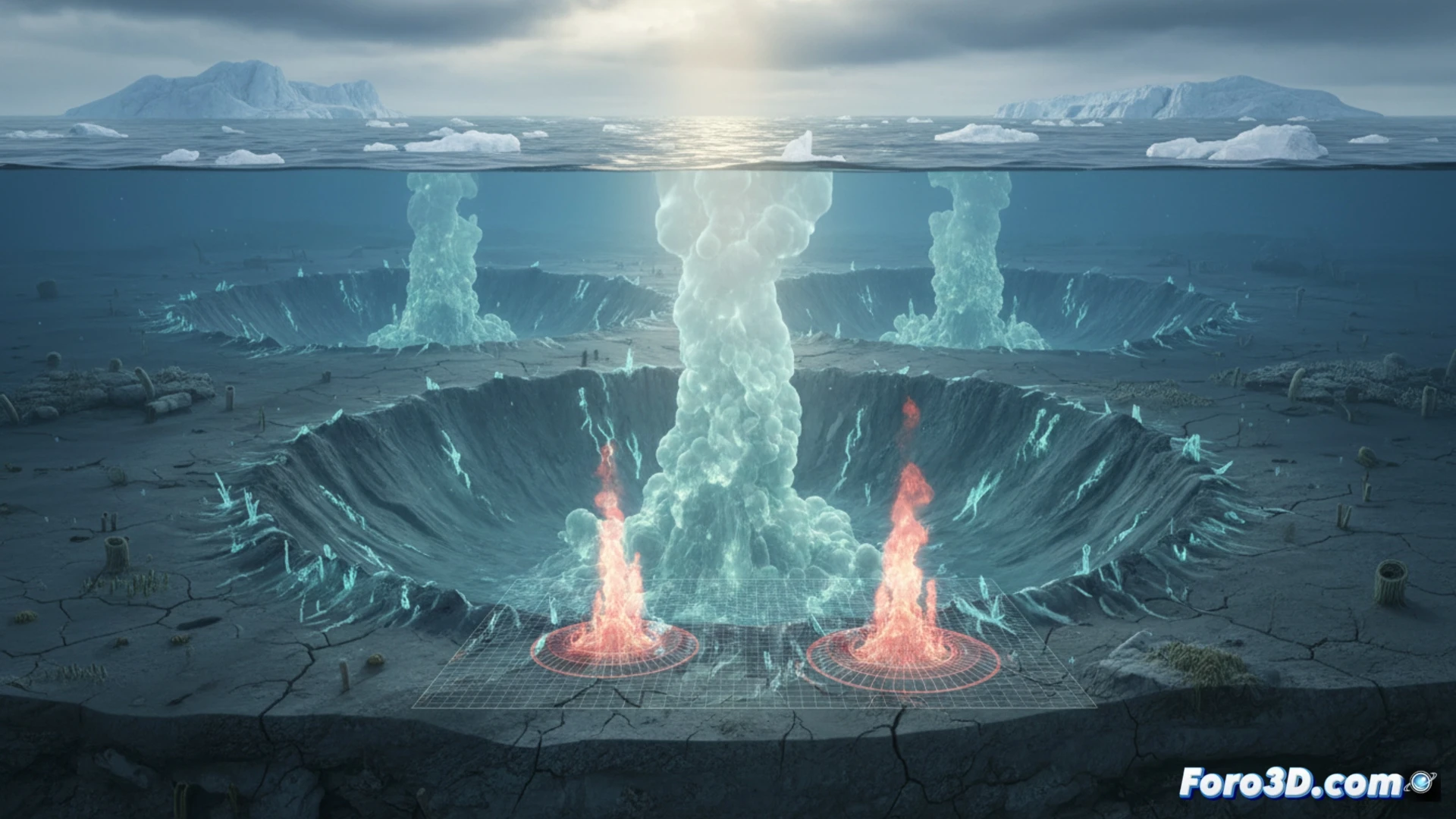
3D Modeling of Methane Hydrate Destabilization 🌍
Three-dimensional visualization of this phenomenon allows us to understand the mechanics of the disaster. By modeling the Greenland seabed, we can simulate how the decrease in pressure and the increase in temperature, caused by the retreat of the ice, break the crystalline structure of the hydrates. The trapped gas expands violently, fracturing the sediment and generating craters up to hundreds of meters in diameter. These simulations, fed with bathymetric and seismic data, are crucial for identifying current risk zones and predicting the volume of methane that could be released in the coming decades.
The Feedback Cycle Accelerating the End of the Ice 🔥
Methane is a greenhouse gas up to 80 times more potent than CO2 in the short term. If current melting releases these reserves, a dangerous feedback cycle would be activated: more heat melts more ice, which releases more methane and further accelerates warming. Risk maps generated with 3D tools show us that the Arctic is a carbon sponge about to be squeezed. Monitoring these regions with simulation technology is not just science; it is a prevention strategy against a silent but devastating global catastrophe.
How can 3D modeling of underwater methane release dynamics anticipate the formation of craters in Greenland and prevent their catastrophic effects on the global climate
(PS: Simulating catastrophes is fun until the computer crashes and you are the catastrophe.)