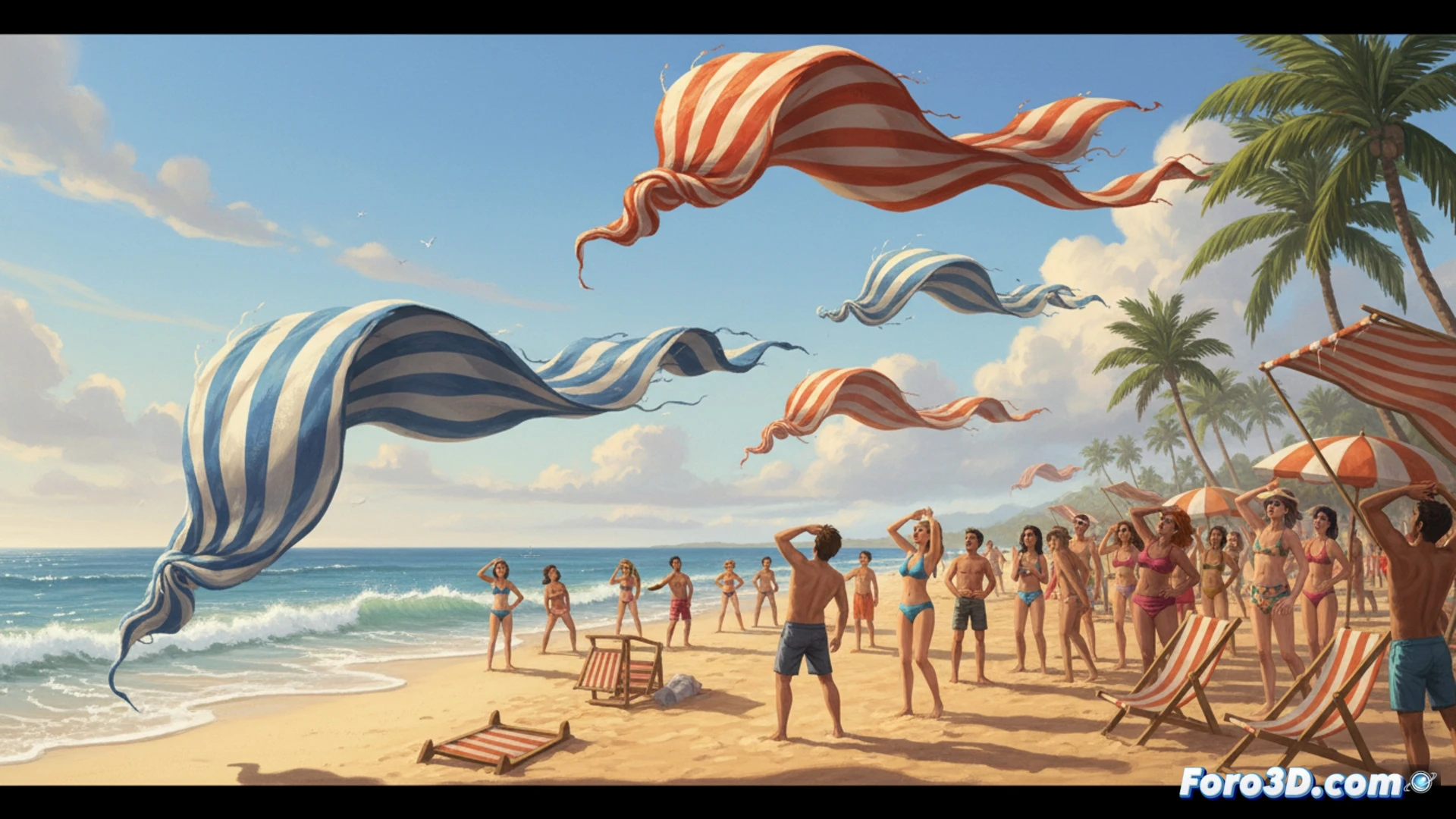
The wind on the beach not only brings waves and a fresh breeze. It also transforms awning curtains into improvised kites that fly aimlessly. No one claims these lost fabrics, which become an ephemeral spectacle for bathers. It is a daily phenomenon that goes unnoticed, but has its own physical and social logic.
The physics of fabric in the wind: resistance and chaos 🌀
Beach curtains are usually made of polyester or light cotton, materials with low surface density. When the wind exceeds 20 km/h, dynamic pressure exerts a drag force that overcomes the friction of the rings or clamps. The fabric behaves like a sail without control: it rises, spins, and falls in a chaotic pattern. There is no stable aerodynamics, only turbulence. Poorly anchored awnings amplify the effect, releasing meters of fabric that end up on the sand or in the sea.
Has anyone seen my curtain? No thanks, I prefer a new one 🏖️
The curious thing is that no one chases after them. Seeing a curtain flying provokes more laughter than action. People look, point, and then return to their towel. No one claims a piece of fabric they probably bought at a discount store for five euros. It is easier to buy another one than to chase a rebellious piece of cloth. In the end, the wind not only steals shade, but also the dignity of whoever tries to hold it with one hand while eating an ice cream.