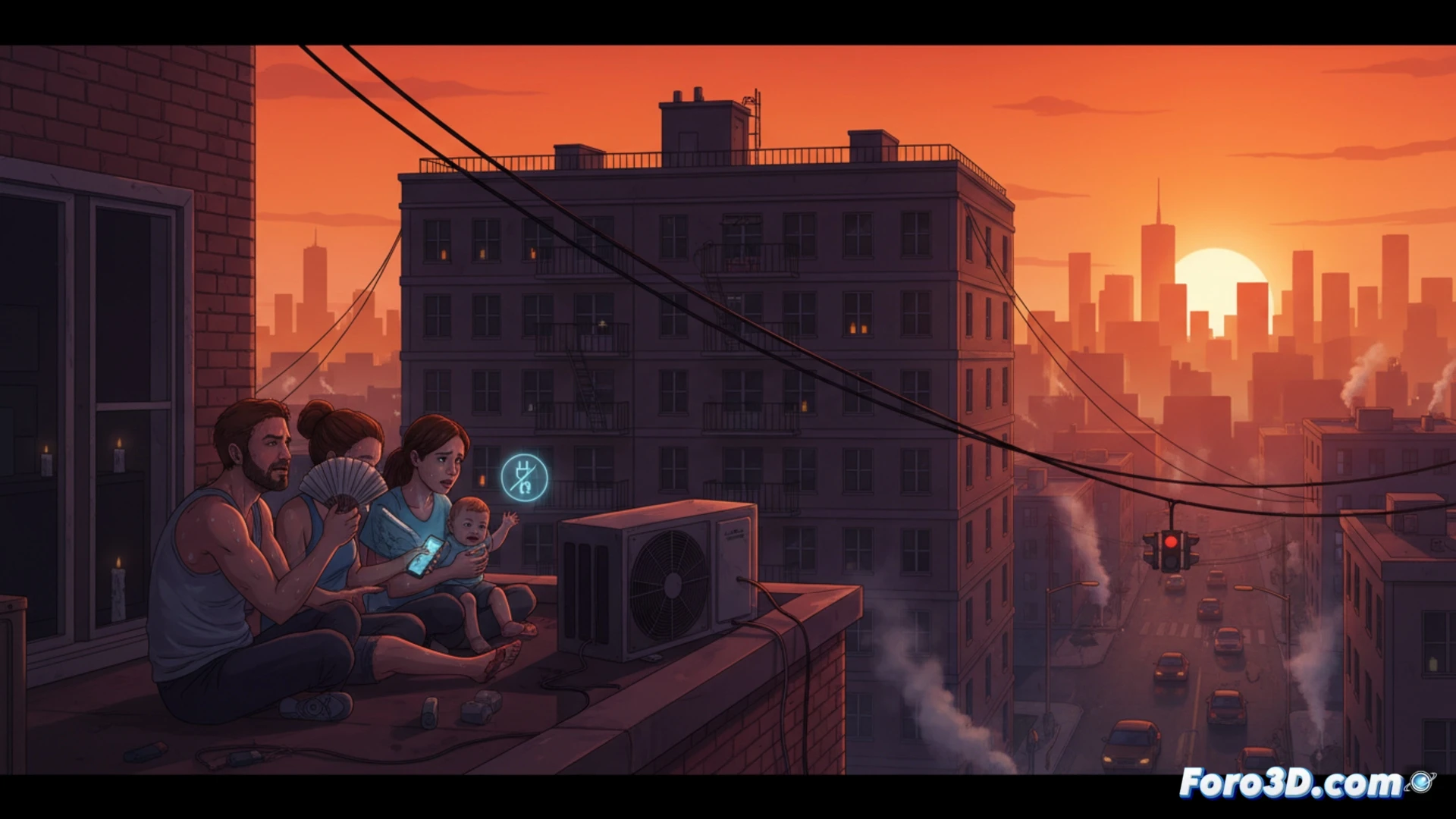
Every summer, the same scene repeats. The thermometer hits a record high, we all crank up the air conditioning to maximum, and suddenly, the neighborhood goes dark. It's not bad luck; it's physics and an electrical grid that can't keep up. We analyze why this phenomenon always happens at the worst possible moment.
The Electrical Grid and the Synchronized Demand Peak ⚡
The problem isn't the heat, but the synchronicity. When the temperature exceeds a certain threshold, millions of air conditioning compressors start up almost simultaneously. This creates a demand peak that pushes consumption far above substation capacity. Transformers, designed for average loads, overheat and blow fuses. Additionally, distribution lines suffer Joule heating losses, and the ambient heat reduces their efficiency. It's a perfect engineering storm.
Murphy's Law Has Air Conditioning 😅
Of course, the outage never happens at three in the morning with 22 degrees. No. It always happens at two in the afternoon on July 15th, just when you've sat down in front of the fan with an ice cube on the back of your neck. The electrical grid seems to have a sadistic sense of humor: it waits until we're all sweating and the fridge is full to say this is as far as we go. The worst part is, when the power comes back, the first noise you hear is the neighbor turning their unit on again.