The recent incident of a deep-sea submarine fiber optic cable being cut has been resolved thanks to the application of 3D forensic techniques. A detailed metrological analysis of the fracture surface, carried out using high-precision laser scanning, has categorically ruled out hypotheses of anchor snagging or natural wear. The geometric evidence unequivocally points to the use of a high-pressure hydraulic shear, redefining the case as an act of intentional sabotage. 🔍
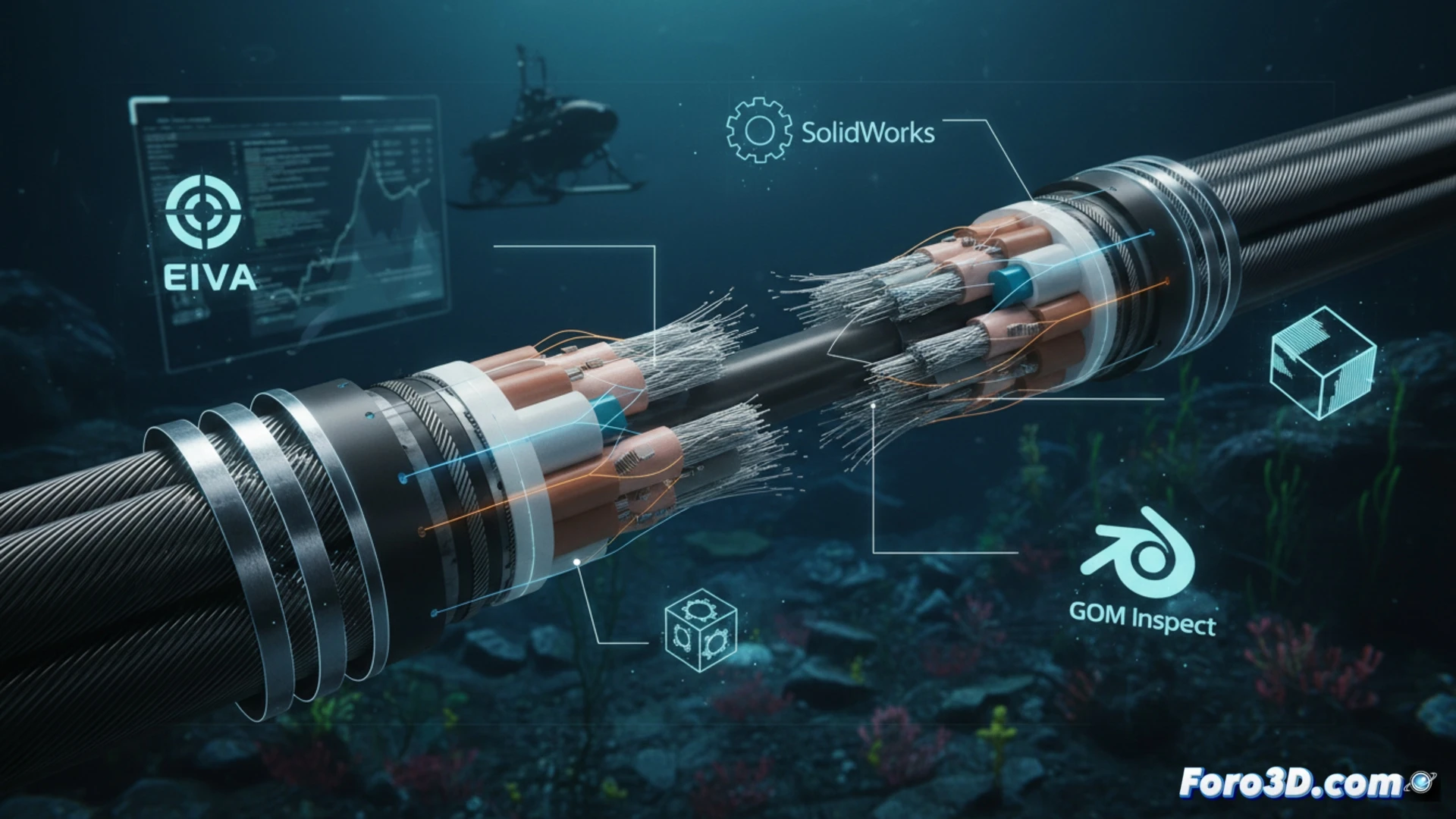
Forensic workflow: from point cloud to mechanical simulation ⚙️
The process began with capturing the three-dimensional geometry of the damaged cable end using a structured light scanner, generating a high-density point cloud. This model was imported into GOM Inspect, where deviation analysis and cross-sections were performed. A pattern of clean plastic deformation and uniform beveling on the steel core was identified, incompatible with a tensile tear. From this data, the exact profile of the tool blade was modeled in SolidWorks. The 3D reconstruction of the cutting mechanism was completed in Blender, and the impact kinematics were simulated in EIVA NaviSuite, confirming that the applied force was perpendicular to the cable axis, typical of a hydraulic shear.
Geometry as an irrefutable witness 📐
The visual comparison between an accidental friction cut and the sabotage pattern is revealing. While accidental damage presents frayed fibers and irregular deformation, the forensic cut shows a clean section, with a constant radius of curvature on the sheath and a symmetrical indentation on the armor. This case demonstrates that 3D metrology not only documents the scene but acts as a mechanical witness that can reconstruct the tool and the angle of attack, transforming a broken cable into solid judicial evidence.
How can the three-dimensional reconstruction of the fracture in the submarine cable differentiate between an accidental cut by anchors and intentional sabotage using specific tools
(PS: don't forget to calibrate the laser scanner before documenting the scene... or you might be modeling a ghost)