Hardspace Shipbreaker is a title that demonstrates how Unity can handle complex destruction and object manipulation mechanics without sacrificing visual fidelity. Developed by Blackbird Interactive, the game allows the player to dismantle entire ships in zero gravity, cutting panels and removing internal components with a laser cutter. Behind this experience lies a technical pipeline that combines modular modeling in Autodesk Maya, procedural texturing in Substance Designer, and a dynamic lighting system that respects the physics of light in metallic interiors.
Real-time cutting pipeline and mesh optimization 🛠️
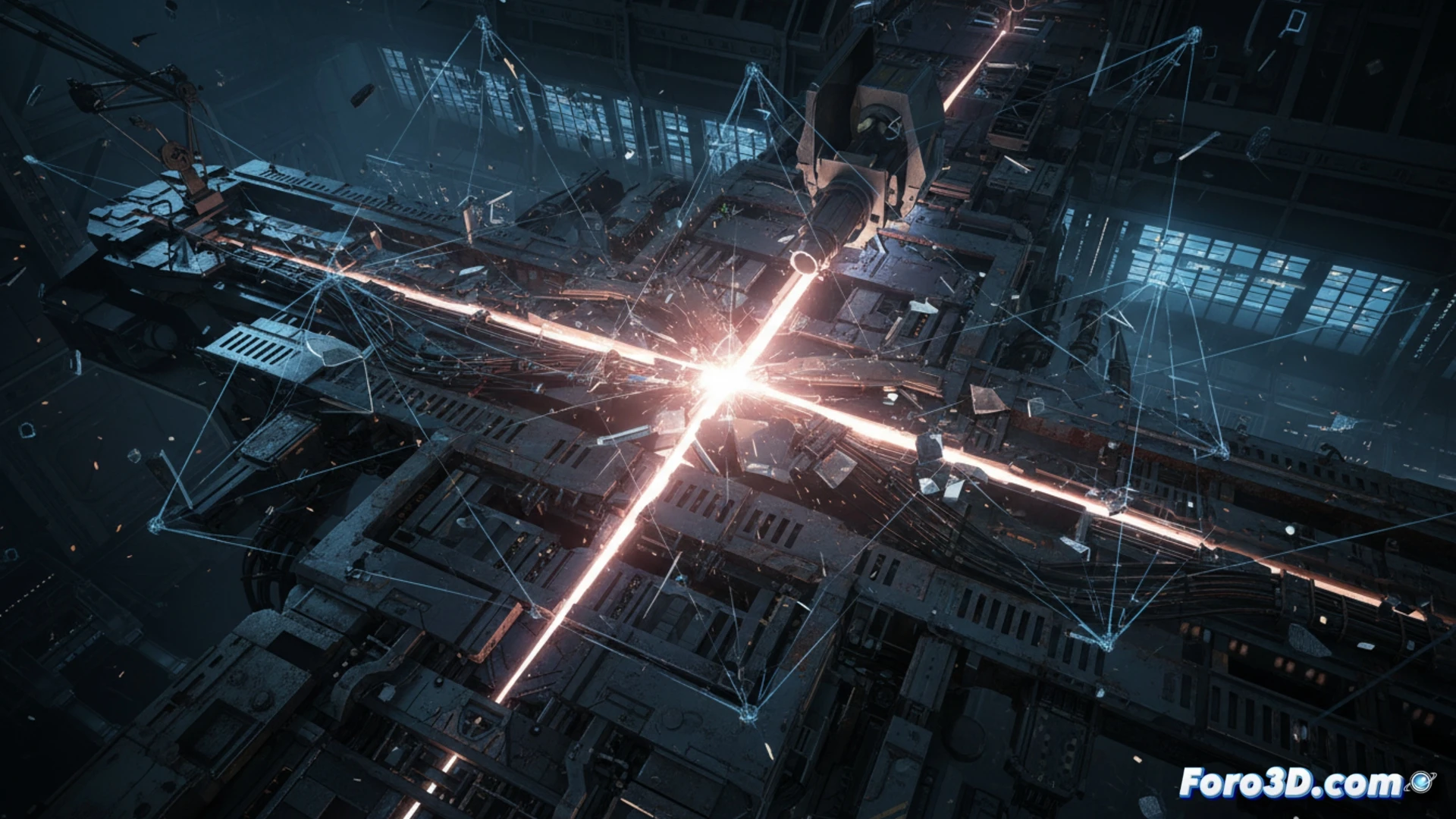
The implementation of real-time geometry cutting relies on Unity's dynamic mesh system. Each ship is built from predefined modules modeled in Maya, where fracture points and weld zones are defined. When cutting, the engine subdivides the original mesh into two independent parts, generating new faces and normals on the fly. To avoid performance collapse, developers limit the number of simultaneous cuts and employ LODs (Level of Detail) that reduce the complexity of pieces as they move away from the camera. Substance Designer is used to create procedural textures that seamlessly adapt to new cut surfaces, maintaining visual coherence even in internal sections of the hull.
Interior lighting and the challenge of industrial science fiction 💡
The industrial science fiction setting demands interior lighting that is both realistic and functional for gameplay. Hardspace Shipbreaker uses a system of point and area lights combined with Light Probes in Unity to illuminate corridors and compartments. The ships, modeled in Maya with closed geometry, allow light to bounce naturally off metallic and dirty surfaces, thanks to roughness and metalness textures created in Substance Designer. The biggest technical challenge was maintaining a stable framerate while lighting hundreds of independent fragments, solved by using baked lights in static zones and a pooling system that reuses dynamic lighting objects.
As a developer, what optimization techniques in Unity did you implement in Hardspace Shipbreaker to achieve real-time geometry cutting without affecting performance and while maintaining realistic lighting?
(PS: a game developer is someone who spends 1000 hours making a game that people complete in 2)