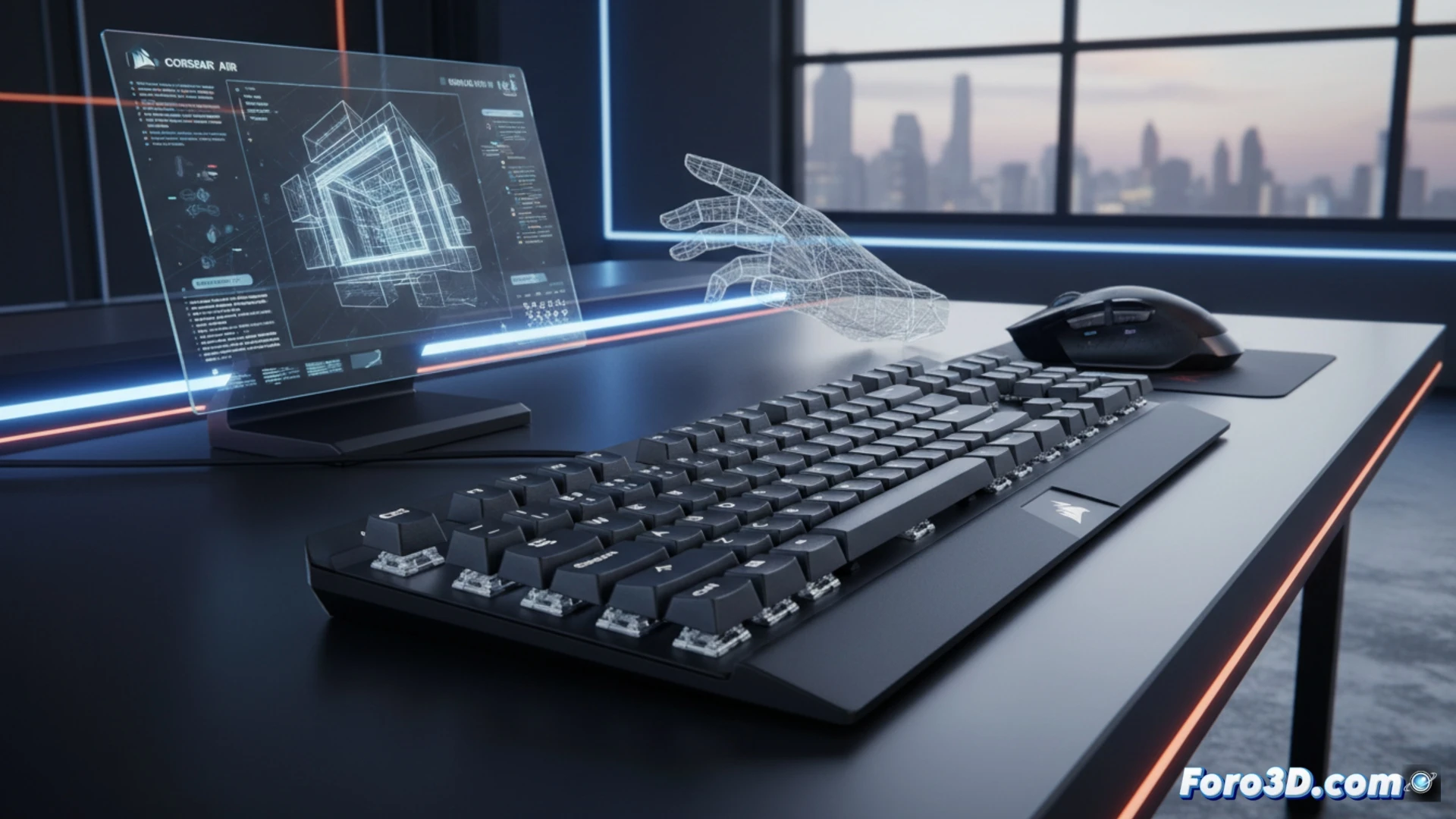
The Corsair K100 AIR Wireless breaks into the market with a profile of just 11 mm, setting a new standard for wireless mechanical keyboards. For the 3D professional, accustomed to long hours at the workstation, this design promises a drastic reduction in wrist and forearm fatigue. We analyze whether its Cherry MX Ultra Low Profile switches and connectivity truly offer a competitive advantage in modeling and rendering workflows. 🚀
Ergonomics and tactile response in intensive work sessions 🖐️
The key to the K100 AIR for the 3D user lies in its profile. At 11 mm thick, it eliminates the need for a wrist rest, allowing for a more natural and flat typing position. This is critical during sculpting or retopology sessions where the wrist remains static. The Cherry MX Ultra Low Profile switches offer a fast actuation point and a defined tactile response, similar to a conventional mechanical switch but with a much shorter travel. While the feel may be strange for those coming from high-profile keyboards, the reduction in keystroke effort is notable. Slipstream wireless connectivity offers 1 ms latency, comparable to a USB connection, eliminating the risk of delays in complex keyboard shortcuts in applications like Blender or Maya.
Minimalist aesthetics or real productivity? ⚙️
The minimalist design of the K100 AIR is not just an aesthetic whim. In a 3D design studio, where desk space is a valuable resource for graphics tablets or control panels, its reduced footprint is a logistical advantage. However, the professional should consider that the absence of per-key RGB backlighting (it only has zone lighting) can be a drawback in low-light environments. For the modeler who prioritizes ergonomics and response speed over visual spectacle, this keyboard positions itself as a precision tool, although its premium price demands a careful evaluation of the return in productivity.
Is it viable to sacrifice the key travel of barely 1mm compared to standard mechanical keyboards to gain ergonomics in long 3D modeling sessions without losing precision in complex shortcuts?
PS: RAM is never enough, like coffees on a Monday morning