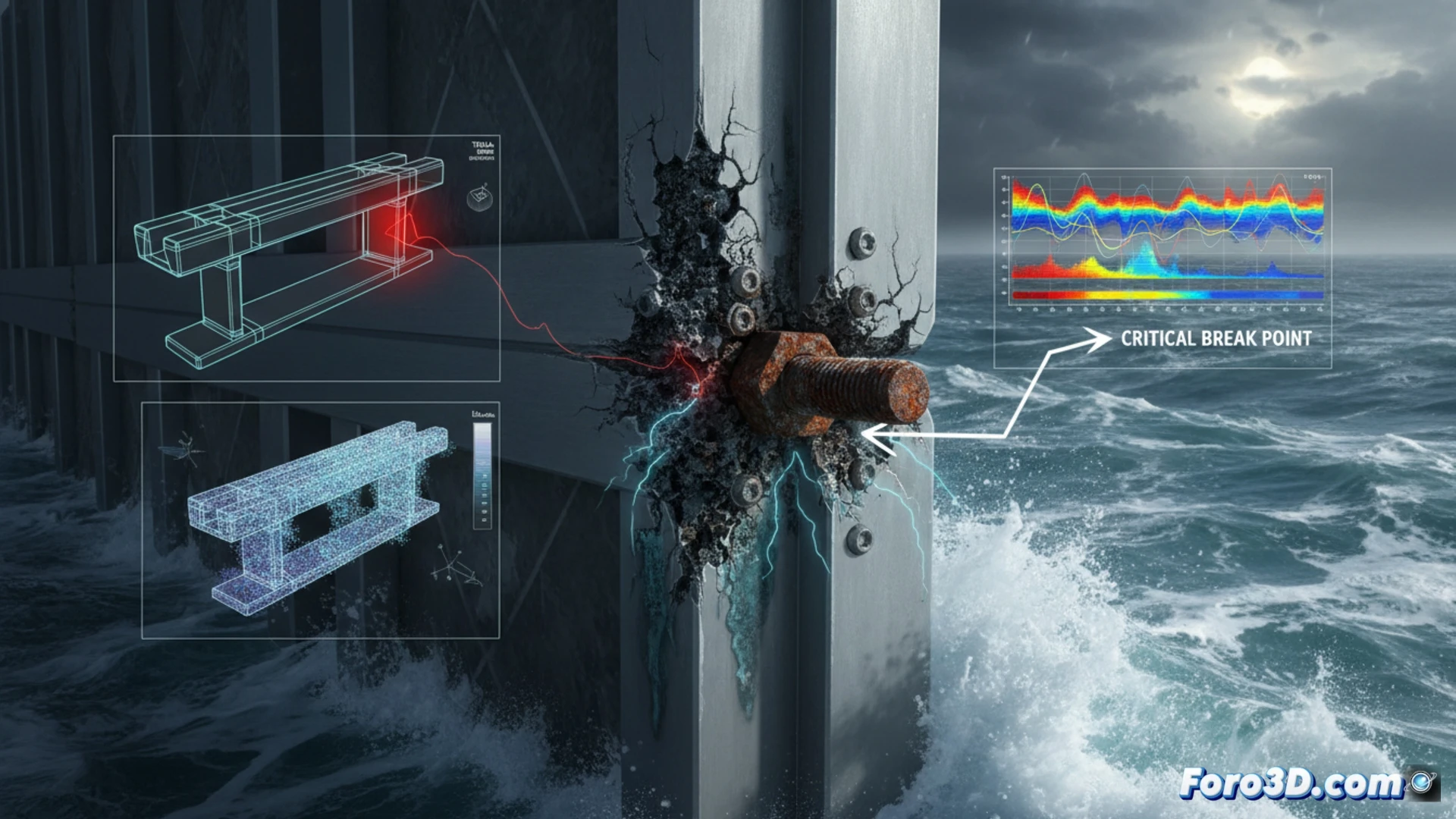
The collapse of an acoustic screen in a coastal environment revealed a critical failure due to galvanic corrosion. The direct connection between aluminum profiles and structural steel, without electrical insulation, generated a galvanic couple accelerated by saline humidity. This article breaks down the simulation workflow that allowed modeling the degradation and predicting the breaking point, using Tekla Structures, Leica Cyclone, and nCode. ⚙️
Technical workflow: BIM, scanning, and fatigue simulation 🛠️
The analysis began with the reconstruction of the original BIM model in Tekla Structures, identifying the contact points between the dissimilar materials. Using a 3D scan with Leica Cyclone, the actual geometry of the corrosion and surface pitting was documented. This point cloud was integrated into nCode to perform a multiaxial fatigue analysis. The software modeled the effective section loss in the aluminum, calculating the reduction in load-bearing capacity under cyclic wind loads. The results showed a stress concentration in the contact zone, where the insulating oxide layer never existed, leading to a premature brittle fracture after only three years of service.
Lessons learned and insulation as a critical barrier 🔒
The simulation confirmed that the lack of a dielectric separator between the aluminum and steel was the root cause of the failure. In saline environments, even a small potential difference generates an active electrolytic cell. For future designs, the use of nylon or rubber washers, as well as epoxy coatings on contact surfaces, is recommended. Integrating tools like nCode into the design phase allows predicting these phenomena and avoiding preventable collapses, transforming simulation into insurance against environmental degradation.
What finite element simulation parameters allow for more accurately modeling the progressive degradation of the interface between aluminum and stainless steel in acoustic screens subjected to saline humidity cycles?
(PS: Material fatigue is like yours after 10 hours of simulation.)