A leak of Gallium-Indium alloy in a supercomputer cooling system caused a massive short circuit that halted a high-performance cluster. The incident, documented on engineering forums, activated a simulation protocol to determine whether external contamination altered the liquid metal's composition, accelerating galvanic corrosion on the aluminum heatsinks. The 3D pipeline combined Autodesk CFD, SolidWorks Simulation, Dragonfly, and KeyShot to model the failure progression.
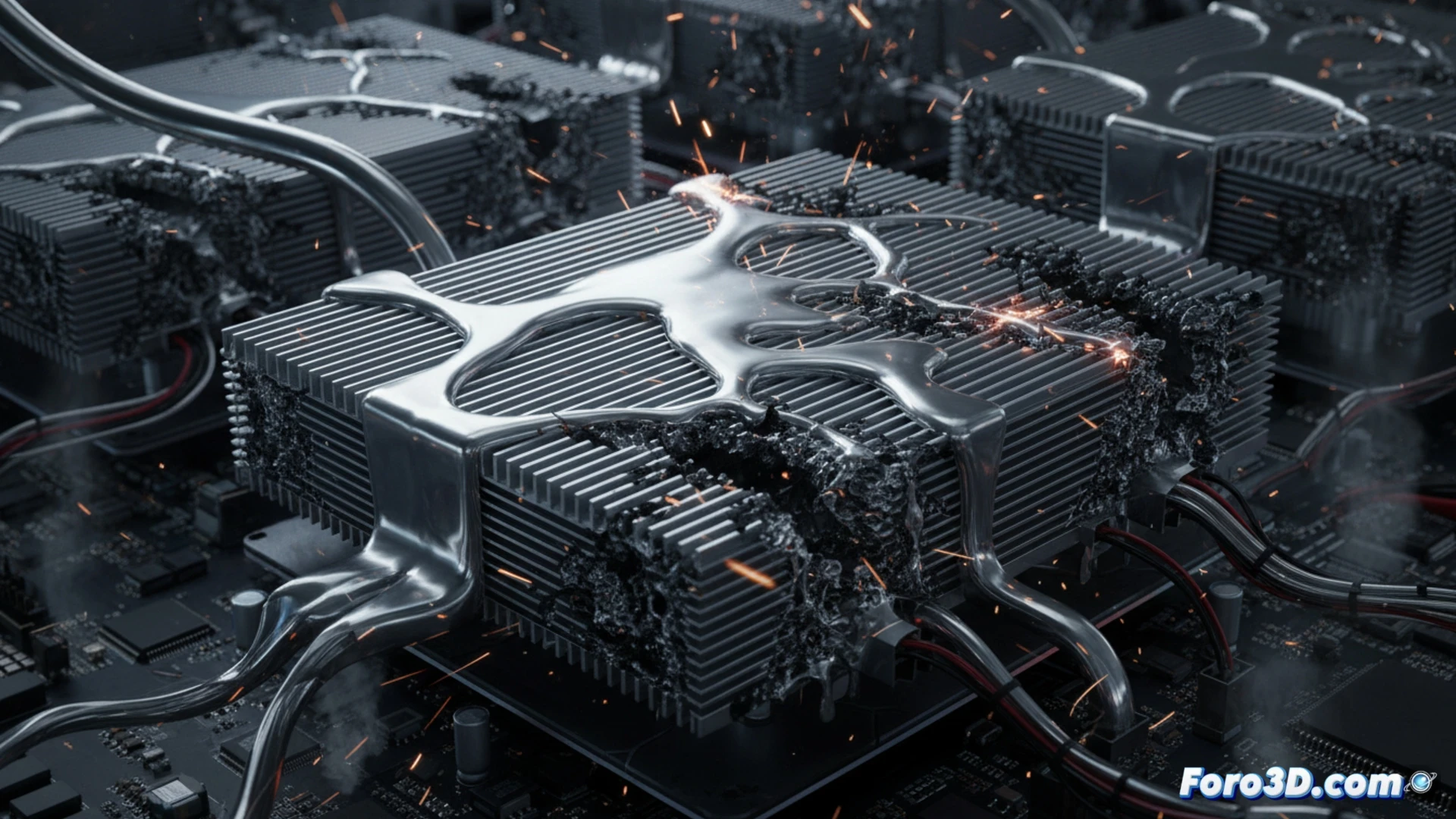
Modeling corrosive progression with Autodesk CFD and SolidWorks Simulation 🔬
The analysis began in Autodesk CFD to simulate the thermal distribution and flow of the liquid alloy after the leak. Surface temperature data was exported to SolidWorks Simulation, where a galvanic corrosion fatigue model was defined. The electrochemical potential difference between Gallium-Indium and 6061 aluminum was parameterized, including variables for contamination by copper and sulfur particles. Dragonfly processed the microscopy images to segment the pitting zones, while KeyShot generated visualizations of the corrosion's temporal progression. The results showed that external contamination reduced the aluminum's corrosion resistance by 40%, concentrating the failure at the microchannel joints.
Lessons for advanced liquid cooling design ⚙️
This case demonstrates that material fatigue simulation must consider not only mechanical loads but also the dynamic chemical environment. The Gallium-Indium alloy, while an excellent thermal conductor, is highly reactive with aluminum if contaminated with foreign ions. Incorporating galvanic corrosion models in the early design phases, using tools like SolidWorks Simulation, allows for predicting failure points and selecting protective coatings or dielectric barriers. 3D visualization of corrosive progression is key to communicating risks to design teams and avoiding costly short circuits in next-generation cooling systems.
What galvanic corrosion fatigue mechanisms are activated in Gallium-Indium alloys when they infiltrate microcracks in copper heatsinks under thermal cycles of a supercomputer?
(PS: Material fatigue is like yours after 10 hours of simulation.)