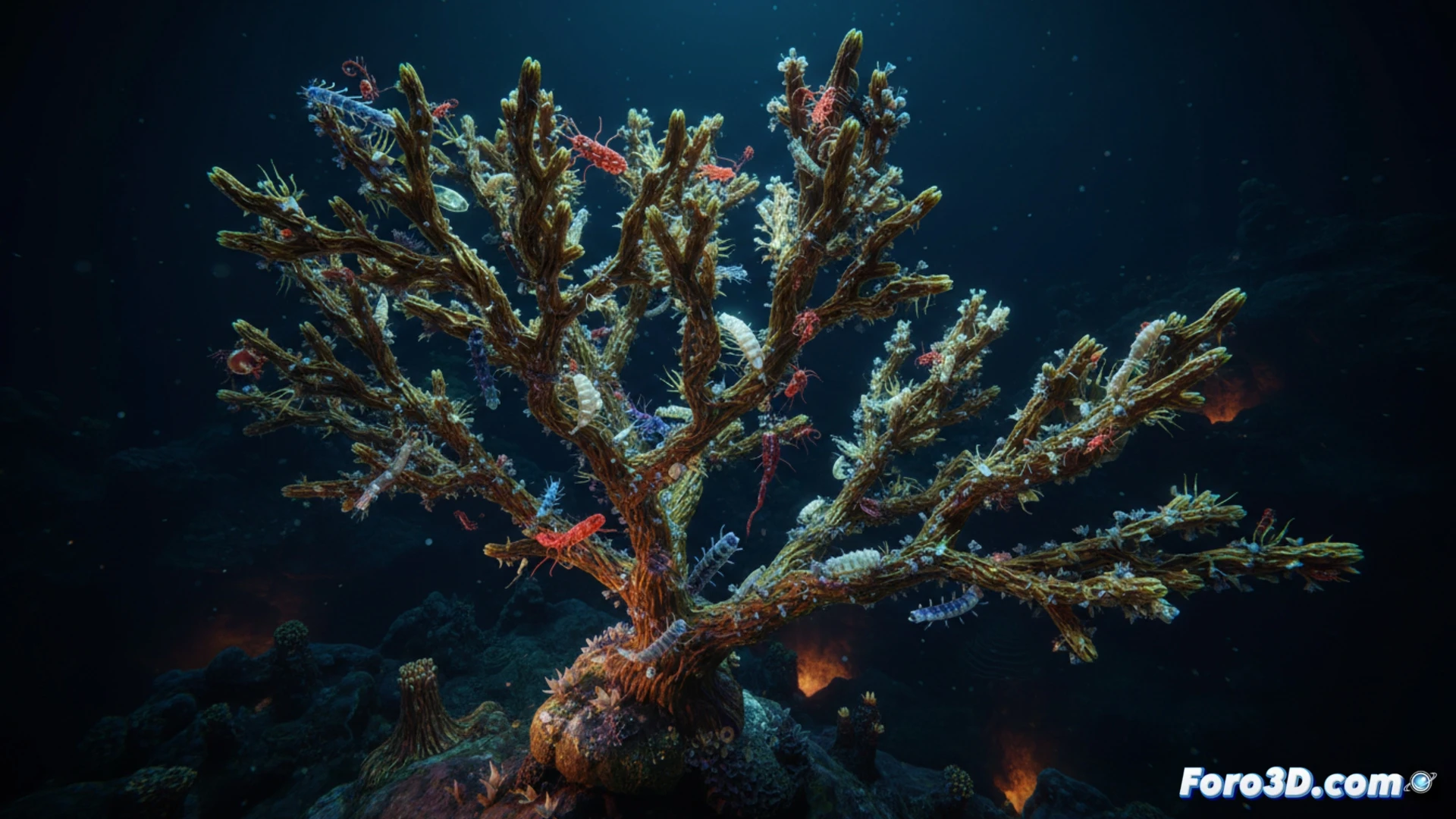
The Golden Coral of Nazca, belonging to the genus Chrysogorgia, is one of the strangest wonders of the deep ocean. Its most distinctive feature is a skeleton composed of calcite and gorgonin, which gives it a golden and iridescent metallic sheen. This organism forms intricate three-dimensional branches that create a perfect habitat for micro-ecosystems, where entire colonies of small crustaceans find shelter and food.
Visualization Pipeline and Oceanographic Data 🌊
To achieve a photorealistic model, the workflow must begin with the capture of volumetric data from real expeditions by the Oceanographic Institute. The base mesh of the skeleton is generated through photogrammetric scanning of preserved samples, then retopologized to simulate the high frequency of branches. The metallic material requires a shader with anisotropy and subsurface scattering (SSS) properties to replicate the golden reflectance. Crustacean colonies, such as amphipods, are modeled as distributed instances following a particle system that respects the geometry of the branches. The final animation must include a procedural rig to simulate the gentle swaying of the branches and the movement of the crustaceans' appendages, validated with ocean current data from the Nazca Trench.
The Challenge of Representing the Inaccessible 🐚
The greatest technical challenge is not just the shine of the skeleton, but conveying the fragility of this deep-sea ecosystem. By modeling this coral, we are documenting a species that deep-sea mining threatens to drive to extinction before science can study it thoroughly. Each golden branch and each animated crustacean is not just a rendering exercise; they are a visual testament to the hidden biodiversity we must preserve. The 3D model thus becomes a tool for scientific outreach as valuable as any expedition.
What is the main technical challenge when 3D modeling the metallic and branched structure of the Chrysogorgia skeleton to achieve accurate scientific visualization under underwater lighting?
(PS: if your manta ray animation doesn't excite, you can always add documentary music from channel 2)