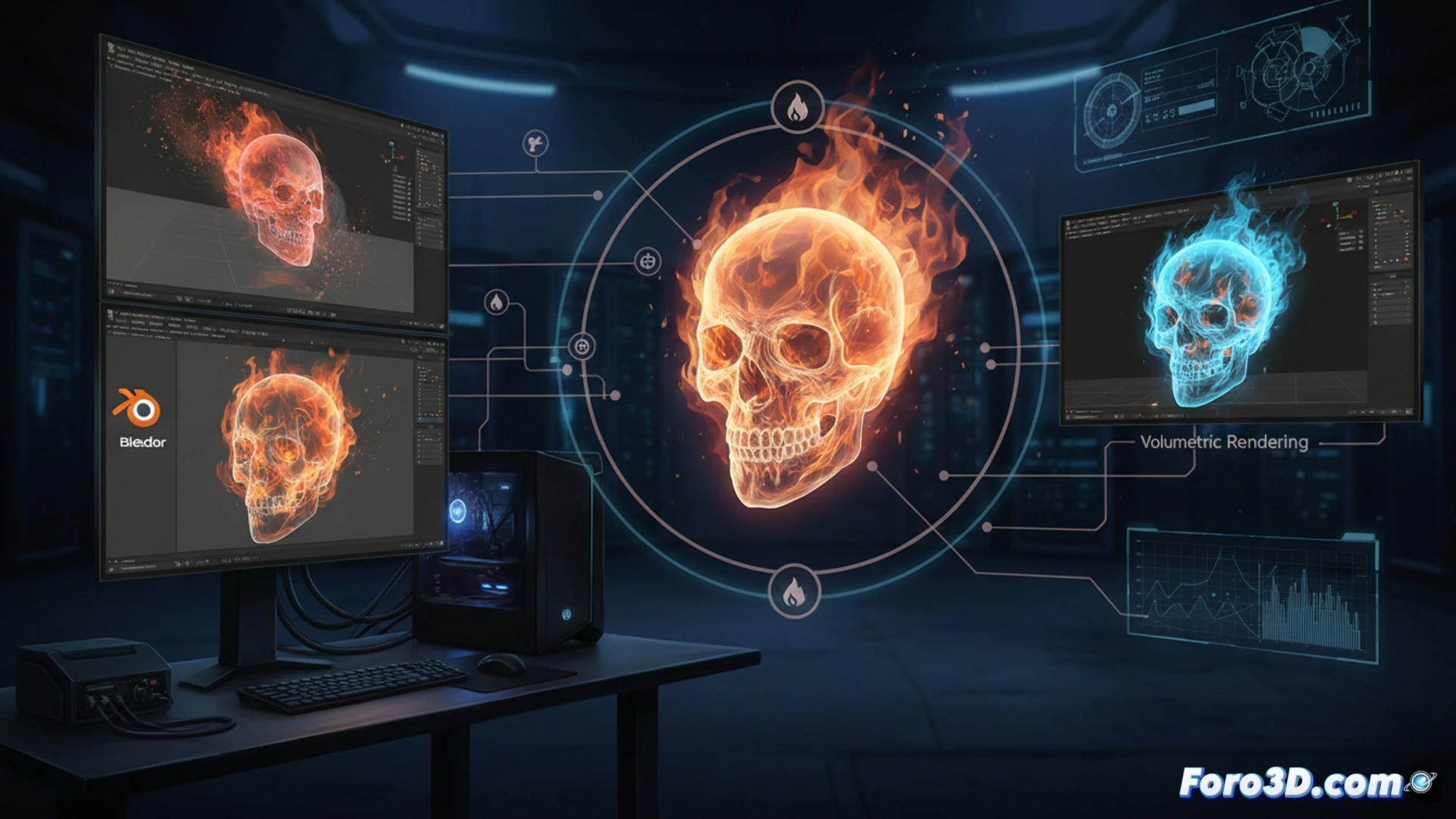
The visual effect of a human skull enveloped in fire, like that of the Marvel character The Blazing Skull, represents a fascinating technical challenge in the world of visual effects. It is not just about overlaying a flame texture; it requires a complex simulation of fluids, particles, and combustion dynamics that respect the skull's anatomy and the physics of fire. In this article, we will analyze cutting-edge techniques in Houdini, Blender, and Unreal Engine to achieve this iconic effect, from pyroclastic simulation to volumetric rendering.
Fire and particle simulation in Houdini and Blender 🔥
To emulate Mark Todd's ability to surround his skull with flames without being consumed, the first step is to create a base skull mesh with clean topology. In Houdini, the most effective technique is to use a Pyro solver (gaseous fluids) with an emission source that adheres to the skull's geometry. Multiple sources must be configured: one surface emission for the external flames and another emission from the nasal and eye cavities for the internal combustion effect. In Blender, the Mantaflow system allows a similar approach, using a fire domain and Hair particles to simulate sparks and rising smoke. A critical parameter is the ignition temperature; as the character is immune to fire, the simulation must show the flames dancing over the surface without adhering to the bone material, achieved by adjusting the combustion speed and the density of the virtual fuel.
Lessons from similar projects for the final render 💡
The visual success of the flaming skull depends on volumetric rendering and lighting. In Unreal Engine, you can use the Niagara system for fire particles combined with Volumetric Fog to give density and heat to the scene. A clear example is the work done in films like Ghost Rider or DC's Scarecrow, where fire is rendered with high contrast between the white-blue core (high temperature) and the orange tips (low temperature). For the project, it is recommended to use a multi-layer shader: an emission layer for the skull's glow, a displacement layer for the shadows cast by the fire, and a subsurface scattering layer to simulate the heat radiated onto the jaw. The final result should convey the character's dual nature: a being of war enveloped in a controlled, not chaotic, flame.
What do you think about this advancement?