Seventeen colossal basalt heads, weighing between 6 and 50 tons, lie scattered across the Gulf of Mexico region. The main mystery is not their carving, but the logistics of their transport. The nearest quarries are over 100 kilometers away, in the Sierra de los Tuxtlas. How did the Olmecs move these megaliths without wheels or pack animals over 3,000 years ago? The answer might not lie in the mud, but in the pixels.
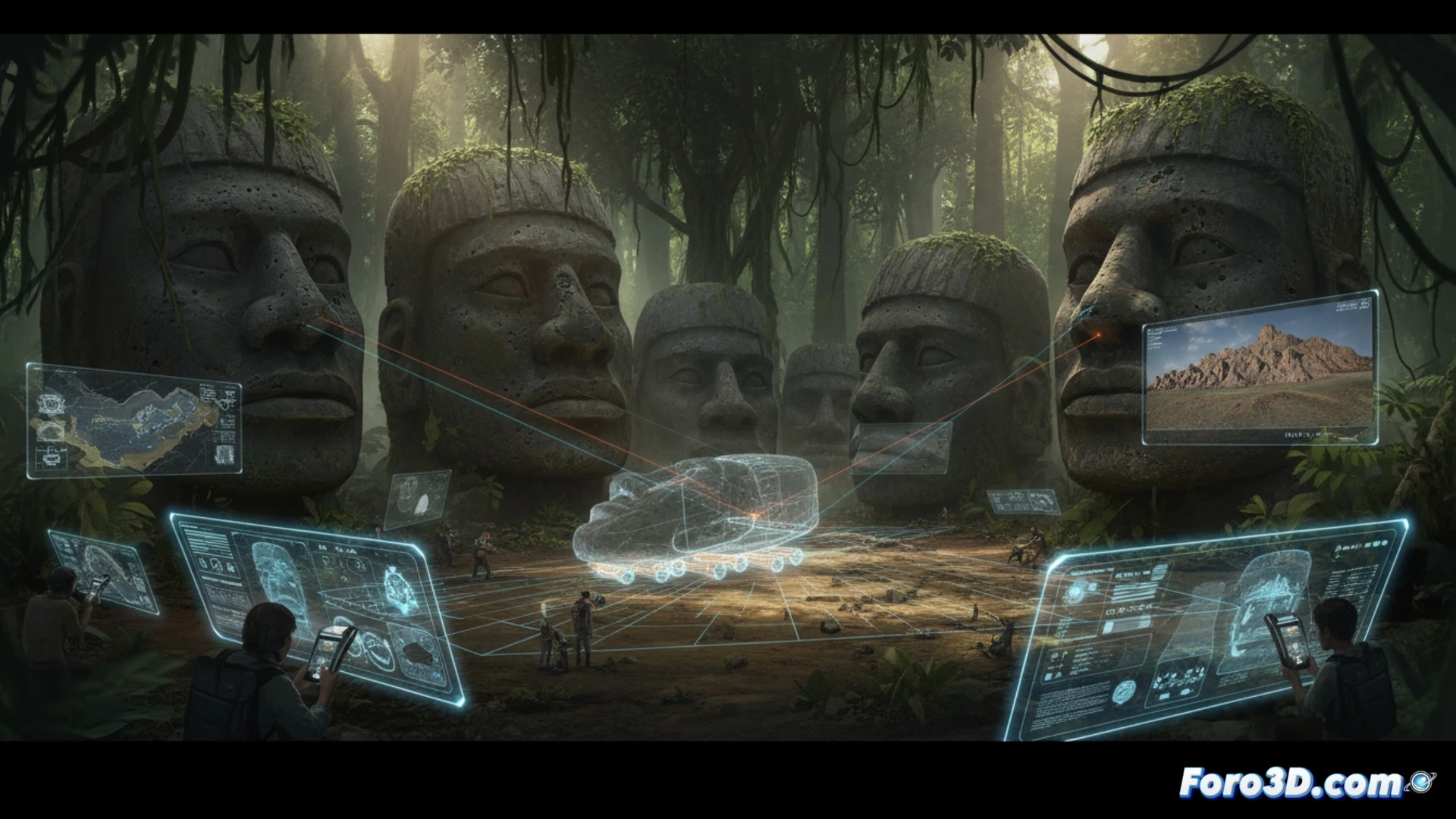
Photogrammetry and Physical Simulation: Reconstructing the Lost Route 🏛️
Digital archaeology offers a virtual laboratory to solve this enigma. Through aerial and terrestrial photogrammetry, high-precision 3D models of the heads and basalt quarries can be generated. These models, integrated into a GIS (Geographic Information System), allow for mapping topographically viable routes. The next step is physical simulation in software like Blender or Unity. Here, virtual engineers can apply friction forces, calculate the exact weight of the block, and simulate the use of wooden rollers, earth sledges, or river rafts. Each hypothesis becomes a numerical experiment, where success is measured by the feasibility of the required human effort.
Beyond the Mystery: A Legacy of Virtual Engineering 🔧
The true value of this approach is not just solving a historical puzzle, but democratizing knowledge. By publishing these 3D models and simulations in open repositories, any researcher or enthusiast can refute or validate the theories. Digital archaeology transforms the Olmec heads from static objects into dynamic engineering problems. We no longer just admire their faces; now, we can virtually sweat alongside the builders to move a mountain of stone.
How can 3D modeling and tool mark analysis on the colossal Olmec heads reveal transport and carving techniques that challenge traditional archaeological theories about the use of basalt
(PS: and remember: if you can't find a bone, you can always model it yourself)