Last month, an autonomous garbage truck collided with a low-lying metal obstacle that, according to reports, was invisible to its proximity sensors. The forensic reconstruction of the accident, carried out using a workflow that integrated RealityCapture for capturing the real scene and SolidWorks for modeling the vehicle components, revealed an unexpected cause: the rebound of ultrasonic waves off curved metal surfaces on the roadway created an acoustic silence zone, deceiving the detection algorithm.
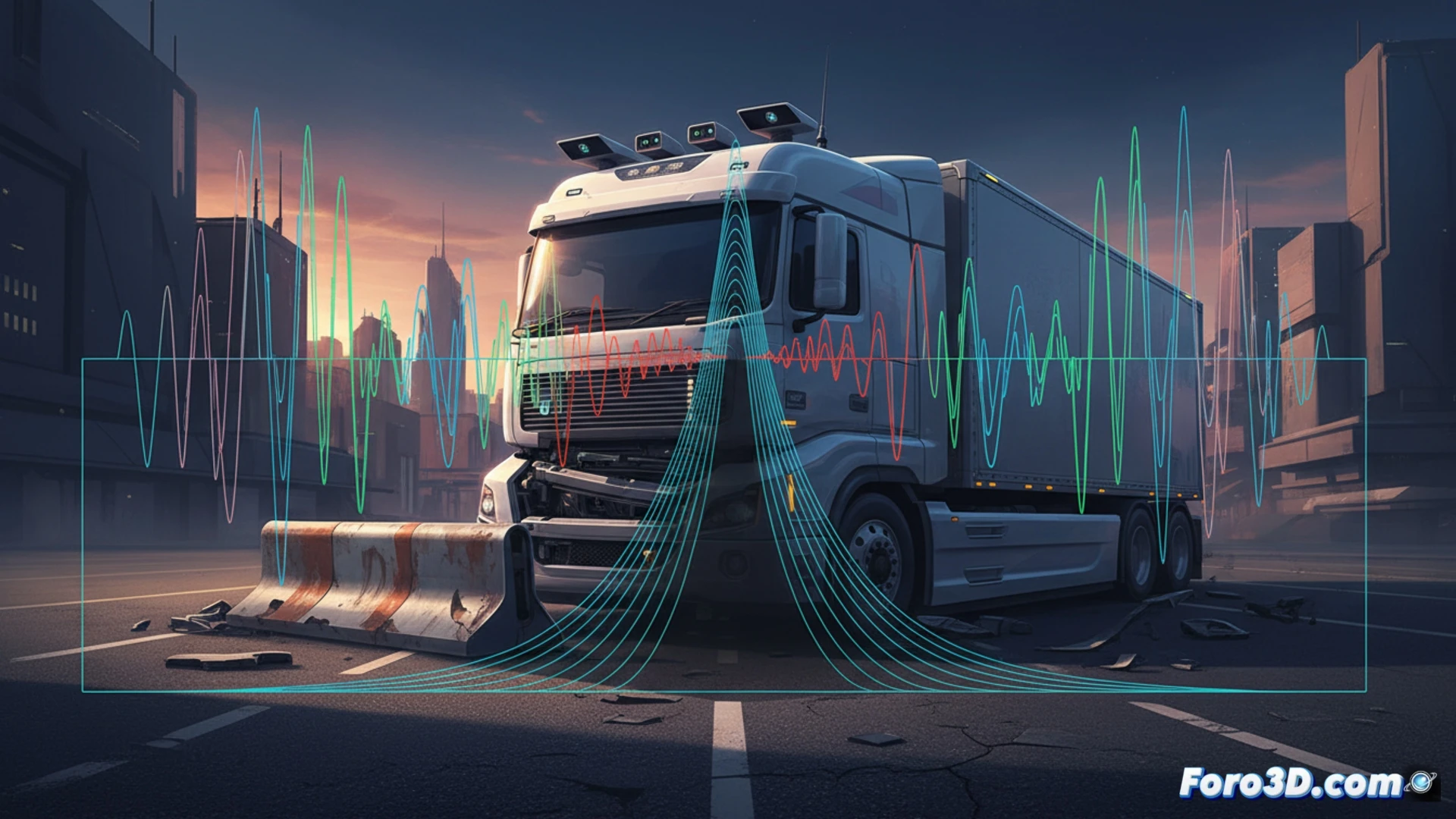
Simulation of the Acoustic Dead Zone in Unity 🎯
To validate the hypothesis, the scene model was exported to Unity, where a sensor simulation system based on spherical raycasting with attenuation and specular reflection parameters was implemented. The results were conclusive: the waves emitted by the front sensor impacted a curved-profile lamppost and a metal curb, deflecting at angles greater than 45 degrees. This rebound directed the acoustic energy away from the sensor receiver, generating an algorithmic blind spot. The obstacle, located precisely in that deflected path, produced no echo, which the system interpreted as free space. The simulation in Cinema 4D allowed visualization of the wavefront and destructive interference between reflected echoes, demonstrating that the failure was not in the hardware, but in the filtering logic that assumes ideal diffuse reflection.
Lessons for Physics Modeling in ADAS 🚗
This case underscores the need to enrich simulation environments with non-linear wave propagation models, especially in urban settings with a high density of reflective surfaces. Implementing a system for detecting acoustic shadow zones in Unity, based on calculating ultrasonic beam divergence, could alert the vehicle to the existence of unverified regions. For ADAS system developers, the lesson is clear: simulating the real physics of sound, and not just geometry, is the only way to prevent a lost echo from turning into a real accident.
What role does the geometry and reflectivity of the obstacle play in the ability of ultrasonic sensors to detect it, and how could 3D photogrammetry be integrated to mitigate these blind spots in autonomous vehicles?
(PS: simulating an ECU is like programming a toaster: it seems easy until you order a croissant)