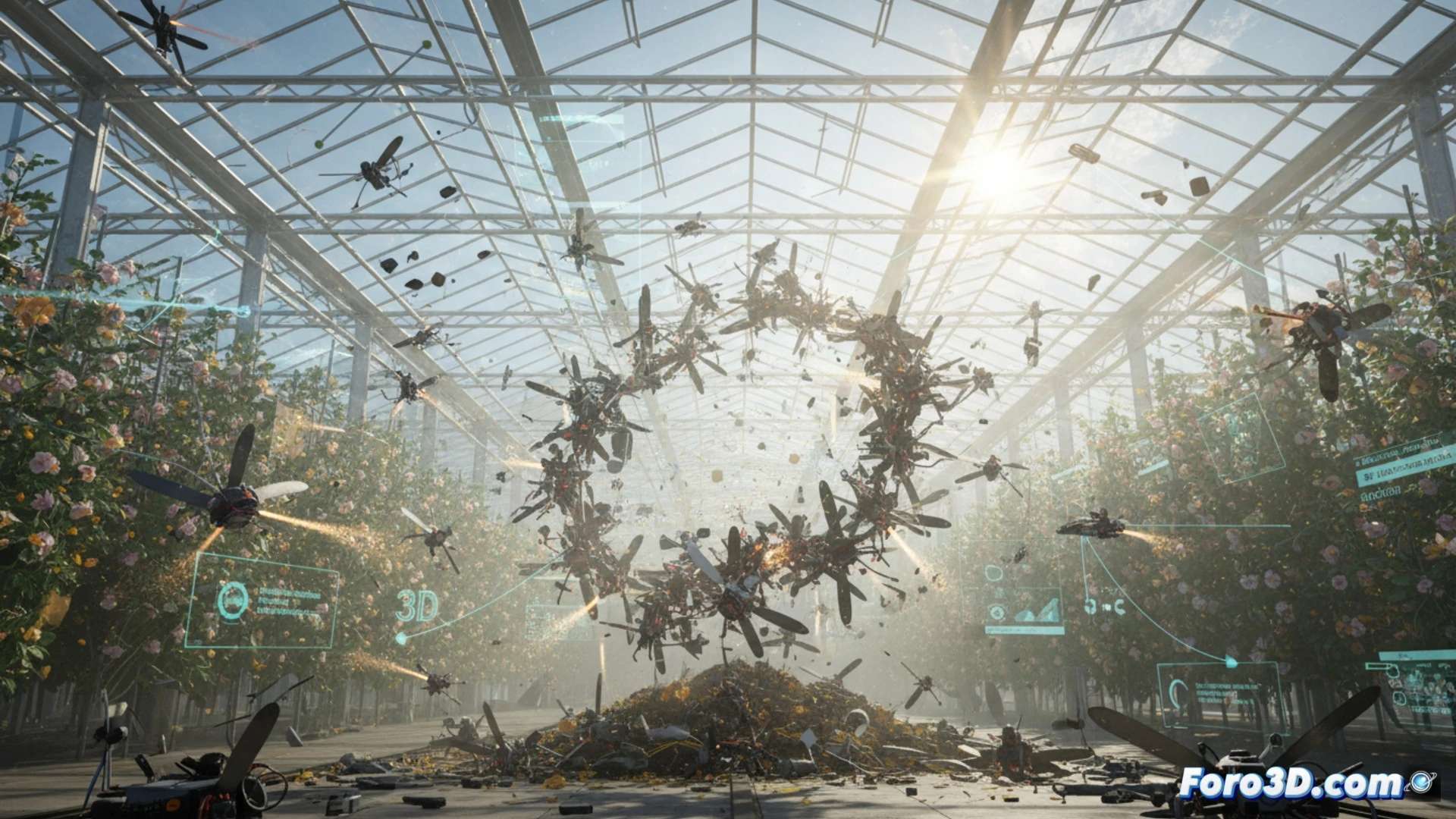
A swarm of hundreds of micro-drones dedicated to artificial pollination suffered a chain collision over a protected crop. The incident, which occurred during a routine operation, has been attributed to a visual occlusion error. Data from the optical flow sensors, now under forensic analysis through 3D reconstruction, indicates that the sun's reflection on the greenhouse cover generated a critical blind spot in the evasion algorithm.
Evasion algorithm audit through simulation and 3D reconstruction 🛸
The engineering team has turned to Gazebo to faithfully recreate the lighting conditions of the accident. Robotic simulation allows injecting the original telemetry data and observing how the optical flow of the sensors saturated at the exact angle of the reflection. In parallel, RealityCapture is used to generate a 3D model of the greenhouse from flight trajectories, and Blender to visualize the line of sight of each drone at the moment of impact. This workflow reveals that the occlusion was not a hardware failure, but a limitation of the algorithm when faced with highly reflective surfaces, a scenario underestimated in field tests.
Lessons for swarm reliability in adverse environments 🔍
This case underscores the need to integrate specular reflection models into the perception systems of robotic swarms. Optical flow sensors, although efficient in controlled indoor environments, are vulnerable to sudden changes in brightness. The combination of tools like Gazebo, RealityCapture, and Blender serves not only to audit failures but also to redesign more robust evasion algorithms, capable of distinguishing between a real obstacle and an optical artifact. Autonomous artificial pollination cannot afford these blind spots.
Can the implementation of a low-cost LiDAR sensor system in pollinating micro-drones prevent chain collisions due to visual occlusion in high-density crop greenhouses?
(PS: Simulating robots is fun, until they decide not to follow your orders.)