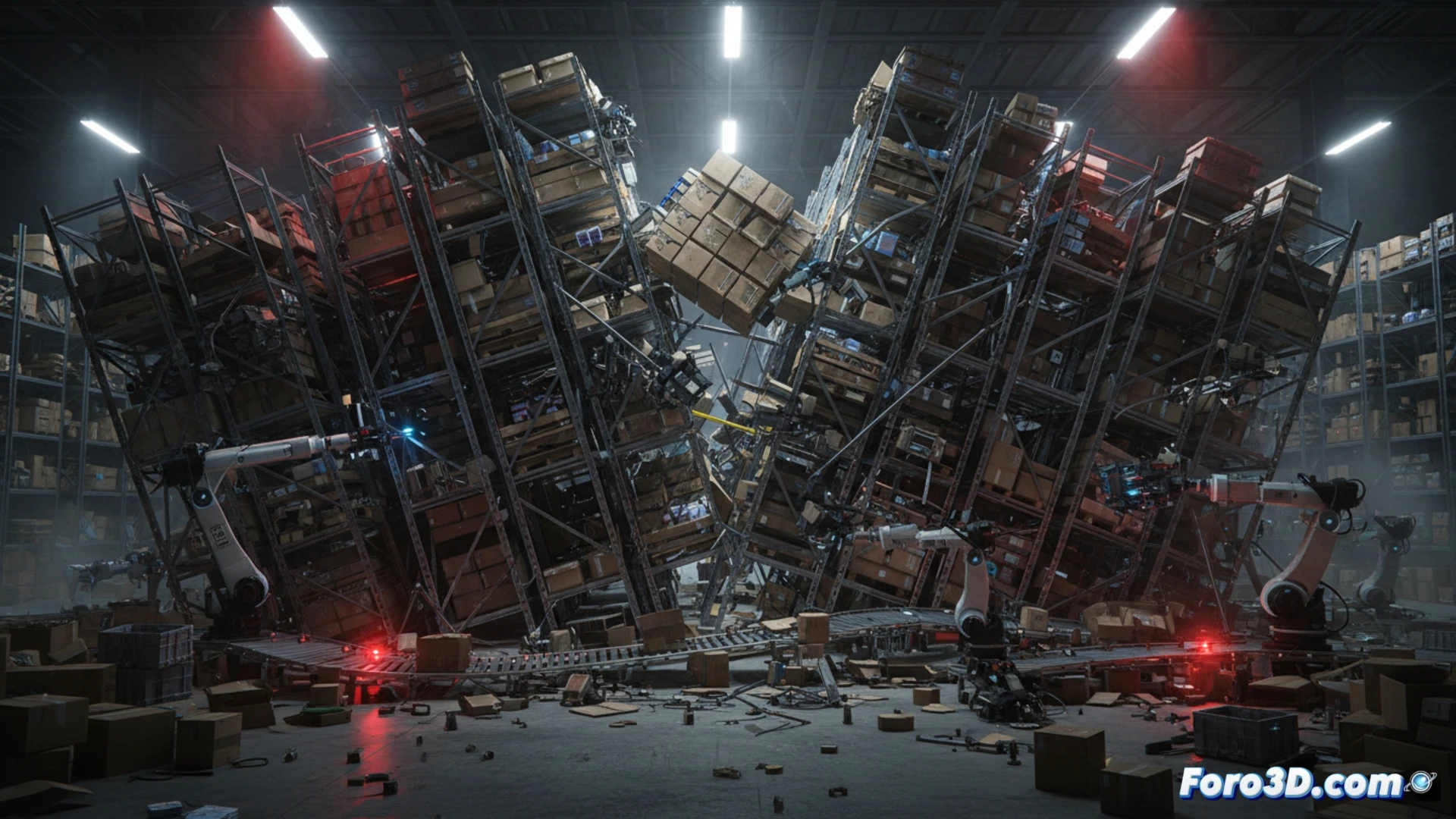
The recent collapse of racks in an automated dark store has brought a critical structural failure under scrutiny: load eccentricity amplified by robots. When automated picking systems move loads without considering symmetrical distribution, they generate torsional moments that exceed the steel's capacity. This incident is not an isolated error, but a warning about integrating heavy machinery with structures designed for static loads.
Failure Modeling: Analysis with Navisworks and SAP2000 🏗️
To understand the collapse mechanics, a digital twin of the warehouse was created using Leica Cyclone for post-failure point cloud capture. Navisworks integrated the BIM models of the racks and robotic trajectories. Structural analysis in SAP2000 revealed that load eccentricity, caused by the accumulation of pallets on one side of the aisle, generated progressive lateral-torsional buckling. The frame's rigidity could not compensate for the bending moment induced by the shelf robot, leading to a cascading collapse. The simulation showed that a 15% variation in the center of gravity position reduced load capacity by 40%.
Lessons for Industrial 3D Logistics ⚙️
This case demonstrates that automation does not replace structural engineering; it amplifies it. Safety protocols must include dynamic load sensors on robots and continuous monitoring of rack deformation using 3D scanners. The solution involves redesigning rack bases with greater torsional resistance and programming picking algorithms to avoid load asymmetry. In industrial logistics, the next step is not just moving faster, but moving with structural intelligence.
What structural simulation methodology allows accurately anticipating the effect of load eccentricity on automated dark store racks before they are put into operation?
(PS: at Foro3D we optimize routes like we optimize polygons: until the computer says stop)