Last winter, the next-generation airship hangar collapsed after an atypical hailstorm. The free-light structure, designed to house experimental aircraft, sank within minutes. Now, the 3D forensic investigation seeks to determine whether the tension in the steel cables exceeded the yield limit due to a critical error in the climate load model.
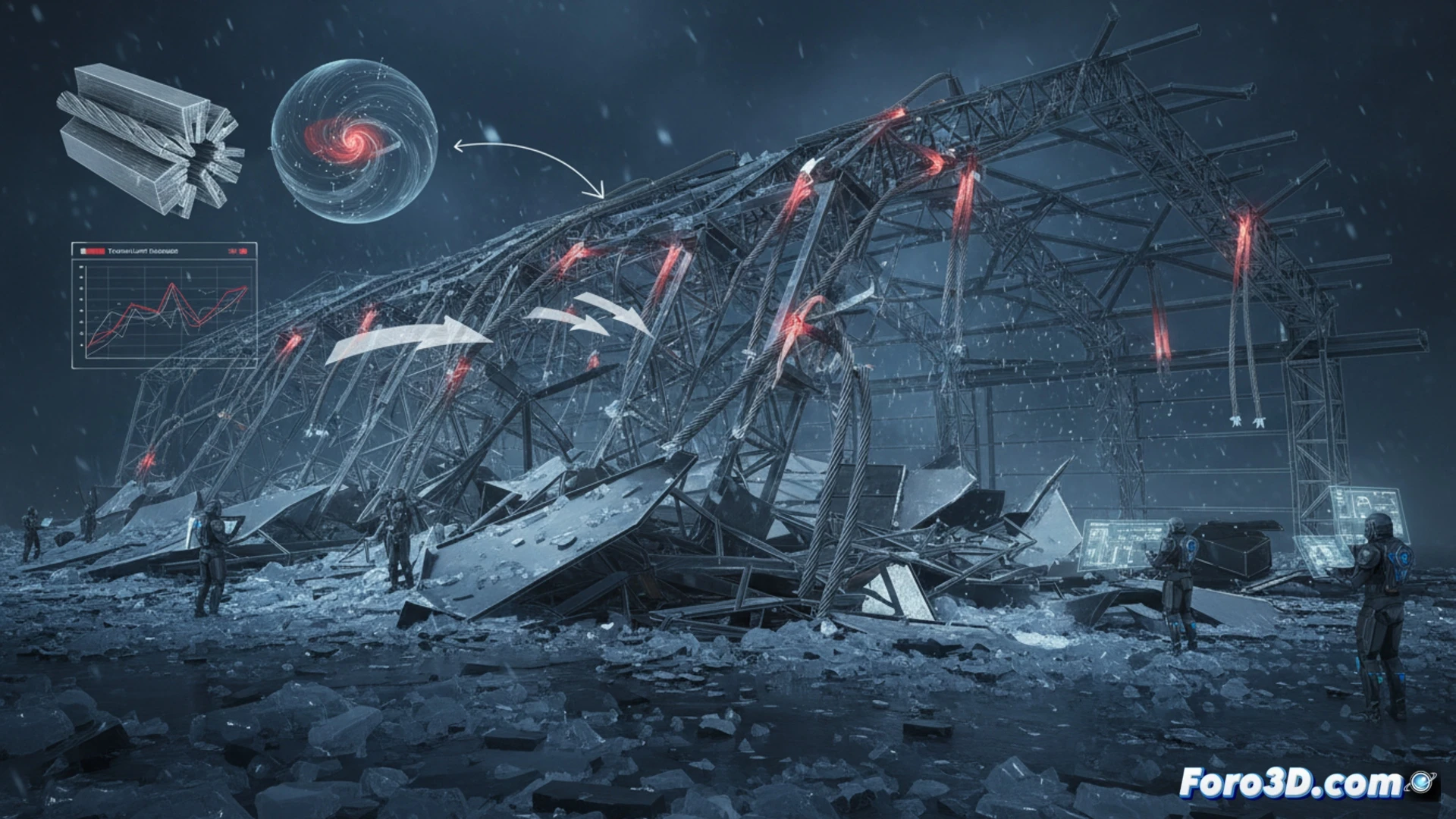
LiDAR scanning and modeling: the digital twin of the disaster 🏗️
The forensic team used a Leica Cyclone scanner to capture the point cloud of the collapsed hangar. With this data, the original model was reconstructed in Tekla Structures, comparing it with the design plans. The discrepancy was evident: the accumulation of hail on the roof generated an unforeseen point load. The geometry was imported into SAP2000 to simulate the structural behavior. The results showed that the steel cables, subjected to axial tension 30% higher than the design value, reached the yield limit and failed due to progressive plastic deformation, triggering the chain collapse of the main frames.
Lessons from the failure: when weather surpasses theory 🌩️
The simulation in Twinmotion visualized the progressive collapse, revealing how the hail, unable to drain, formed an ice slab that overloaded the central structure. The error was not in the materials, but in the load hypothesis: the original climate model assumed a uniform dispersion of hail, ignoring accumulation due to crosswind. This 3D forensic investigation demonstrates that, without dynamic validation of extreme scenarios, even the most modern hangars are not safe from a miscalculated storm.
How can 3D modeling applied to structural forensics differentiate between a fatigue failure of the wiring and a collapse induced by direct hail impact on a next-generation airship hangar?
(PS: Simulating a collapse is easy. The hard part is making sure the program doesn't crash.)