Last August, a 15-level hydroponic cultivation system collapsed in a vertical farming facility, leaving behind a tangle of metal profiles and saturated substrates. At first glance, it appeared to be a failure due to overload: too much weight on the trays. However, forensic modeling in Autodesk Revit and Tekla Structures, combined with dynamic simulations in Ansys Discovery, has revealed a much more subtle cause: a structural resonance phenomenon induced by the vibration of the HVAC fans.
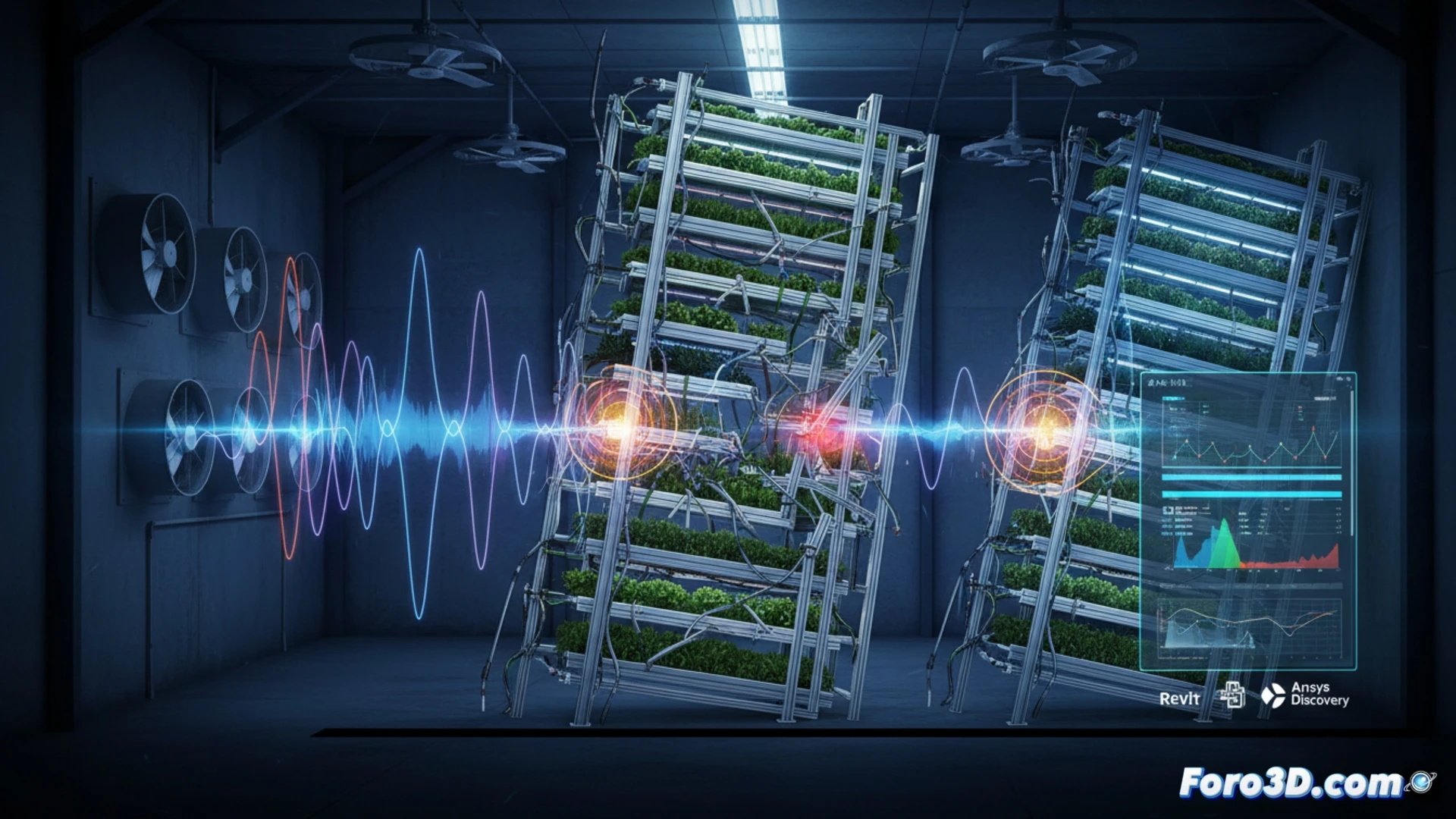
Digital reconstruction of the failure: from Revit to Ansys Discovery 🛠️
The process began with the exact recreation of the rack in Revit, capturing every bolted joint and the geometry of the irrigation channels. Subsequently, the geometry was exported to Tekla Structures to adjust the stiffness coefficients of the joints, a critical detail often overlooked by simplified models. The model was transferred to Ansys Discovery, where two load conditions were applied: the static weight of the water in the substrates (calculated at 320 kg per level) and a harmonic excitation of 15 Hz, the operating frequency of the extractors. The modal analysis revealed that the natural frequency of the second lateral bending mode of the structure was 14.8 Hz. The coincidence was almost perfect.
What does this collapse teach us for future design? 💡
The initial visual inspection attributed the incident to localized corrosion on a main beam. However, the 3D analysis showed that the corrosion was secondary; the true culprit was the cyclic amplification of loads. Each vibration cycle added a small plastic deformation to the nodes, until fatigue exceeded the steel's load-bearing capacity. This case underscores a key lesson: in environments with vibrating machinery, structural design cannot be based solely on static loads. Dynamic simulation, using tools like Ansys Discovery, must be a mandatory step in the engineering process.
How can 3D modeling of natural frequencies in multi-level structures prevent collapse due to resonance in vertical farming systems?
(PS: Simulating a collapse is easy. The hard part is not crashing the program.)