Last month, a high-density automated warehouse suffered a total production shutdown when over 200 robots became blocked in a domino effect. The apparent cause was a massive jam in the aluminum grid. To determine whether a leveling error of just 2 millimeters caused the collapse, the industrial inspection team used three key tools: Leica Cyclone for point cloud capture, Navisworks for clash detection, and MassMotion for robot traffic simulation.
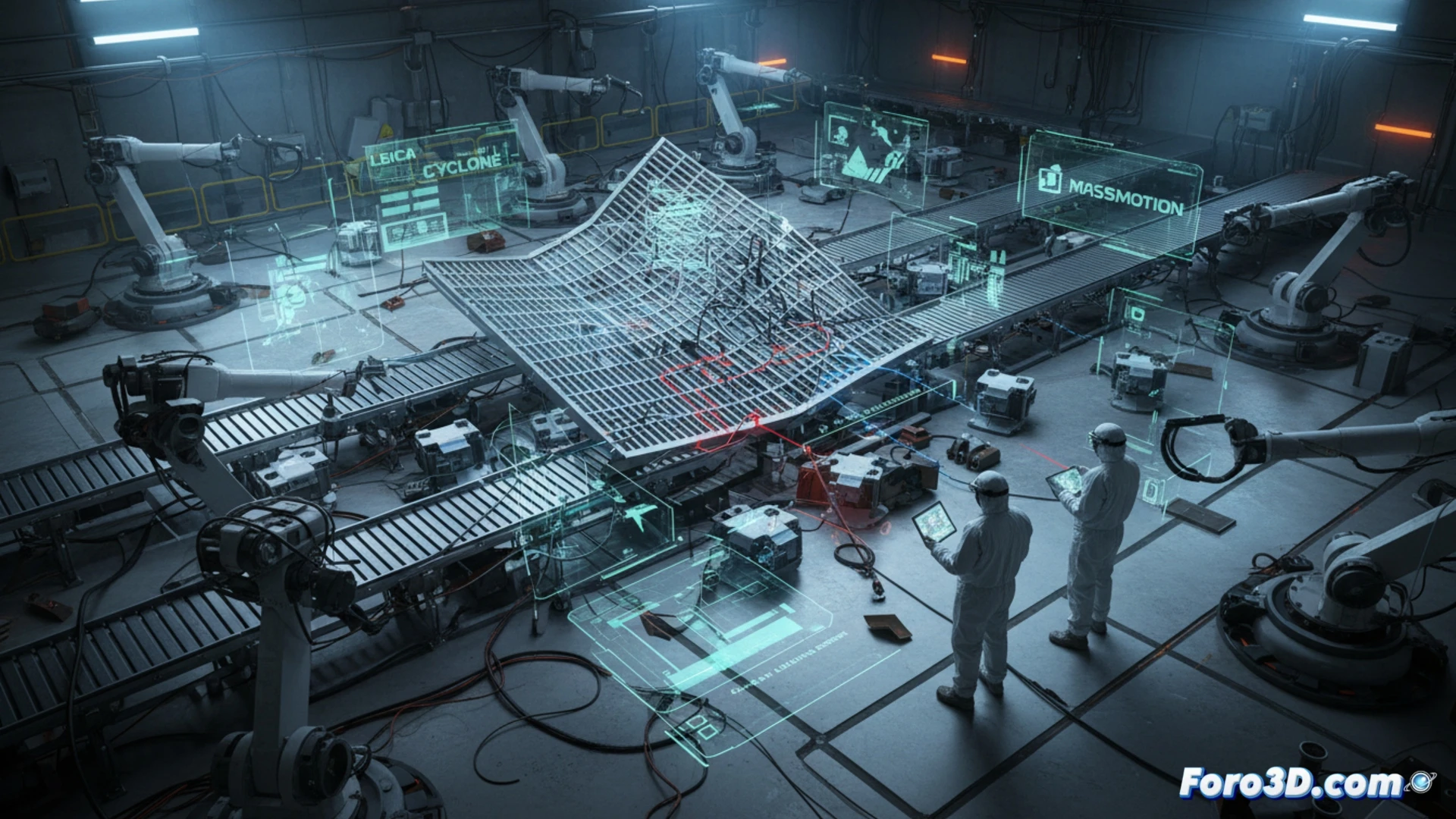
Forensic Analysis of Grid Deformation with Cyclone and Navisworks 🔍
The first step of the inspection was to scan the entire metal structure with a Leica laser scanner. The resulting point cloud was imported into Autodesk Navisworks, where it was overlaid with the original CAD model. The discrepancy revealed a progressive sinking in the loading area, where the grid showed a deviation of 3.2 mm from the horizontal plane. This error, though millimeter-scale, was enough for the robots' wheels (designed with tolerances of 1 mm) to lose traction. The clash detection analysis in Navisworks confirmed that asymmetric wear on the rails caused the robots to deviate from their path, colliding laterally and generating the chain jam.
Predictive Simulation with MassMotion: Lessons for Warehouse Design 🤖
The inspection sought not only the cause but also prevention. Using MassMotion, engineers recreated the robot flow under the deformed grid condition. The simulation showed that, even with a slope of 0.1 degrees, the grid navigation system failed to calculate emergency routes. The technical lesson is clear: in AutoStore-style warehouses, floor leveling must be monitored in real-time using 3D sensors. Any millimeter deviation, imperceptible to the human eye, can trigger a logistical collapse that halts the supply chain for hours.
What 3D scanning and structural analysis methodology would you apply to inspect the deformation of the aluminum grid and determine whether the collapse was due to material fatigue or error in the dynamic load design of the robots?
(PS: 3D bottlenecks are like traffic jams: you see them coming but you can't avoid them)