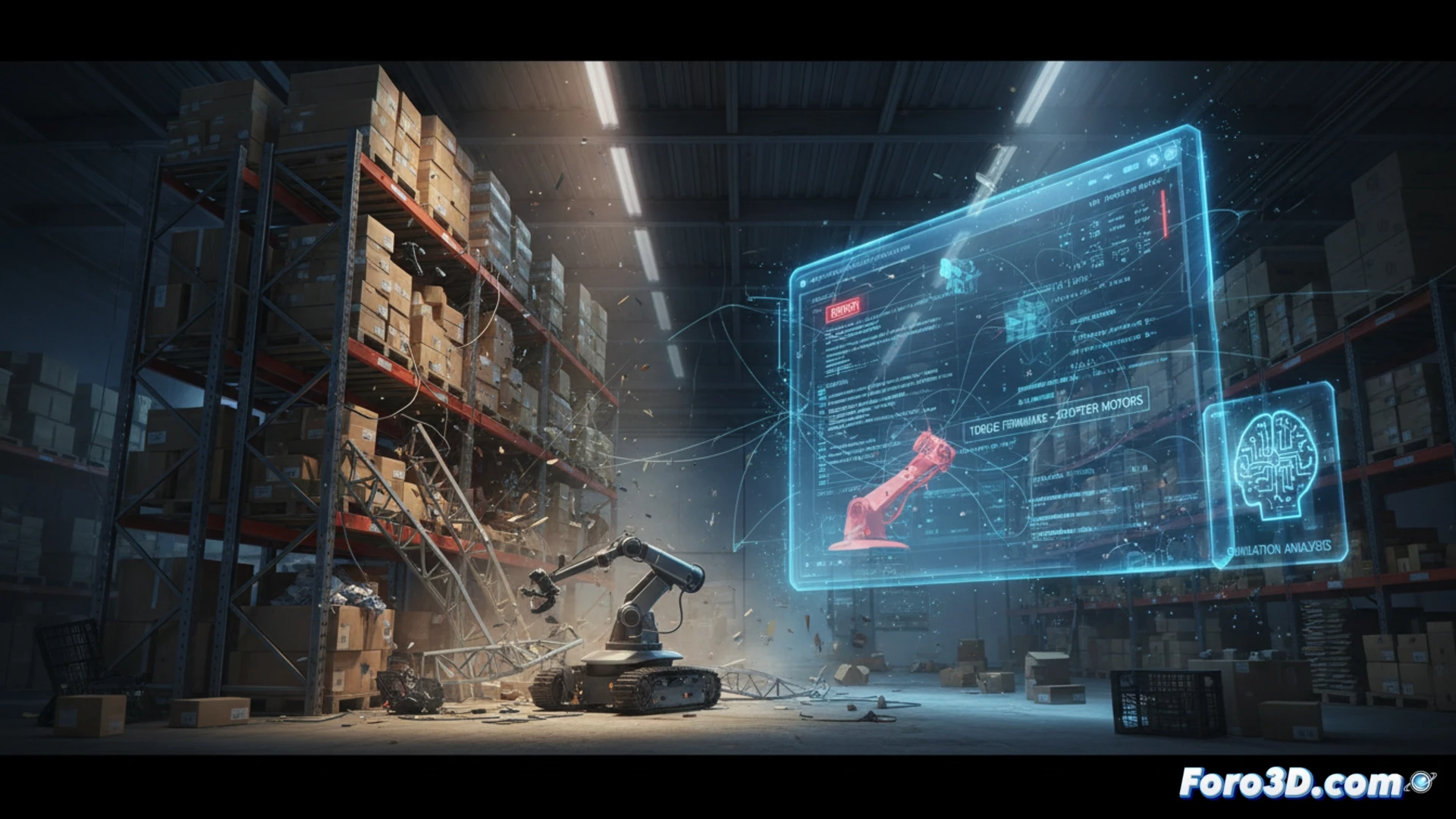
An incident in a dark store warehouse has jeopardized the safety of robotic picking systems. A 10-meter shelf collapsed after being hit by a robot, and the initial analysis pointed to a mechanical failure. However, a 3D simulation pipeline, combining Gazebo, Solid Edge, and Python, has revealed the true cause: a critical error in the torque control firmware of the stepper motors. 🔧
Forensic Reconstruction with Simulation and Data Analysis 🕵️
The engineering team implemented a digital twin of the robot and the shelf. First, they modeled the exact geometry of the load in Solid Edge to calculate the center of mass and moments of inertia. Then, they imported the model into Gazebo, where they injected the motor current logs extracted from the robot's PLC. The analysis in Python revealed an anomaly: the firmware did not limit torque during a 90-degree turn, generating angular acceleration that exceeded the structural limit of the shelf's base. The simulation reproduced the exact overturn, confirming that the software error, not a physical overload, was responsible.
Lessons for Industrial Automation ⚙️
This case demonstrates that 3D simulation is not just a design tool, but a pillar for operational safety. A simple flaw in torque logic can trigger a logistical catastrophe. Integrating telemetry data (current logs) with precise physical models (Solid Edge) and testing environments (Gazebo) allows detecting these firmware blind spots before they cause damage. For the industry, the lesson is clear: validating every line of control with a digital twin is as critical as the hardware itself.
Considering that the failure was detected by the digital twin but not by the physical sensors, what calibration and synchronization protocol between virtual and real data would you propose to prevent a torque error in picking motors from causing a structural collapse in 10-meter shelves?
(PS: simulating an industrial plant is like playing The Sims, but without pools to remove the ladder)