A vertical greenhouse integrated into a skyscraper suddenly collapsed overnight, with no prior seismic warning. Initial reports pointed to a generic structural failure, but forensic analysis using mass capture technology revealed the true cause: a critical fluid overload. 3D scanning with Leica Cyclone allowed engineers to freeze the moment of the disaster, documenting the exact deformation of the metal profiles and the accumulation of water in the blocked irrigation channels.
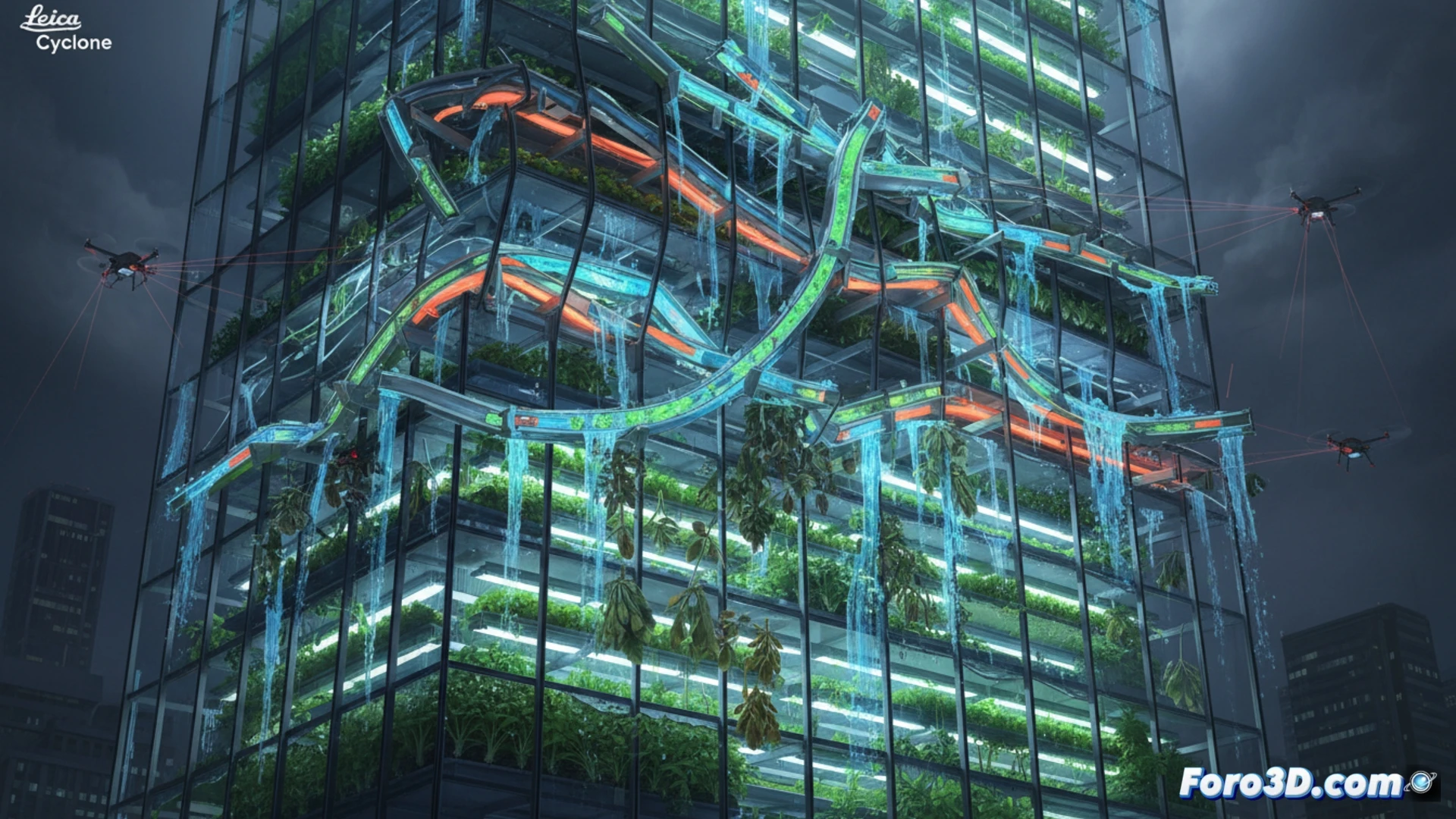
Forensic workflow: from point cloud to simulation in SAP2000 🏗️
The investigation process began with capturing the scene using a terrestrial laser scanner. The resulting point cloud was imported into Leica Cyclone REGISTER for registration and cleaning of environmental noise. Subsequently, the data was transferred to Navisworks, where a BIM model of the collapsed structure was generated. This model allowed visualizing the obstruction in the recirculation channels, showing that water had accumulated in a single sector. With this real geometry, the mesh was exported to SAP2000 to perform a non-linear structural analysis. The simulation confirmed that the weight of the retained fluid exceeded the load capacity of the central cantilever by 40%, causing buckling failure.
Lessons for vertical farming: water as a dynamic load 🌱
This case demonstrates that the design of vertical agricultural infrastructure must consider water not only as a resource, but as a live load that can redistribute catastrophically. The combination of forensic 3D scanning and finite element simulation allows identifying blind spots in the design, such as the lack of flow sensors and insufficient slopes in the channels. For engineers, the lesson is clear: integrate a digital twin from the project phase that evaluates hydraulic obstruction scenarios, preventing a simple blockage from turning into a vertical collapse.
As a structural engineer, what practical lessons about fatigue and sealing of precision hydraulic systems can we extract from the forensic 3D analysis of this nocturnal collapse to prevent similar failures in vertical agricultural towers?
(PS: Simulating catastrophes is fun until the computer melts down and you are the catastrophe.)