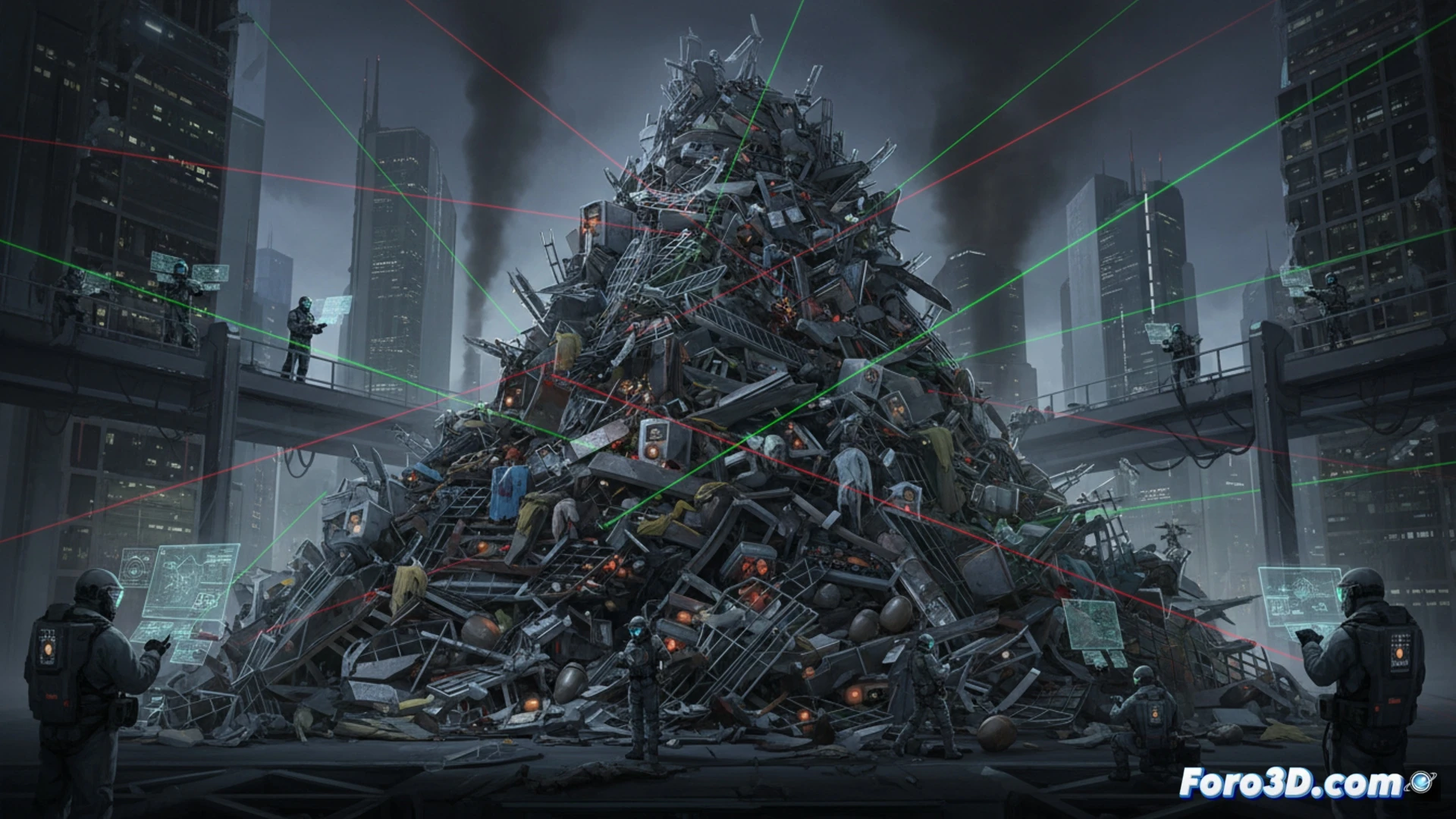
The catastrophic failure of an automated vertical cemetery in an Asian megalopolis has posed an unprecedented forensic challenge. The robotic niche storage and retrieval system suffered a critical structural failure, causing the collapse of dozens of concrete modules in a 15-story tower. The resulting tangled mass, an unstable mixture of steel, concrete, and human remains, prevented any direct manual intervention. The solution involved a high-precision 3D laser survey to generate a point cloud of the structural chaos without the risk of secondary collapse.
Technical Workflow: From Point Cloud to Fatigue Model 🏗️
A Zoller + Frohlich 5016 scanner was deployed to capture the internal geometry of the collapsed columbarium. The equipment recorded over 200 million points from safe perimeter positions, avoiding vibration that could trigger further collapse. Raw data was processed in Zoller + Frohlich LaserControl to filter noise and align stations. The clean point cloud was imported into Autodesk ReCap, where debris volumes were segmented and fracture lines in the concrete slabs were identified. Subsequently, in Tekla Structures, the original structure was modeled and superimposed with the collapsed state to calculate force vectors and fatigue of the robotic guidance system, identifying wear on the elevator rails as the primary cause.
Virtual Simulation and Respectful Recovery 🕊️
The point cloud and fatigue model were integrated into Unreal Engine 5 to generate a virtual recreation of the incident. This digital twin allowed forensic teams to plan the extraction of remains without disturbing the debris pile. The disassembly order of the panels was simulated, prioritizing the stability of the pile and the identification of niches using damaged QR codes. The result was a forensic recovery operation that minimized impact on the remains, demonstrating that scanning technology not only documents the disaster but also guides a technically respectful grieving process.
How can the analysis of deformations in laser scanning point clouds differentiate between a progressive structural failure and a sudden collapse in an automated vertical storage system like the Robotic Columbarium?
(PS: Simulating a collapse is easy. The hard part is not crashing the program.)