Last month, a gravity energy storage tower catastrophically collapsed during a charging cycle. The structure, designed to lift and lower 30-ton concrete blocks, failed when one of the central modules detached at a height of 80 meters. Our forensic team has recreated the incident using finite element simulation tools to determine the root cause between a possible synchronization failure in the winches or premature fatigue in the steel cables.
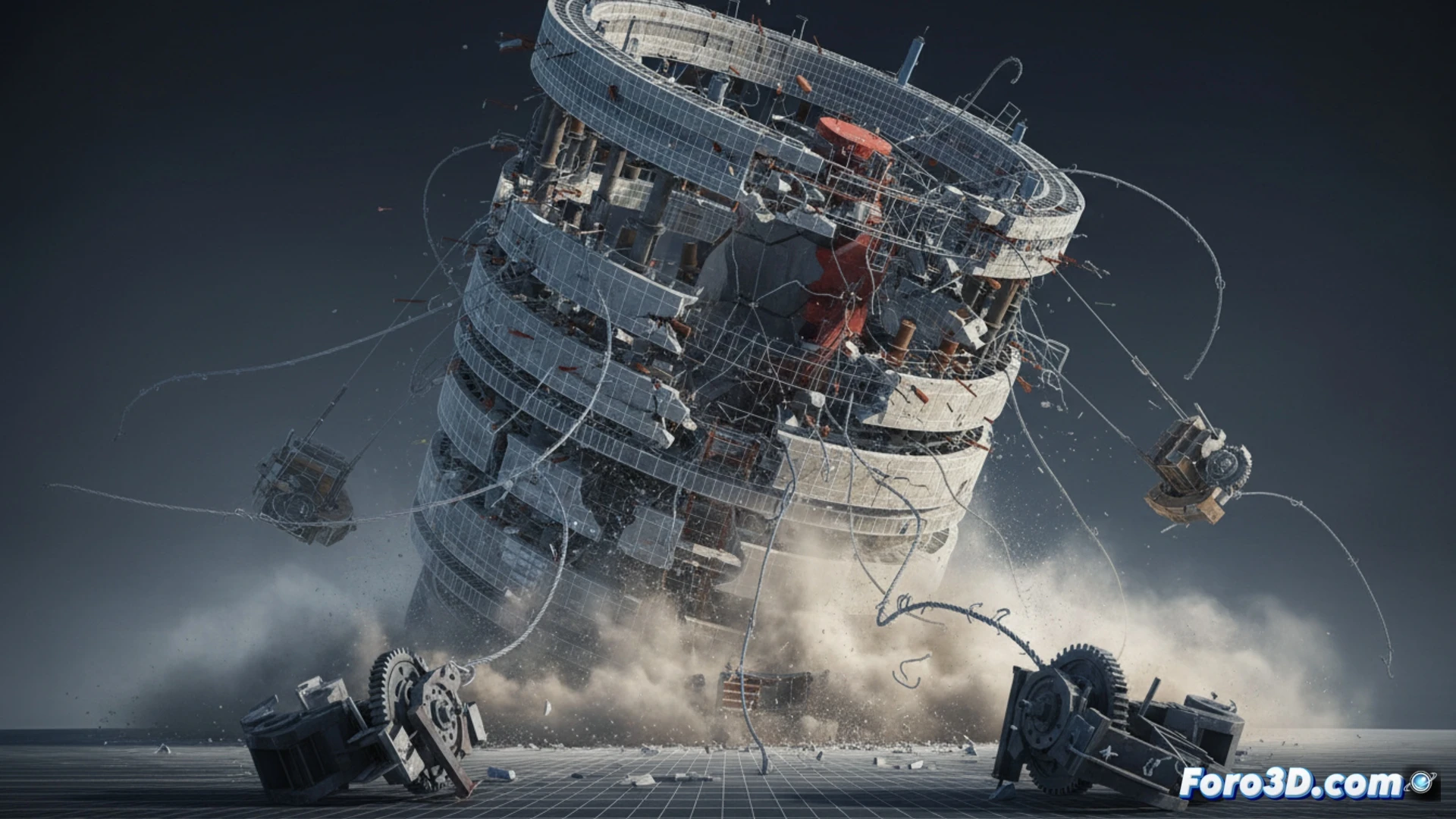
3D Reconstruction and Simulation with LS-DYNA and Bentley OpenTower 🏗️
The forensic process began with laser scanning of the debris using Leica Cyclone, generating a high-density point cloud that allowed the pre-collapse geometry to be reconstructed in Bentley OpenTower. There, the complete tower was modeled, including the four winches and the tensioners of the 64 mm diameter cables. The dynamic simulation was run in LS-DYNA, applying two scenarios: in the first, a 0.3-second offset in motor synchronization generated an asymmetric load that produced progressive buckling in the central column. In the second, a 15% reduction in the cross-section of a cable due to cyclic fatigue was introduced, causing a brittle fracture during maximum tensile stress. The results showed that the deformation pattern of the metal structure exactly matches the desynchronization scenario, ruling out fatigue as the primary cause.
Lessons Learned for the Design of Synchronized Lifting Systems ⚙️
This investigation demonstrates that, in gravitational storage structures, redundancy in winch control systems is more critical than the ultimate strength of the cables. The simulation validated that a minimal offset in lifting generates torsional moments that no safety factor can absorb. We recommend incorporating real-time position sensors and independent braking systems for each winch. The 3D recreation not only identified the culprit but offers a roadmap for future towers to avoid this silent yet devastating failure mode.
Would you simulate the complete collapse or only static analysis?