Last March, a perimeter retaining wall manufactured using 3D concrete printing collapsed after heavy rain at a residential construction site. The incident, which resulted in no fatalities, has opened a technical debate on the reliability of interlayer bonds in additive construction. The forensic investigation team has initiated a multidisciplinary analysis combining laser scanning, finite element simulation, and BIM modeling to determine whether a thermal discontinuity during extrusion was the root cause of the structural failure.
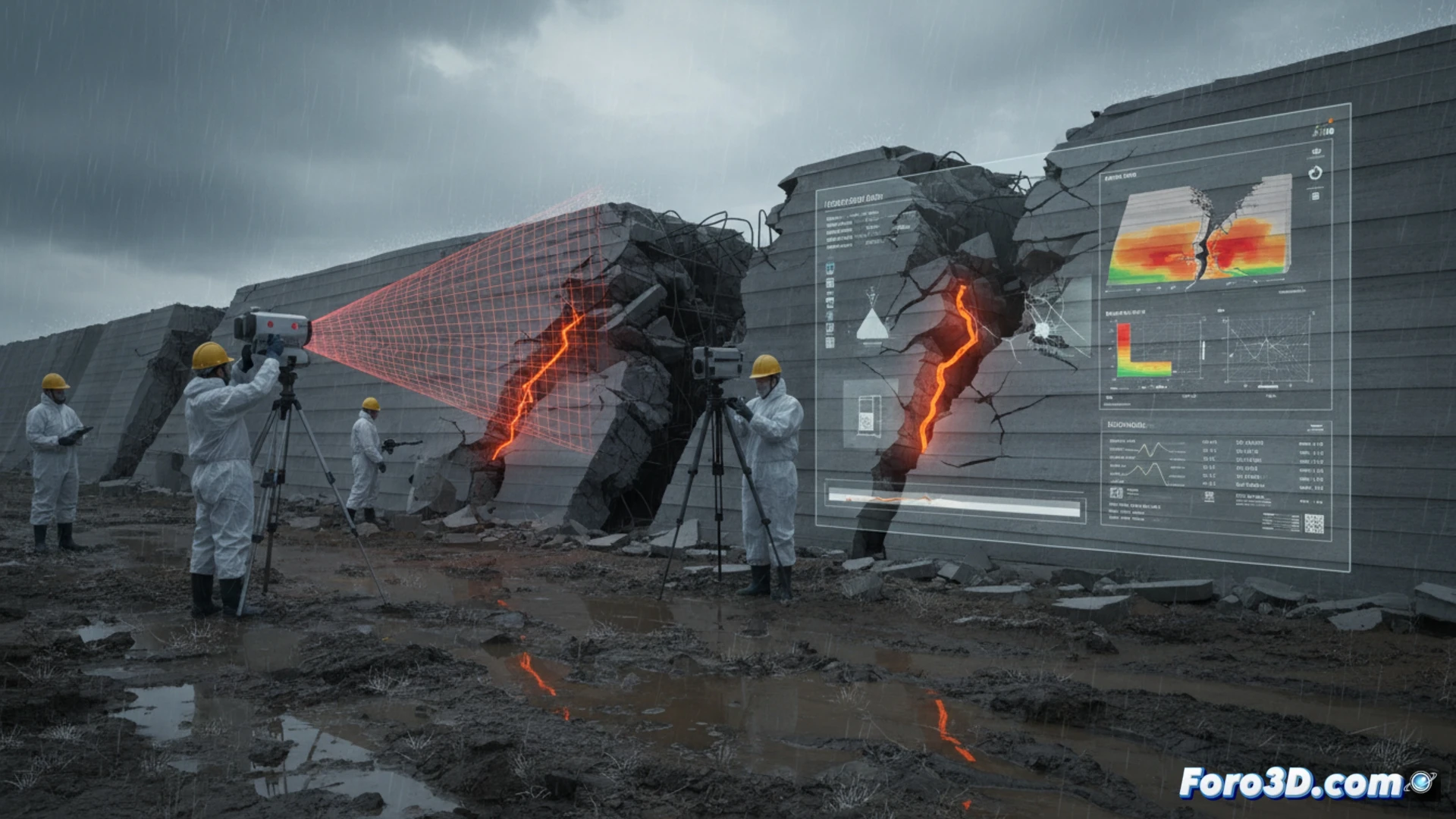
Technical workflow: from 3D scanning to thermal simulation in Ansys 🔧
The investigation process began with capturing the collapsed geometry using a structured light scanner, whose data was processed in GOM Inspect to align the point clouds with the original Revit BIM model. The comparison revealed deviations of up to 8 mm in the thickness of certain layers. Subsequently, virtual specimens were extracted from the fracture zone to analyze interlaminar adhesion. In Rhino, the extruder head path was reconstructed and exported to Ansys, where real thermal gradients were applied (ambient temperature of 12 degrees Celsius during the night prior to the rain). The simulation identified residual stresses of up to 4.2 MPa at the joints, exceeding the allowable limit for fresh concrete.
Lessons for the future of additive construction 🏗️
The investigation concludes that the thermal discontinuity, caused by a sudden drop in temperature between the extrusion of consecutive layers, generated a zone of weakness that the rain ultimately saturated. This case demonstrates that 3D concrete printing requires not only geometric control but also strict environmental monitoring during execution. For the forensic community, the combined use of GOM Inspect, Revit, and Ansys is becoming the standard for validating the integrity of on-site printed structures.
What critical parameters from the BIM model and post-collapse 3D scanning allowed differentiating between a failure due to water infiltration and a deficiency in interlayer adhesion of the printed concrete in the perimeter wall?
(PS: Simulating a collapse is easy. The hard part is keeping the program from crashing.)