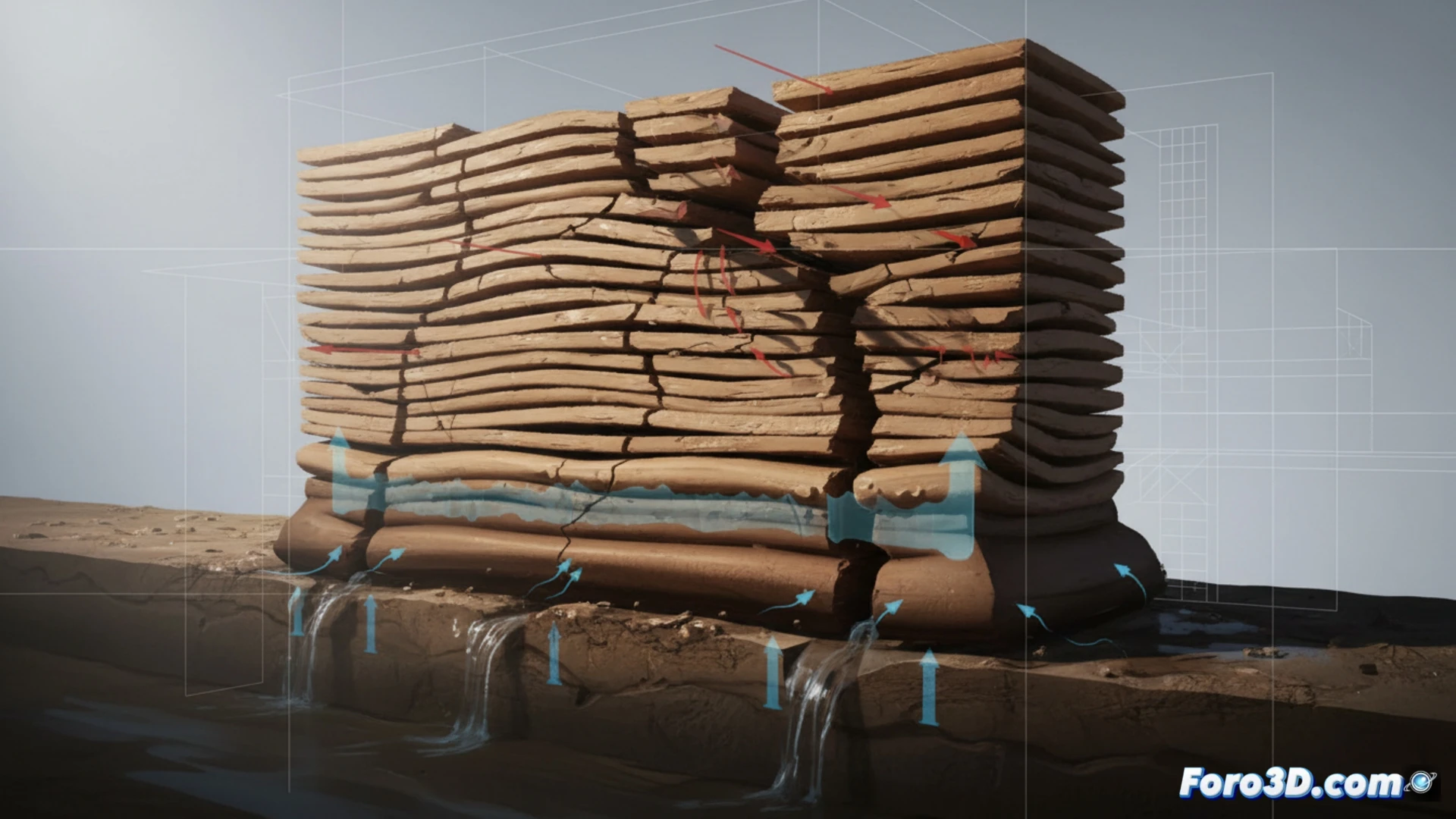
A prototype 3D-printed clay wall, designed as a low-cost sustainable dwelling, collapsed after a week of uninterrupted rainfall. What seemed like a simple moisture failure became a critical case study for materials engineering. The subsequent analysis, using 3D scanning and volumetric simulation, revealed that the lower layers of the wall had absorbed water beyond the saturation point, causing differential expansion that fractured the structure from the base.
Fatigue simulation and hygroscopic digital twins 🧱
The research team used GOM Inspect to compare the original CAD model with the post-collapse scan, identifying millimeter-scale deformations at the layer joints. Material fatigue under wetting cycles was simulated with Autodesk Fusion, while Rhino, using the Ladybug plugin, integrated local climate data of accumulated precipitation to recreate the exact scenario. The analysis confirmed that the design ignored the clay's coefficient of hygroscopic expansion. The failure progression was visualized in Blender, showing how the weight of moisture at the base generated stresses that the dry material could not withstand. The catastrophe was not an accident, but an omission in the digital twin's input data.
Predicting disaster before it rains 🌧️
This case demonstrates that sustainability cannot sacrifice structural safety. Integrating moisture absorption models into 3D simulations is now a necessity, not an option. Tools like Ladybug allow us to anticipate the behavior of natural materials under real climatic stress. The clay wall catastrophe reminds us that an incomplete digital twin is a calculated risk that can literally collapse under the rain. The future of sustainable construction depends on 3D modeling including all environmental variables.
What 3D hydrodynamic simulation parameters would allow predicting the critical saturation point in 3D-printed clay walls to prevent collapses during extreme rainfall?
(PS: Simulating catastrophes is fun until the computer crashes and you are the catastrophe.)