Last month, a 20-ton vegetal facade detached from a corporate skyscraper, causing the closure of several streets. The incident, which occurred during a storm, exposed the failed chemical anchors. The forensic team used drones to capture the geometry of the collapse and, through photogrammetry, reconstruct the previous state of the structure, seeking the root cause in the accumulation of moisture not considered in the original design.
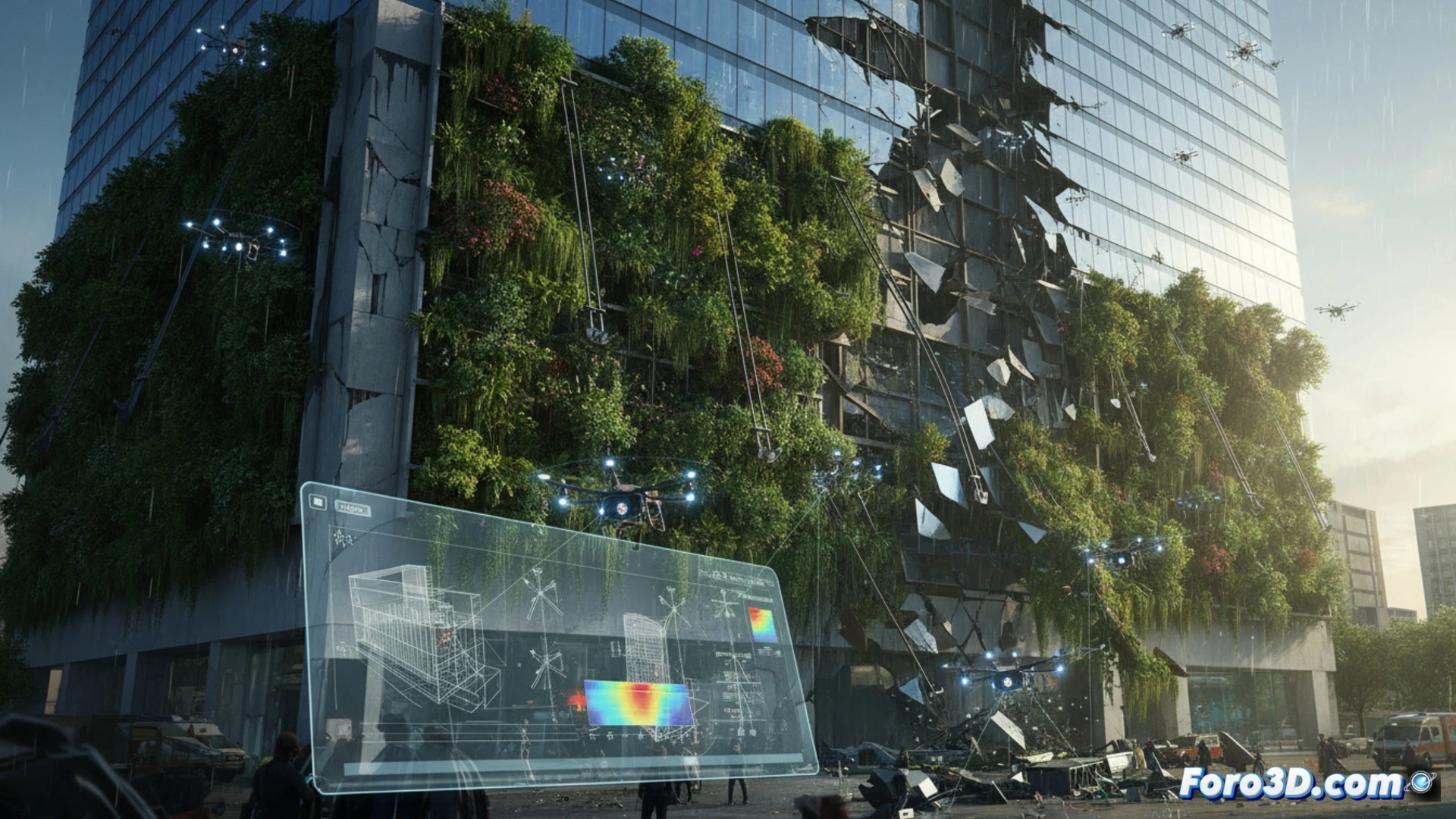
Forensic workflow: from drone to fatigue simulation 🛠️
The process began with a drone flyover, capturing over 800 images of the collapsed area. These were processed in Agisoft Metashape and RealityCapture to generate a dense point cloud and a textured 3D model of the facade and anchor remnants. This model was imported into Autodesk Revit, where it was compared with the original BIM, identifying discrepancies in bolt locations. Subsequently, the model was simplified for analysis in Ansys. There, static and dynamic loads were simulated, introducing variables of moisture and substrate expansion. The results indicated that trapped moisture generated an overload of 2.5 times the yield strength of the steel bolts, causing their fatigue failure.
Lessons for vertical gardens at height 🌿
This case demonstrates that vertical gardens require a dynamic structural analysis that accounts for long-term water retention. Moisture not only adds weight but also accelerates anchor corrosion. The integration of photogrammetry with finite element simulation is consolidating as a key tool for failure investigation. For future projects, it is recommended to install moisture sensors in the substrate and oversize the anchor bolts, considering a safety factor of 300% against the expected static loads.
What digital twin validation methodology do you recommend to correlate the structural fatigue patterns detected by the drone with the simulations in Ansys, considering that the sensors of the vegetal facade failed weeks before the collapse?
(PS: Simulating a collapse is easy. The hard part is not crashing the program.)