Last winter, an inflatable dome at the Tennis Center collapsed during a snowstorm, leaving engineers with two hypotheses: a failure in the inflation system that reduced internal pressure, or a catastrophic tear in the membrane seam. To clarify the incident, our forensic analysis team recreated the dome's geometry in Rhino 3D and subjected it to a rigorous multiphysics study. By combining SAP2000 for structural analysis and Ansys Fluent for fluid dynamics, we were able to determine the exact sequence of the collapse.
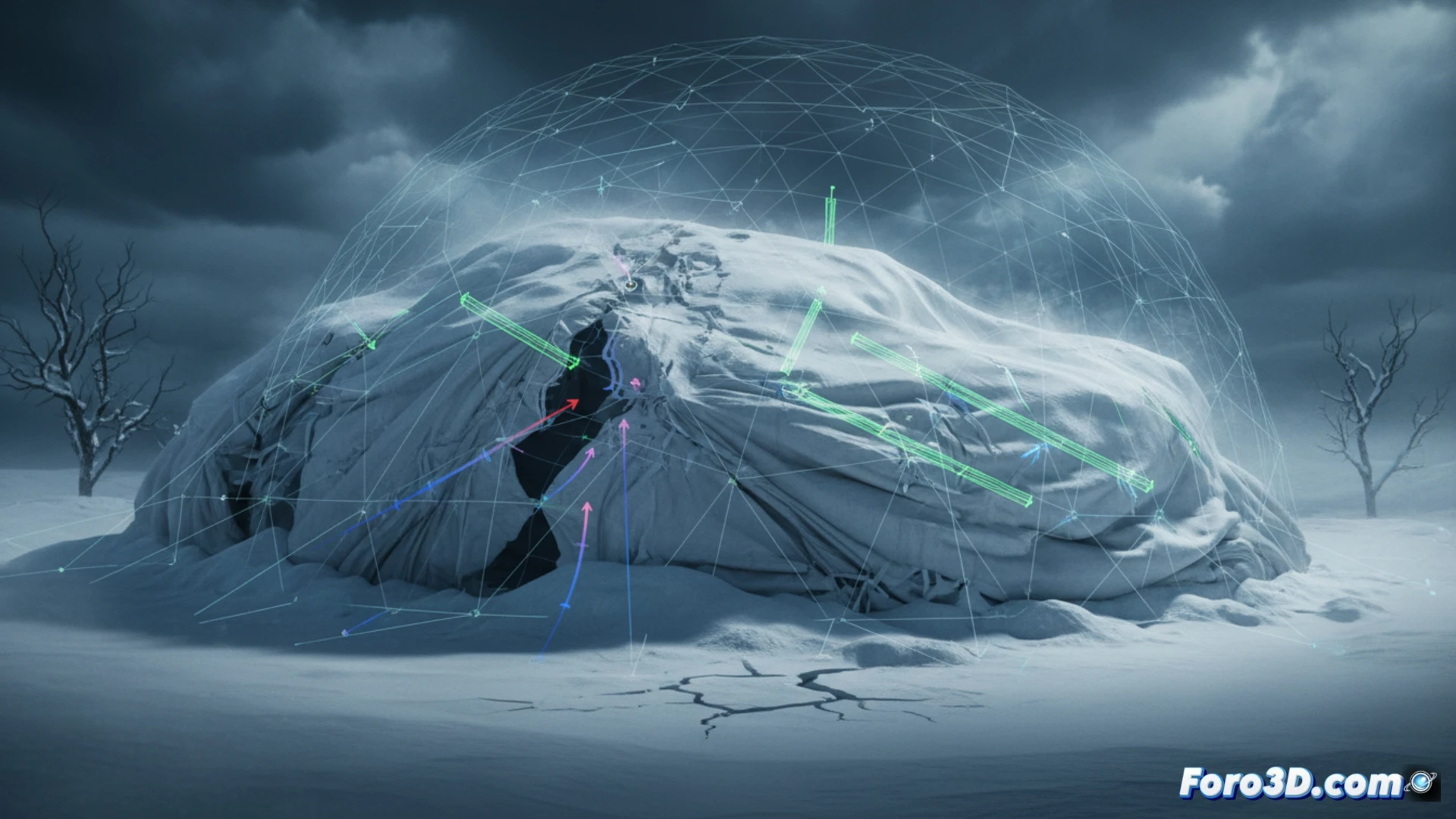
Coupled Simulation: Snow and Wind Load in Ansys Fluent 🌀
The Rhino 3D model was exported as a NURBS surface to Ansys Fluent, where a wind domain with a 90 km/h gust profile and a snow accumulation of 45 kg/m2 was configured. In parallel, the membrane was modeled in SAP2000 as a cable-membrane element with a design internal pressure of 250 Pa. The CFD simulation revealed that, under wind load, the dynamic pressure on the windward face generated a depression on the rear cover, increasing stress on the longitudinal seams. The results showed that when internal pressure dropped below 180 Pa, excessive deformation occurred, exceeding the elastic limit of the PVC material by 23%.
Verification of the Catalyst: Inflation vs. Seam Tear 🔍
The data comparison was conclusive. The simulations indicated that a seam tear would have caused a rapid, asymmetric collapse, whereas the inflation failure generated a progressive, symmetric sinking, matching the deformation patterns observed in the incident images. The internal pressure vs. time curve, extracted from SAP2000, showed a linear drop from 250 Pa to 0 Pa in 4 seconds, typical of a fan blackout. Thus, it was confirmed that the collapse was initiated by an electrical failure in the pressurization system, not by a tear in the fabric.
What stiffness and structural damping parameters should be modeled in a finite element analysis to accurately simulate the dynamic instability of an inflatable dome under asymmetric snow loads?
(PS: Simulating a collapse is easy. The hard part is keeping the program from crashing.)