Last weekend, a pressurized sports dome collapsed during a large event, leaving dozens with minor injuries and a trail of technical questions. Initial hypotheses pointed to a structural failure, but forensic analysis using 3D simulation has revealed a more complex truth: a sudden loss of pressure caused by an error in the emergency PLC and a failure in the door system. This case becomes a manual on how NOT to design the safety of an inflatable dome.
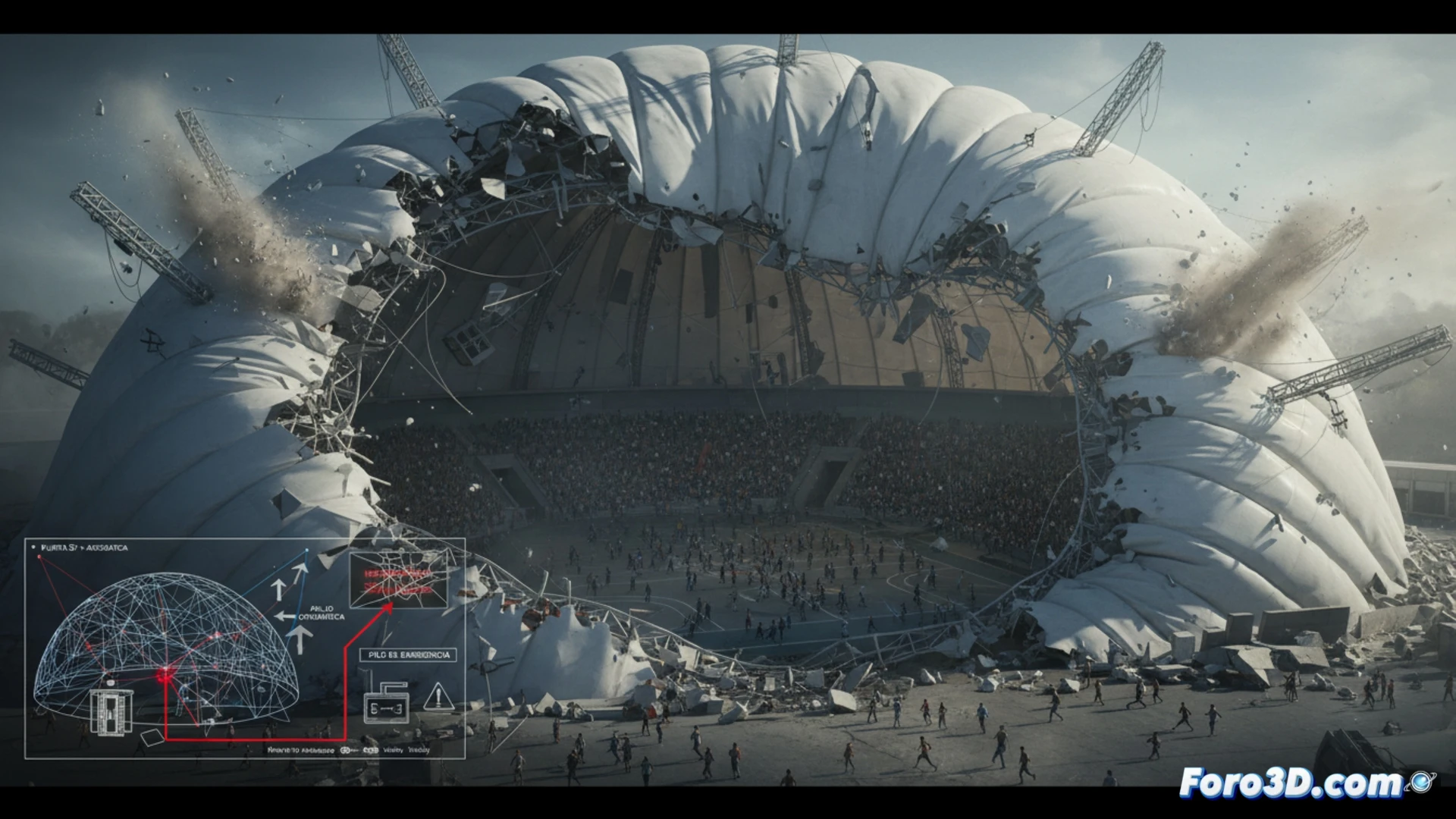
Digital reconstruction: from Rhino and Kangaroo to Abaqus 🛠️
The forensic engineering team used Rhino 3D with the Kangaroo plugin to model the textile membrane as a finite element mesh. The initial simulation showed a stable stress distribution at 250 Pa. However, when introducing the PLC failure scenario in Abaqus, which did not activate the backup fans when the access door opened, the pressure dropped below 50 Pa in just 12 seconds. The mesh lost its stiffness, generating deformation waves that replicated the actual collapse observed on security cameras. The reconstruction in Blender and interactive visualization in Unity allowed experts to validate that human error (a poorly calibrated door sensor) was the root cause, not a material defect.
3D Prevention: beyond the render 🧠
This incident demonstrates that parametric simulation is not just for architectural design, but a vital tool for safety certification in public events. The Kangaroo model allowed for virtual testing of corrective solutions, such as installing decompression gates and a second redundant PLC. Visualizing the collapse in real-time in Unity helped facility managers understand the fragility of control systems. The lesson is clear: an inflatable dome is not a balloon; it is a living structure that demands precision engineering and forensic simulations before a catastrophe occurs.
What was the critical error in design or maintenance protocols that the forensic 3D simulation identified as the main cause of the inflatable dome collapse?
(PS: Simulating catastrophes is fun until the computer melts down and you are the catastrophe.)