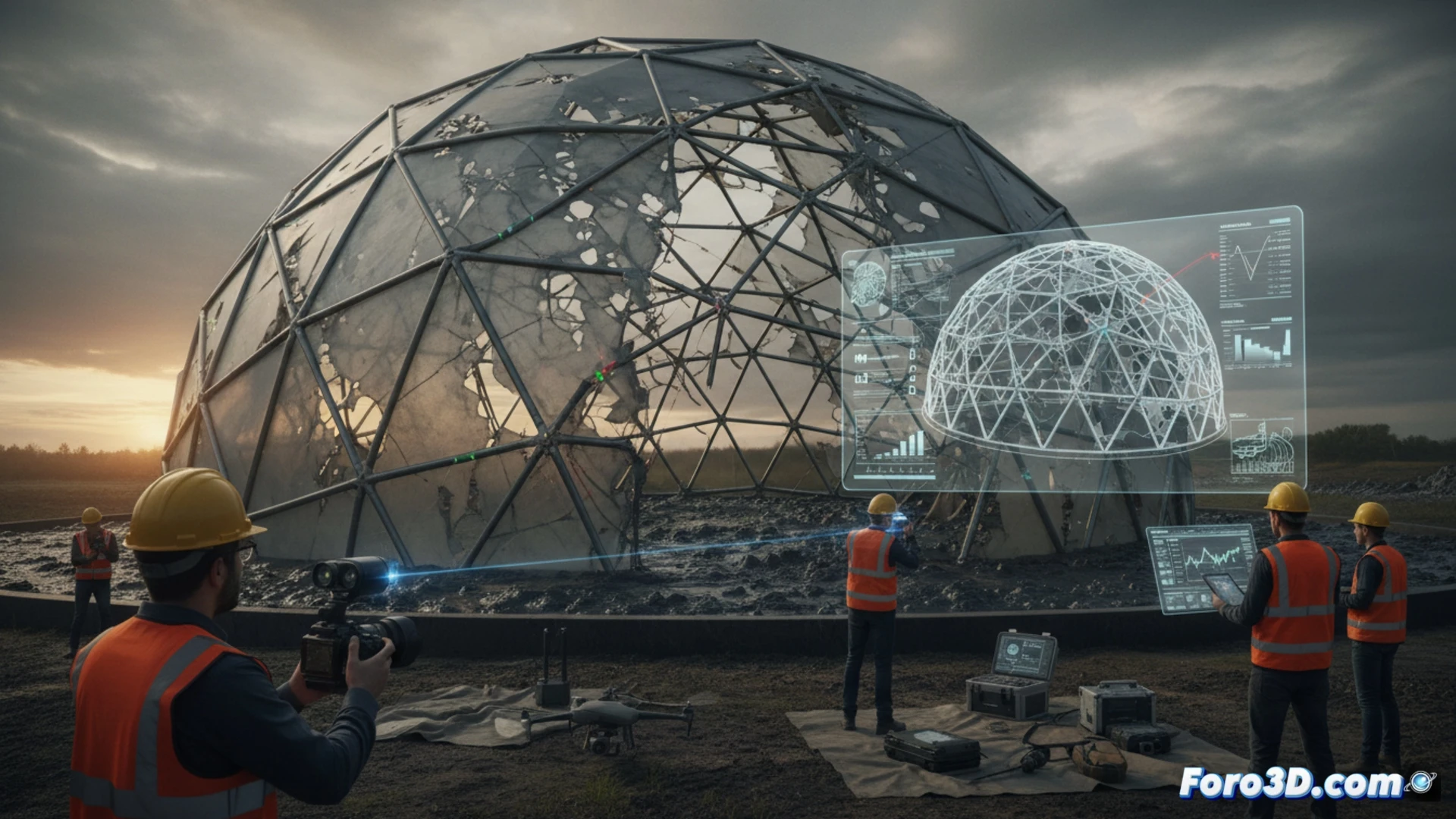
Last quarter, a geodesic dome at a biogas plant collapsed due to asymmetric pressure buildup. The failure was not structural in the classical sense, but a sealing problem: the synthetic fabric and its welded seams gave way due to chemical fatigue. The subsequent 3D forensic analysis used short-range photogrammetry to capture residual deformation and locate micro-cracks invisible to the human eye, sparking a debate on membrane simulation in aggressive environments.
Technical workflow: from point cloud to simulation with Kangaroo 🔧
The process began with capturing the collapsed dome using Agisoft Metashape, generating a dense point cloud that recorded every fold and wrinkle of the fabric. This geometry was imported into Rhinoceros, where the Kangaroo plugin simulated the residual surface tension, revealing zones of stress concentration at the seams. Subsequently, Ansys performed a nonlinear membrane analysis, cross-referencing deformation data with the chemical attack patterns of biogas (hydrogen sulfide and organic acids). The conclusion was clear: the micro-cracks originated at the welded edges, where chemical fatigue accelerated the degradation of the base material.
Failure prevention: the challenge of monitoring in biogas infrastructure 🛡️
This case demonstrates that the design of geodesic domes cannot be limited to static pressure resistance. The interaction between cyclic fabric bending and chemical exposure demands multiparametric simulations. Tools like Kangaroo and Ansys allow predicting fatigue hot spots, but the real challenge is translating that knowledge into real-time sensors. Periodic photogrammetry, combined with finite element models, is emerging as the solution to prevent the next collapse from being caused by a micro-crack that no one saw coming.
How the effect of chemical fatigue induced by biogas on geodesic membranes is numerically modeled to predict collapses due to asymmetric pressure, such as the one that occurred at the recent plant
(PS: Material fatigue is like yours after 10 hours of simulation.)