A main brine discharge pipe at a desalination plant collapsed underwater, releasing the concentrated effluent directly into the ocean. The 3D reconstruction of the incident, carried out using BlueView side-scan sonar and underwater photogrammetry, revealed that the accumulation of salt crystals (scaling) drastically reduced the internal diameter of the conduit. This narrowing generated a hydrodynamic pressure peak that exceeded the strength of the fiberglass-reinforced plastic (FRP), causing the catastrophic rupture.
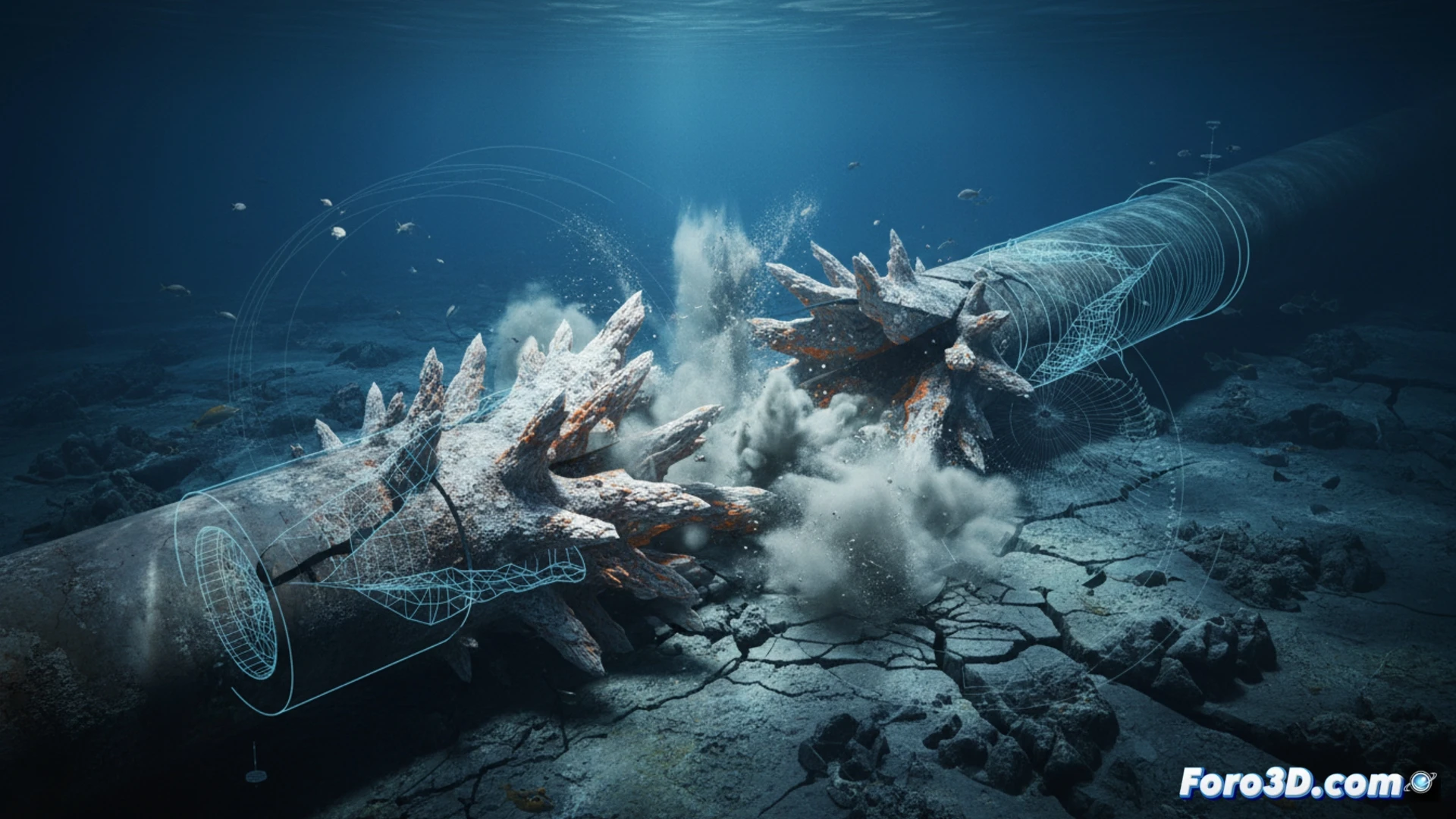
Reconstruction with 3D sonar and CFD simulation in Star-CCM+ 🛠️
The forensic engineering team used the BlueView 3D sonar to generate a point cloud of the seabed and the remains of the manifold. Additionally, underwater photogrammetry allowed texturing the interior of the collapsed pipe, identifying salt deposits up to 4 centimeters thick on the walls. With this data, the digital twin was modeled in Bentley OpenPlant, reducing the effective diameter from 300 mm to 210 mm. The CFD simulation with Star-CCM+ calculated that the flow rate of 450 m3/h, when passing through the constricted section, increased the local pressure to 8.7 bar, 40% above the FRP design limit (6.2 bar). Stress analysis showed that the failure initiated at a longitudinal joint, propagating in seconds along 12 meters of pipe.
Lessons from the disaster: scaling as a silent enemy ⚠️
The manifold collapse demonstrates that crystallization in brine systems is not just an efficiency issue, but a structural risk that can trigger catastrophic failures. The combination of 3D sonar and CFD allowed validating the hypothesis that the progressive narrowing of the diameter, without a predictive cleaning program, turns a standard pipe into a time bomb. For future installations, it is recommended to install differential pressure sensors and conduct periodic inspections with autonomous underwater vehicles to detect scaling before it reaches a critical thickness.
How is the scaling phenomenon in FRP pipes modeled to predict the exact point of structural collapse under hydrostatic pressure and brine concentration in underwater environments?
(PS: Simulating catastrophes is fun until the computer crashes and you are the catastrophe.)