The structural failure of a 3D-printed synthetic reef has revealed a critical vulnerability in bio-polymeric materials exposed to dynamic marine environments. Post-collapse analysis, conducted using BlueView 3D sonar, identified that the massive accumulation of bryozoans drastically altered the structure's hydrodynamic profile, increasing drag load until it exceeded the composite material's breaking limit.
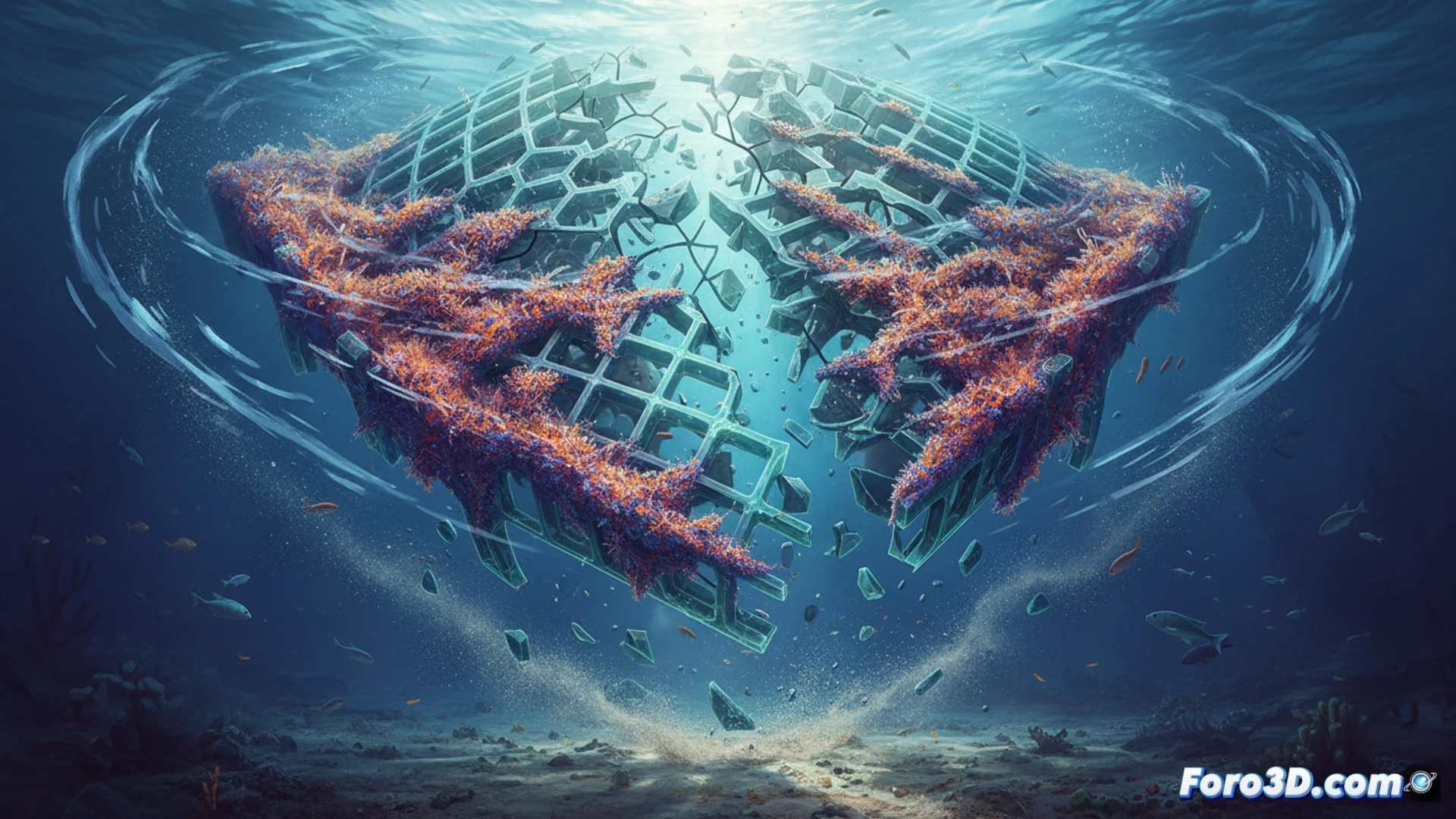
FEM and CFD Analysis: Modeling Fracture by Biofouling 🌊
The incident simulation was approached with a multiphysics strategy. First, BlueView's underwater 3D mapping generated a precise point cloud of the collapsed geometry and attached colonies. This model was imported into Rhino 3D to reconstruct the rough post-colonization surface. Subsequently, Star-CCM+ ran Computational Fluid Dynamics (CFD) simulations to calculate the drag coefficient on the biofouled surface. The results were coupled with a Finite Element Model (FEM), which revealed that the stress generated by the additional drag exceeded the biopolymer's fatigue resistance by 40%, locating the crack initiation point at the joint between printed modules.
Lessons for Bio-Mimicry and Predictive Design 🧬
This case demonstrates that fatigue models for 3D-printed marine structures must integrate biological variables as active load variables. Colonization is not merely an aesthetic ornament; it is a weight factor that alters the object's mass and frontal area. For future designs, it is recommended to include a dynamic safety factor in the material that considers the maximum expected biofilm growth. Additionally, the use of rough biomimetic geometries on the surface could induce micro-turbulence that reduces bryozoan attachment, a field where generative design in Rhino 3D can offer innovative solutions.
How can the load cycle experienced by a biopolymer in a 3D reef be modeled, considering mechanical fatigue induced not only by wave action but also by the growth and boring of marine organisms?
(PS: Material fatigue is like yours after 10 hours of simulation.)