A 3D bio-printed bone scaffold collapsed before completing natural bone regeneration. Forensic analysis revealed that the scaffold's porosity deviated from the original design due to incorrect bio-ink extrusion temperature, generating low-density zones that could not withstand mechanical load. The case exposes a critical error in the additive manufacturing process with direct implications for patient safety.
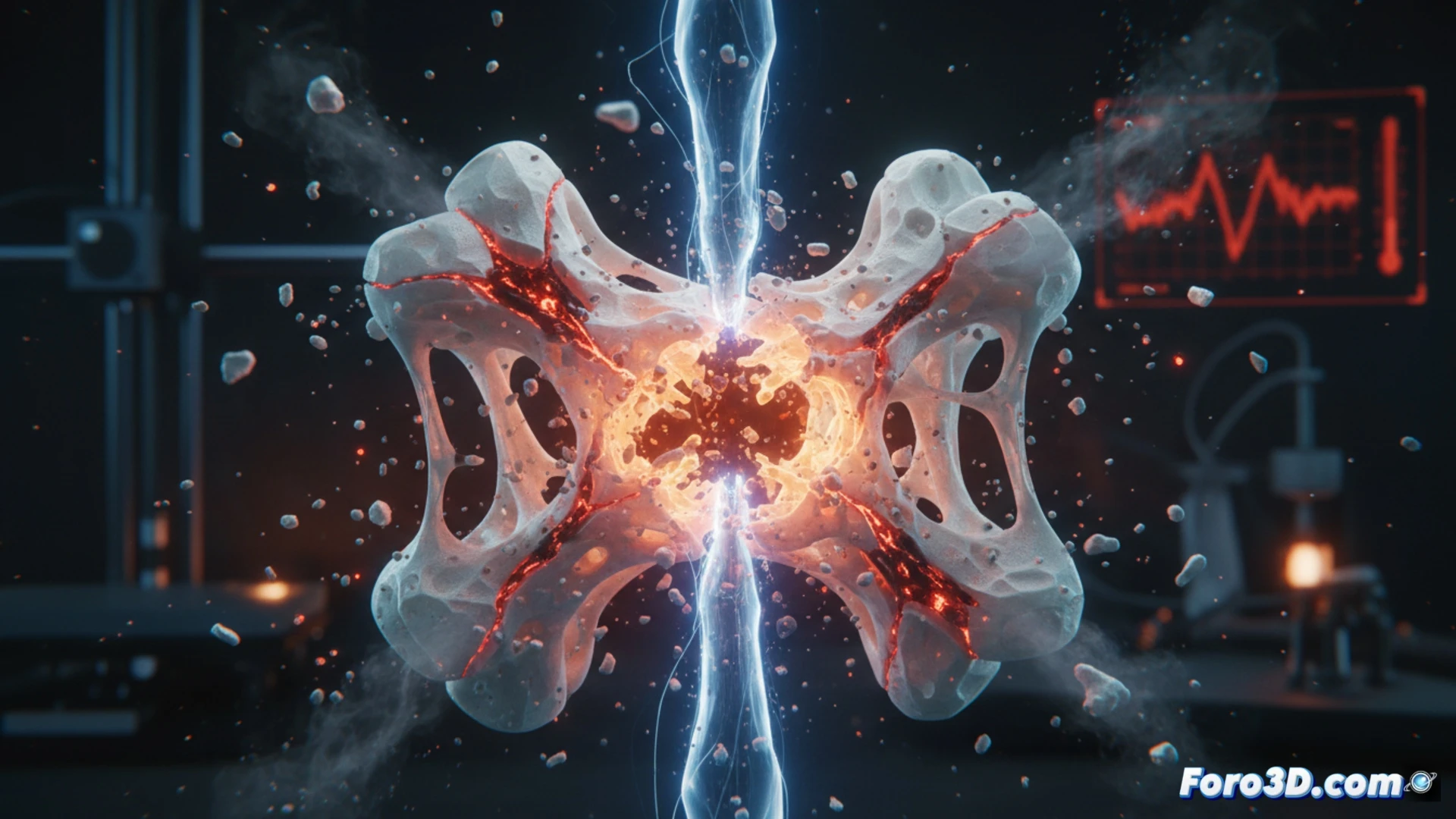
Forensic simulation: porosity and mechanical resistance 🧬
The investigation used Materialise Mimics to segment the CT scans of the failed implant, reconstructing its actual microarchitecture. VGSTUDIO MAX was used to analyze internal porosity, detecting excessively sized interconnected pores in the fracture zone. Simulation in Ansys, with tissue growth models, demonstrated that the scaffold's stiffness was 40% below the minimum required. The elevated extrusion temperature degraded the bio-ink polymer, reducing viscosity and generating irregular extrusion that altered pore geometry. The result was a scaffold incapable of transferring loads to the regenerating bone.
Lessons for future implant designs 🔧
This failure underscores the need to validate each batch of bio-ink with rheometers before printing, adjusting temperature in real-time. The scaffold design must include a safety margin in porosity, simulating in Ansys not only tissue growth but also cyclic fatigue under physiological load. Integrating post-printing quality control with VGSTUDIO MAX is mandatory to detect deviations before implantation. 3D biomedicine advances, but each error reminds us that process precision is as vital as material biology.
Is it possible to predict and avoid temperature-induced collapse of a bio-printed bone scaffold by integrating real-time thermal sensors during the printing process?
(PS: If you 3D print a heart, make sure it beats... or at least doesn't cause copyright issues.)