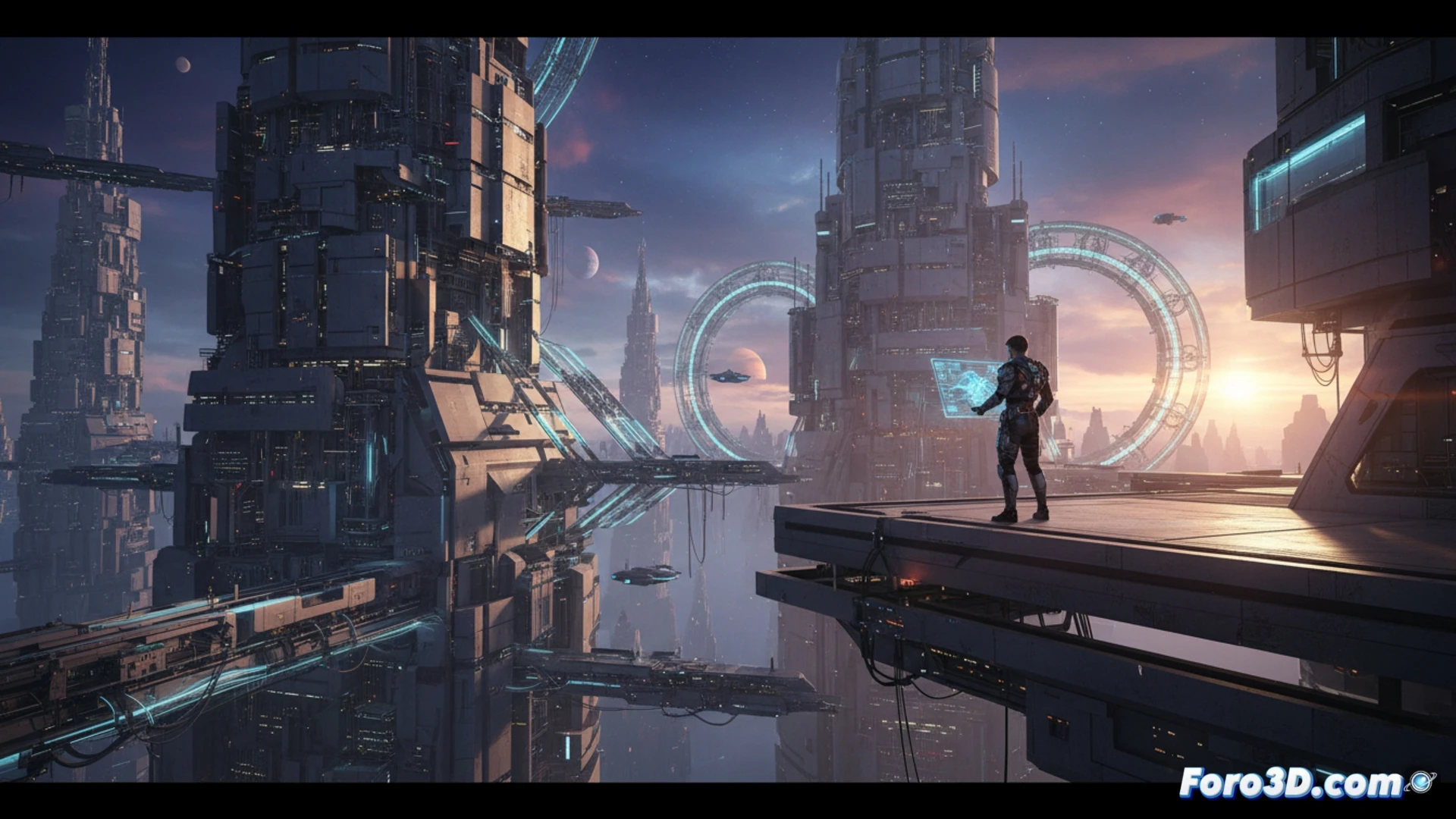
NetEase Games has unveiled Code: Explorer, an ambitious project that leverages Unreal Engine 5 to build a sci-fi world of colossal scale. The title not only aims for visual impact but also demonstrates a mature technical workflow, combining classic modeling with procedural generation. For developers, this project serves as a case study on integrating Nanite and Houdini to achieve environments previously unthinkable in real-time.
Technical Pipeline: Maya, Houdini, and Assembly in UE5 🚀
The creative process of Code: Explorer is divided into three key phases. First, artists use Maya to sculpt hero assets and the base geometry of ships or stations. Then, Houdini comes into play for procedural generation of details: fuselage panels, pipes, and repetitions of modular elements that create the illusion of an infinite megastructure. Finally, Unreal Engine 5 assembles everything. Here, Nanite allows rendering those trillions of polygons without sacrificing performance, eliminating the need for traditional LODs. The result is a scene where every rivet and crack has physical presence, something key for environmental storytelling.
Lessons for Indies: How to Tell Stories with Geometry 🎨
Code: Explorer demonstrates that visual storytelling does not require extensive dialogue. The arrangement of a ship's wreckage, the lighting of a corridor, or the scale of an airlock can narrate abandonment or conflict. For small studios, the advice is to prioritize modularity in Houdini: create a kit of parts that allows reusing geometry and altering its arrangement without overloading memory. Additionally, using Nanite from the start of the project avoids optimization headaches, allowing focus on atmosphere and immersion.
What specific technical challenges of Unreal Engine 5, such as the use of Nanite and Lumen, must NetEase Games developers overcome to maintain performance and stability in the sci-fi megastructures of Code: Explorer without sacrificing the colossal scale of the open world?
(PS: game jams are like weddings: everyone is happy, no one sleeps, and you end up crying)