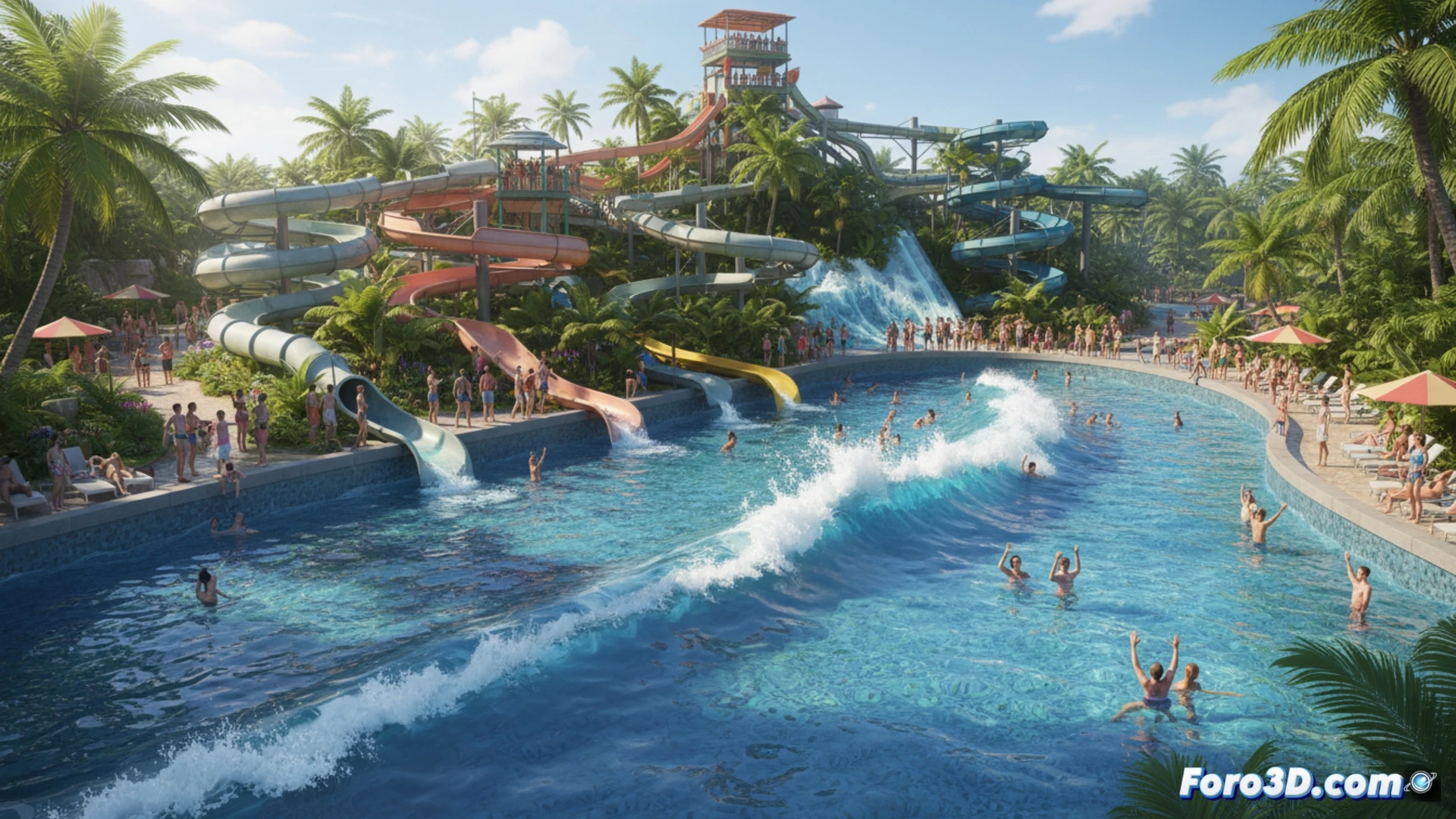
Frontier Developments has pushed its proprietary Cobra Engine to the limit with Planet Coaster 2. The main technical innovation lies in the photorealistic rendering of water, a system that dynamically simulates reflections, refractions, and waves in real time. This advancement allows pools, slides, and artificial lakes to react to the game's physics without sacrificing performance, even when the screen hosts thousands of simultaneous visitors.
Production Pipeline: From ZBrush to Houdini for Massive Assets 🌊
The art team has optimized a cross-platform workflow to manage the high polygon density required by the attractions. In ZBrush, organic details of decorative figures and characters are sculpted, while Autodesk Maya handles rigging and procedural animation of crowds. Houdini is used for procedural environment generation, allowing water slides to dynamically deform based on water speed. This pipeline ensures that each visitor, even if one among five thousand, maintains a recognizable silhouette and precise shadows thanks to a staggered LOD (level of detail) system.
The Balance Between Graphical Fidelity and Mass Simulation 🎢
The biggest technical challenge of Planet Coaster 2 has been synchronizing fluid simulation with visitor artificial intelligence. Cobra Engine solves this through a hybrid calculation: water is rendered with high-quality shaders in the foreground, while in the distance it is simplified to an animated mesh. Visitors, for their part, use a node-based pathfinding system that avoids collisions even in crowded pools. This architecture demonstrates that realism in simulators no longer depends solely on textures, but on how the engine manages resources between physics and the crowd.
What is the technical approach that Cobra Engine uses in Planet Coaster 2 to simulate the dynamic interaction between water and park objects, and how does it overcome the limitations of traditional fluid systems in video game engines?
(PS: optimizing for mobile is like trying to fit an elephant into a Mini Cooper)