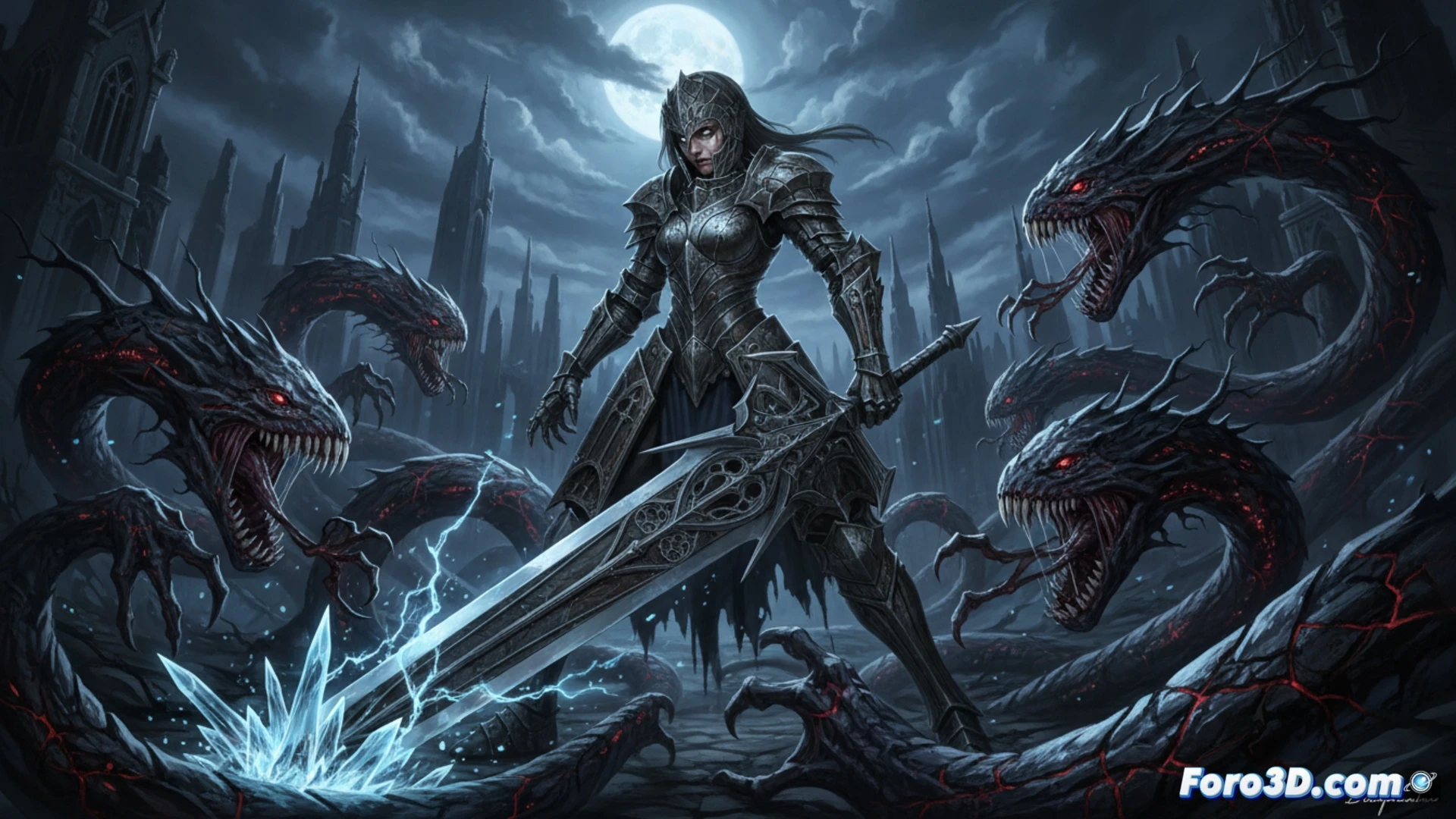
In the universe of Norihiro Yagi, the Claymores are hybrid warriors who fight against man-eating demons, but their true battle is internal: resisting monstrous transformation. This conflict materializes in a character design that contrasts the almost sculptural stylization of the heroines with the organic, nightmarish forms of the Awakened Beings. For digital art and visual activism, this duality offers powerful symbolism about identity and resistance in the face of dehumanization.
3D Modeling and the Aesthetic Duality of the Monstrous Body 🎨
From a technical perspective, the design of the Claymores lends itself to 3D modeling due to its clean, symmetrical geometry, with armor reminiscent of gothic architecture and faces seeking a cold, contained beauty. In contrast, the Awakened Beings demand an organic and chaotic approach, with rough textures, elongated limbs, and forms that challenge conventional topology. This contrast is not only visual but narrative: while the Claymores represent digital containment (optimized polygons, symmetry), the monsters embody the deformation of the body as a metaphor for oppression or loss of control—a resource that digital art can exploit to speak about identity and marginality.
Visual Activism: Monstrosity as a Cry of Resistance 🛡️
The art of Claymore transcends entertainment when we read it as digital activism. The stylization of the warriors is not merely aesthetic, but an act of visual resistance: maintaining human form is clinging to identity in a world that pushes you to become a monster. The Awakened Beings, with their gothic and organic aesthetic, represent the consequences of systemic oppression or structural violence. In 3D modeling, this contrast allows for creating narratives where the mutant body is a symbol of struggle, not defeat. Thus, Claymore becomes a tool for reflecting on how digital art can give visual form to political resistance and the defense of humanity in the face of adversity.
As a digital artist, in what ways can the 3D modeling of the Claymores reinterpret gothic symbolism to turn it into a tool of visual resistance against contemporary power structures?
(PS: at Foro3D we believe all art is political, especially when the computer freezes)