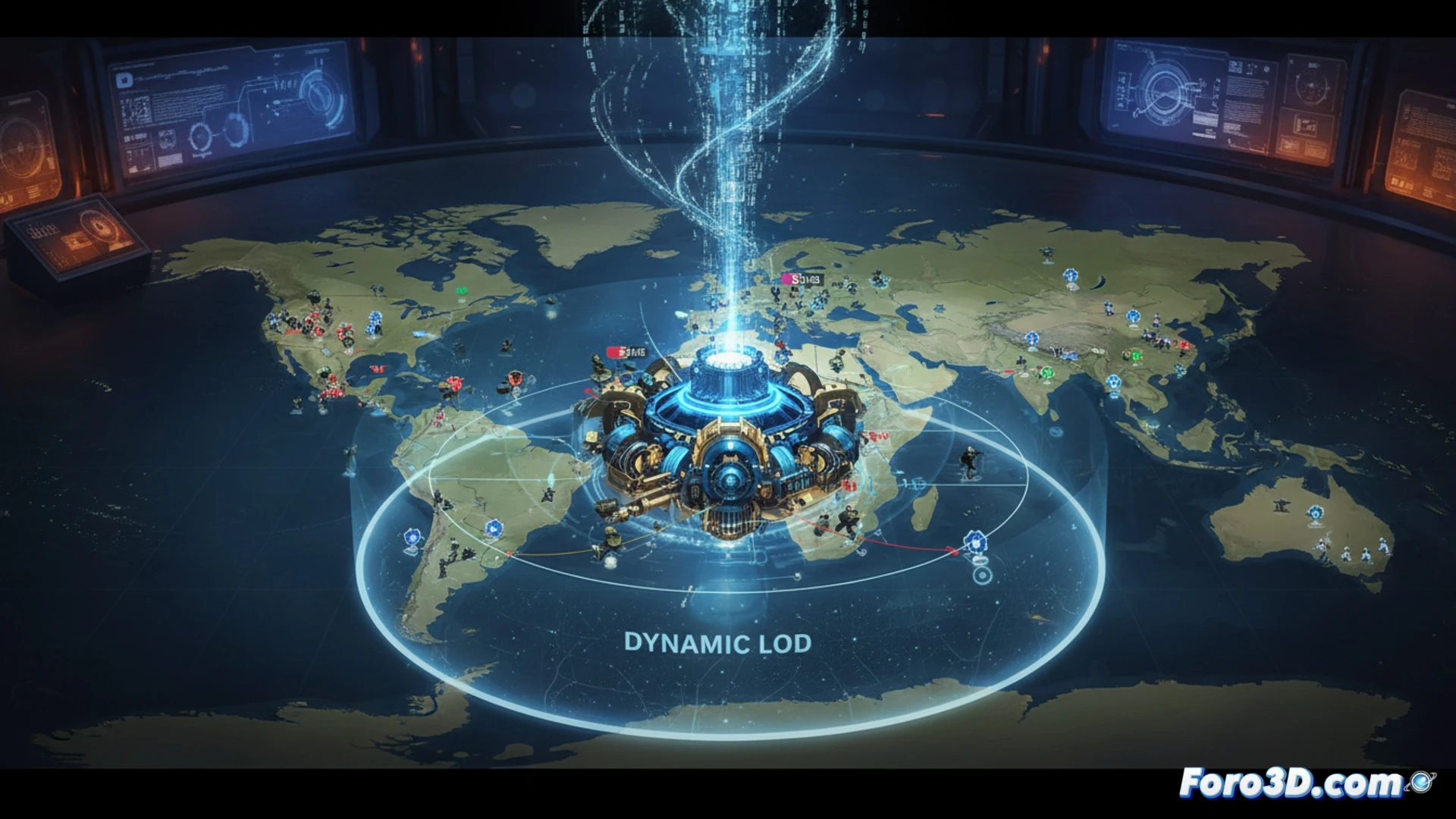
The Clausewitz Engine, Paradox Interactive's proprietary engine, faces one of the most complex challenges in strategy development: managing thousands of simultaneous units on a global map without collapsing performance. In Hearts of Iron IV, optimization depends not only on culling distant objects but on a dynamic level-of-detail system that prioritizes the visibility of land divisions, naval fleets, and air squadrons based on the player's camera.
LOD and culling techniques for global battles 🎯
The engine implements aggressive occlusion culling combined with progressive LODs. Land units are represented as 2D sprites at a continental scale, transitioning to simplified 3D models when zooming in. For naval battles, the Clausewitz Engine groups fleets into combat nodes, reducing individual physics calculations. On the air front, an optimized particle system is used for contrails and explosions, avoiding rendering each plane separately. This architecture allows the engine to process hundreds of simultaneous interactions without saturating the GPU, maintaining a stable frame rate even in late-game campaigns with high troop density.
The role of Photoshop in visual efficiency 🎨
Asset creation in Hearts of Iron IV relies on Photoshop to generate compressed textures and normal maps that maximize detail without excessive weight. Artists design division sprites and ship models with reduced palettes, optimized for the Clausewitz Engine's texture atlas. This workflow ensures that every unit, from a destroyer to a strategic bomber, maintains visual legibility on the global map without compromising 60 FPS, demonstrating that technical efficiency begins in the asset creation phase.
What specific optimization techniques does the Clausewitz Engine implement in Hearts of Iron IV to handle massive simulation of units and events without sacrificing real-time performance?
(PS: 90% of development time is polishing, the other 90% is fixing bugs)