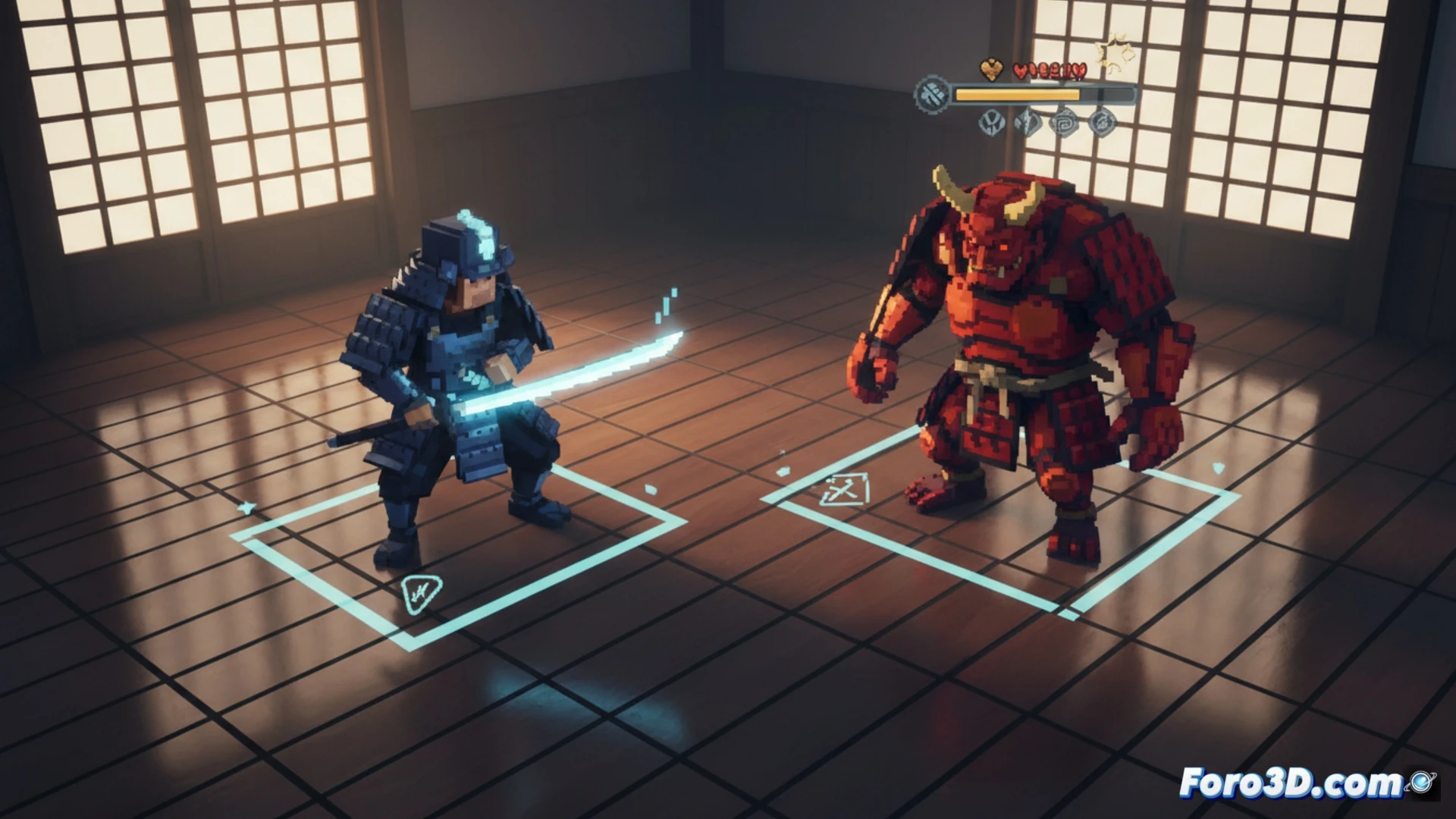
The minimalist pixel art of Shogun Showdown is not an aesthetic limitation, but a functional design decision. In a turn-based combat game where the character's position and the impact of each blow define the strategy, readability is critical. This title demonstrates that fewer visual elements can translate into more useful information for the player.
Aseprite and Unity: the technical synergy of tactical pixel art 🎮
The creation of sprites in Aseprite focuses on defined silhouettes and limited color palettes to differentiate the player from enemies without ambiguity. Each Japanese weapon, from the katana to the yari, has an attack animation that lasts exactly the time needed to convey the range and direction of the strike. In Unity, the orthographic camera system and the use of invisible colliders on each board cell allow the engine to calculate impact trajectories precisely. Visual feedback, such as the sprite blinking when taking damage or the color change in movement cells, is managed through simple coroutines that prioritize response speed over complex effects.
Why visual restriction improves the gaming experience 🧠
By eliminating detailed backgrounds and excessive particles, the developer forces the player to focus on the battle grid and the animation of attacks. This clarity allows positioning mechanics, such as dodging or flanking, to be understood intuitively. Shogun Showdown demonstrates that a powerful engine like Unity does not need to exploit complex graphics to be effective; sometimes, the best optimization is teaching the player to read the board at a single glance.
How the limitation of minimalist pixel art affects the readability of the action flow in turn-based combat and what lessons an indie developer can learn when designing visually clear interfaces without relying on detailed graphics
(PS: 90% of development time is polishing, the other 90% is fixing bugs)