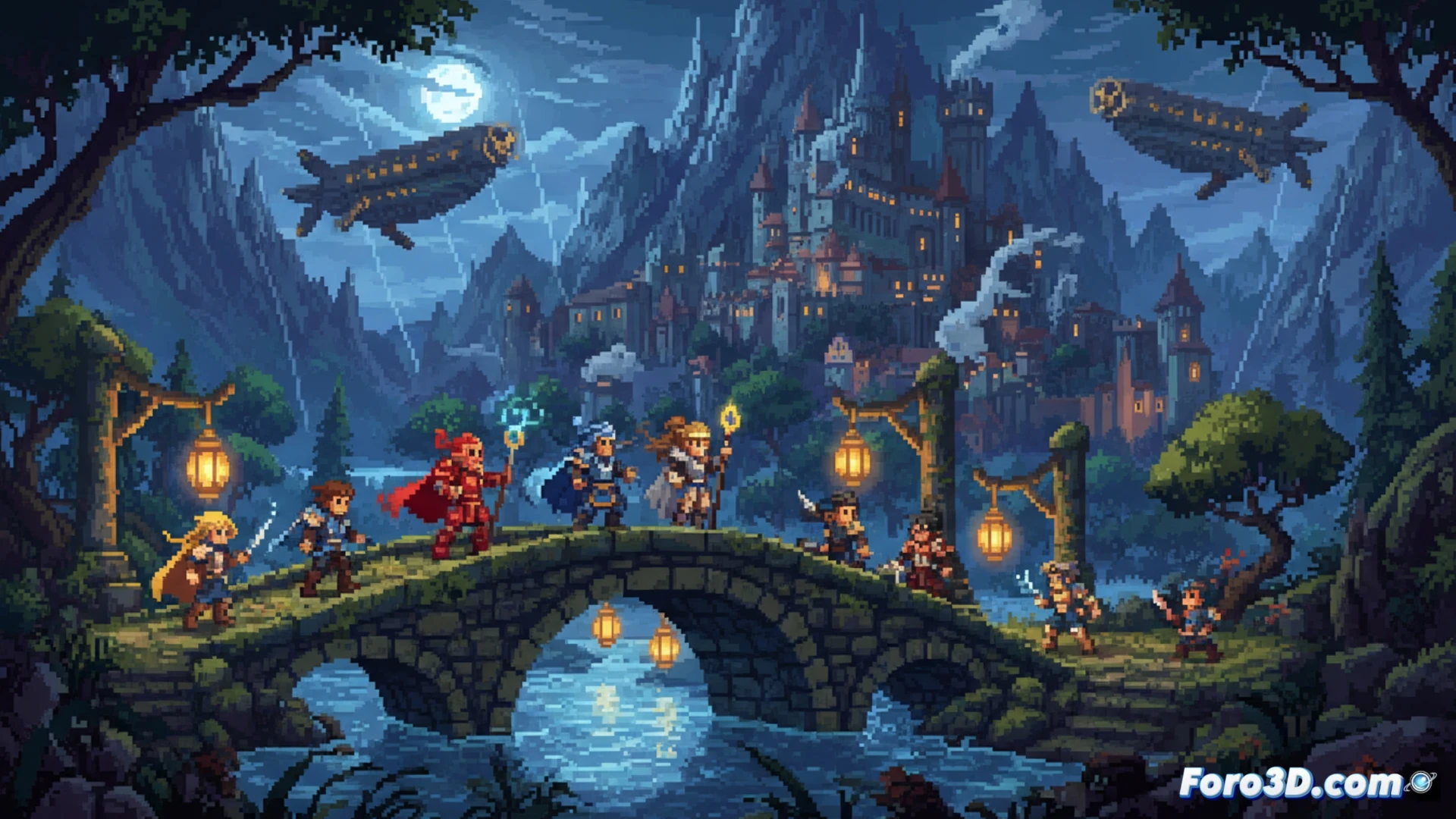
Chained Echoes proves that classic 16-bit pixel art is not dead, but has evolved. This indie title, developed in Unity, uses sprites and tilesets created in Aseprite, combined with Photoshop portraits. The key to its visual success lies in applying real-time lighting and transparency effects, something impossible on the original SNES hardware, achieving a retro aesthetic without sacrificing technical modernity.
Technical Pipeline: From Aseprite to Unity with Shaders 🎨
The production pipeline begins in Aseprite, where all sprites and tilesets are drawn respecting a limited palette and 16-bit resolution. However, when integrated into Unity, the engine allows them to be scaled to modern resolutions without losing the point filter. The real technical leap occurs with custom shaders and post-processing. Dynamic lighting effects (point lights) are applied to the tilesets, something the SNES could not compute due to lack of processing power. Transparency is achieved through the alpha channel of textures, allowing particle overlays and soft shadows. Photoshop portraits are imported as flat sprites, but a depth of field or bloom effect is applied to them in the Unity camera, giving them a more organic integration with the 2D world.
Lessons for Indies: Optimizing 2D Assets in 3D Engines 🚀
For indie developers, Chained Echoes teaches that it is not necessary to create a 2D engine from scratch. Unity, being a 3D engine, handles 2D sprites perfectly if sorting layers are correctly configured and texture atlases are used to reduce draw calls. The main lesson is that low-resolution pixel art greatly benefits from modern lighting; there is no need to fear mixing retro with contemporary. Additionally, using Aseprite for frame-by-frame animation and Photoshop for detailed portraits allows for an agile and professional workflow, as long as they are exported in formats compatible with Unity (PNG with alpha channel).
As an indie developer, what was the biggest technical challenge when integrating Aseprite and Photoshop with Unity to achieve the modern SNES aesthetic of Chained Echoes without sacrificing performance?
(PS: optimizing for mobile is like trying to fit an elephant into a Mini Cooper)