The announcement of Bleach: Rebirth of Souls has captured the industry's attention due to its technical commitment: replicating high-fidelity anime style using Unreal Engine 5. Unlike previous titles, this project seeks advanced cel-shading that preserves the visual identity of the manga, relying on a classic production pipeline optimized for real-time, where Maya and Photoshop remain key tools.
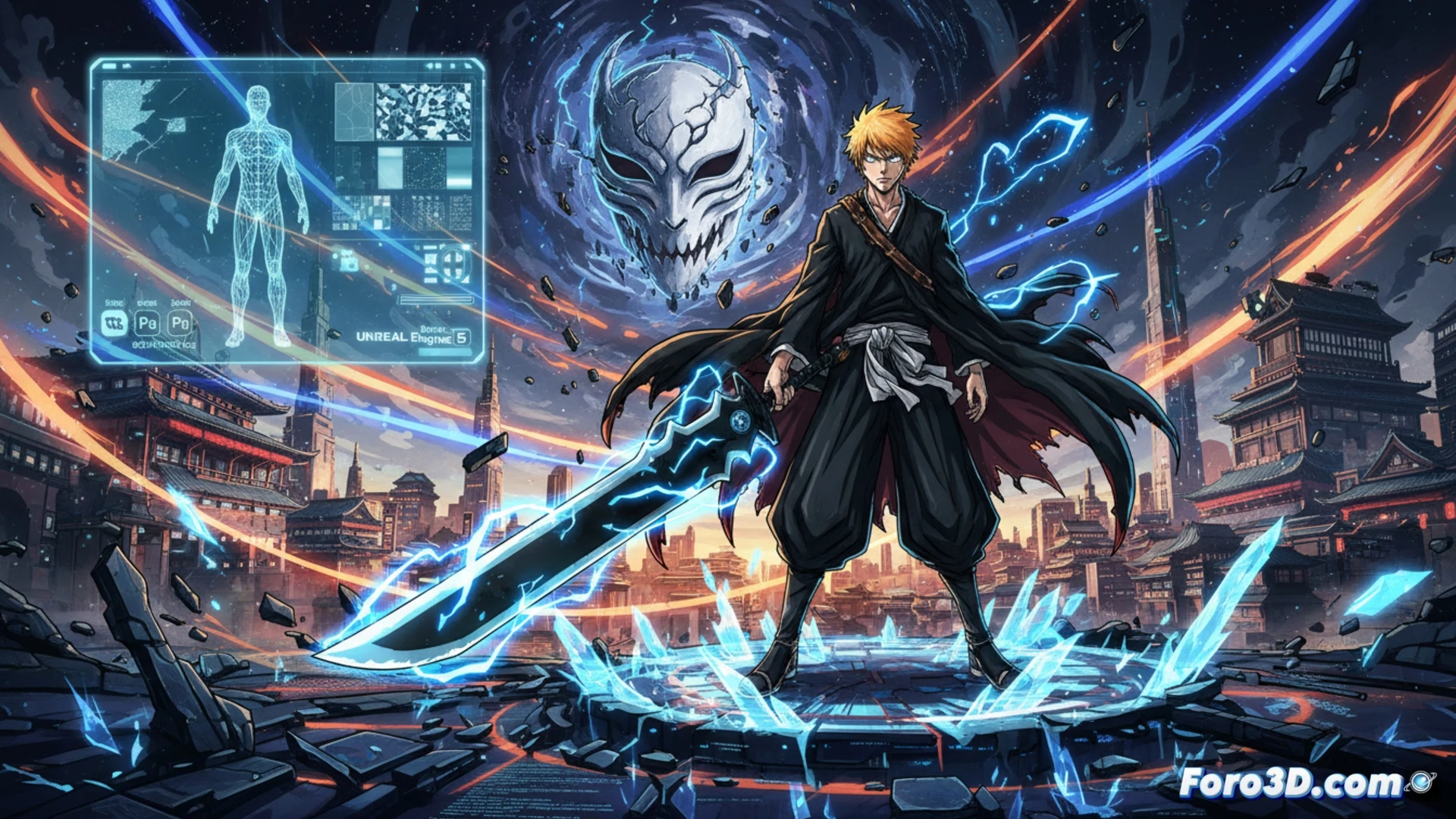
Production Pipeline: Modeling, Texturing, and Real-Time Integration 🎨
The workflow begins in Autodesk Maya, where characters are modeled with topology designed for extreme deformations, essential for combat movements and dramatic Bankai poses. Textures are generated in Photoshop, applying flat color maps and contour lines that the engine interprets to simulate anime ink. The real challenge lies in Unreal Engine 5, where a custom toon shader is implemented. This shader uses a stepped diffuse lighting model and a post-process silhouette system, making reflections and shadows behave like 2D animation without losing 3D depth. The integration of particle effects for ultimate abilities requires a careful balance between cinematic detail and console performance.
The Key to Anime Realism: Optimizing Cinematic Effects ⚡
The real-time representation of Bankai is the project's critical point. To avoid visual saturation, the team applies Level of Detail (LOD) techniques to particles and uses translucent materials in Unreal Engine that react to ambient light without breaking the flat aesthetic. This approach demonstrates that modern cel-shading is not just a matter of post-processing, but of coherent asset design from the modeling phase, where every polygon and every brushstroke in Photoshop has a narrative and technical purpose.
How has the cel-shading workflow in Unreal Engine 5 been optimized to replicate the anime style of Bleach: Rebirth of Souls without sacrificing real-time performance?
(PS: optimizing for mobile is like trying to fit an elephant into a Mini Cooper)