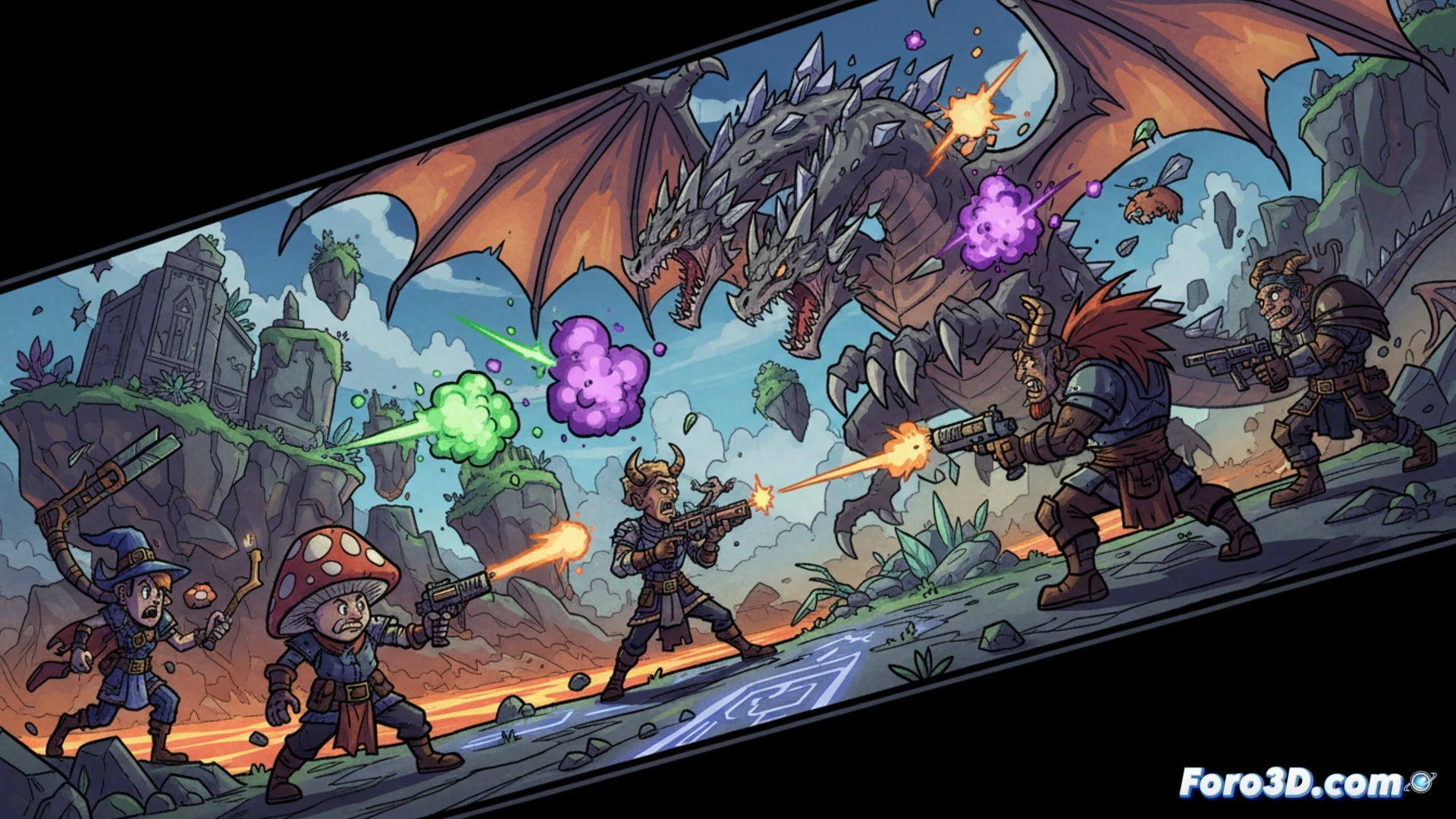
The visual style of Tiny Tina's Wonderlands represents a milestone in the application of cel-shading with edge detection within Unreal Engine 4. This engine allows rendering dynamic contour lines over polygonal models, generating an interactive comic aesthetic. The technical key lies in the use of a post-process material that identifies discontinuities in normals and depth, painting black edges without the need for additional geometry. This reduces the polygon load while maintaining the characteristic visual sharpness of the game.
Technical pipeline: rigging in Maya and hand-drawn textures 🎨
For flying creatures like dragons, the team used Autodesk Maya implementing rigging with hierarchical joint chains and weight-based skinning systems. The wing bones include procedural flapping controllers to avoid robotic animations. In parallel, hand-drawn textures simulating artisanal brushstrokes were developed in Photoshop. These textures are exported as albedo maps with tone and opacity variations, while a flat roughness channel (value 0.6) unifies light reflection, imitating satin paper. The engine's edge detection is adjusted with a threshold of 0.3 to avoid ghost lines in shadow areas.
Optimization for epic fantasy in real-time ⚡
The biggest challenge was maintaining bright spell particle effects without saturating the pipeline. The solution was to use GPU Sprites with materials without dynamic lighting, preloading 200 particle textures into a 4096x4096 atlas. Organic environments, like enchanted forests, use LODs with vertex animation for wind, reducing draw calls by 40%. Cel-shading not only beautifies but also hides imperfections in low-poly models, allowing epic fantasy to run stably even on last-generation consoles.
What specific edge detection techniques in Unreal Engine 4 allow Tiny Tina's Wonderlands to achieve its characteristic epic cel-shading without sacrificing dynamic lighting and environmental details?
(PS: optimizing for mobile is like trying to fit an elephant into a Mini Cooper)