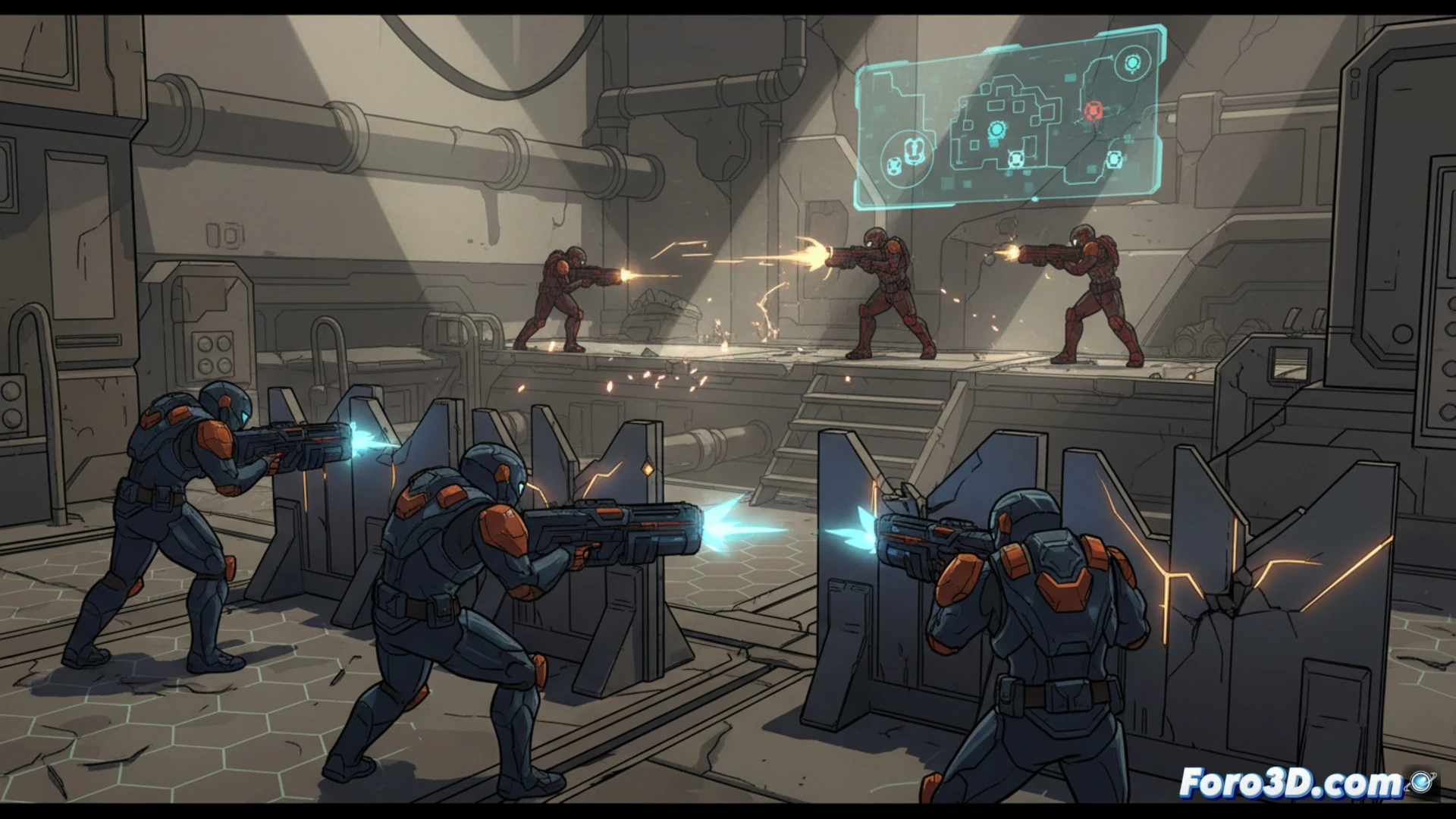
Spectre Divide bets on a cel-shading style that evokes 90s sci-fi comics, but its real technical challenge is not just aesthetic, but functional. In a tactical team-based shooter, visual legibility is as critical as the shooting mechanics. The team has had to balance the thick outlines and flat lighting characteristic of the cartoon style with the need for every enemy, piece of cover, and particle effect to be instantly distinguishable amidst the chaos of a match.
Pipeline: From ZBrush to Unreal Engine, via Maya and Substance Painter 🎨
The workflow begins in ZBrush, where high-resolution models are sculpted with a focus on exaggerated silhouettes, avoiding microscopic details that would be lost at gameplay distance. These assets then move to Maya for retopology and rigging, reducing the polygon count without losing form clarity. The magic of flat shading is achieved in Substance Painter, where ID maps are painted that Unreal Engine 4.27's custom shader interprets to generate discrete light bands, instead of smooth gradients. The engine receives this data and applies a post-process edge detection, which draws black lines on object edges, mimicking comic book inking, but only where it doesn't obstruct the player's view. The result is a style that reads instantly even at 60 fps and with high network latency.
The paradox of narrative art in a competitive game 🎯
The decision to use cel-shading in a multiplayer title is not trivial. While single-player games can afford saturated palettes and dramatic shadows, Spectre Divide needed each character to stand out against any background. The technical solution was to limit the color palette to cool tones for environments and warm tones for agents, using Unreal's shader to apply a dynamic outline that becomes thicker on enemies. Thus, the visual style not only tells a retro-futuristic story but becomes a tool for designing invisible interfaces, demonstrating that aesthetics and competition are not at odds when the technical pipeline is well thought out.
How does Spectre Divide maintain visually consistent cel-shading in a competitive multiplayer environment without compromising performance or character legibility on the battlefield?
(PS: game jams are like weddings: everyone is happy, no one sleeps, and you end up crying)