The production of recombinant insulin demands extreme purity control. However, an entire batch was discarded after metallic microparticles were detected in the final product. The investigation, led by a simulation team, revealed that the bioreactor impeller had microscopic pitting. The origin: cavitation generated by an excessive rotation speed, erroneously programmed in the control software. This case demonstrates that a poorly adjusted operational parameter can compromise material integrity and drug safety.
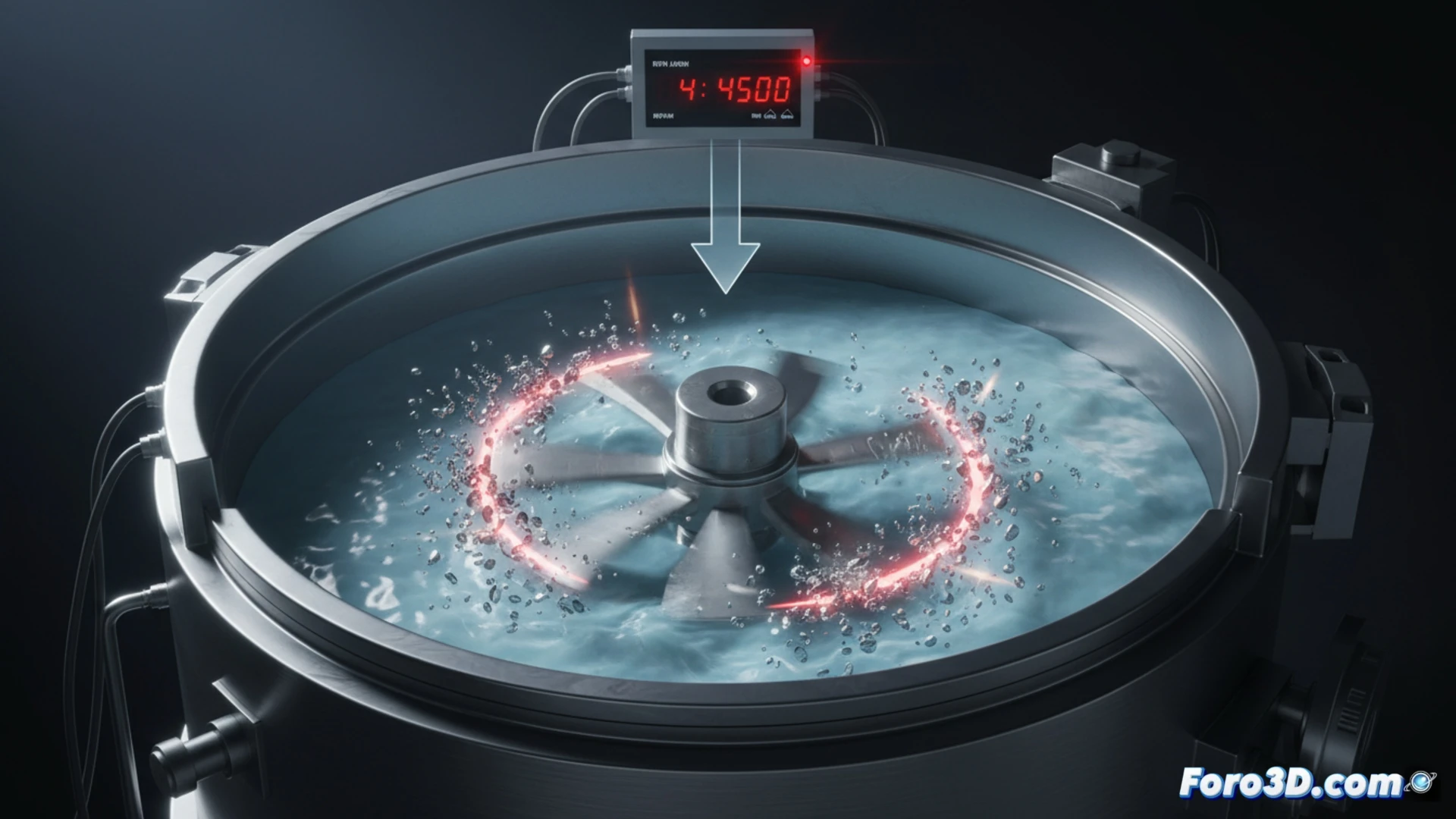
CFD-Microscopy Correlation for Damage Validation 🔬
To reconstruct the failure, ANSYS CFX was used to simulate the two-phase flow inside the bioreactor at the recorded rotation speed. The results showed localized low-pressure regions on the suction side of the impeller, where the vapor pressure of the culture medium was exceeded, forming collapsing bubbles. These implosions generated shock waves that eroded the surface of the 316L stainless steel. Subsequently, a 3D microscopy analysis using ZEISS ZEN confirmed the morphology of the pitting, coinciding with the areas predicted by computational fluid dynamics. The correlation between simulation and physical inspection validated the hypothesis of failure due to cavitation induced by excessive speed.
Digital Twins as a Barrier Against Contamination 🛡️
Beyond forensic investigation, this incident underscores the need to integrate digital twins into critical pharmaceutical processes. Modeling the impeller in Autodesk Fusion 360 and coupling it with a fatigue analysis in ANSYS allows predicting the component's lifespan under different load conditions. If the control software had been linked to a digital twin, the excessive speed would have triggered a cavitation risk alert before the damage occurred. Simulation not only explains the past; it is the tool that protects the purity of future batches.
Is it possible to predict the lifespan of an impeller in an insulin bioreactor through cavitation fatigue simulations before batch contamination occurs?
(PS: Material fatigue is like yours after 10 hours of simulation.)