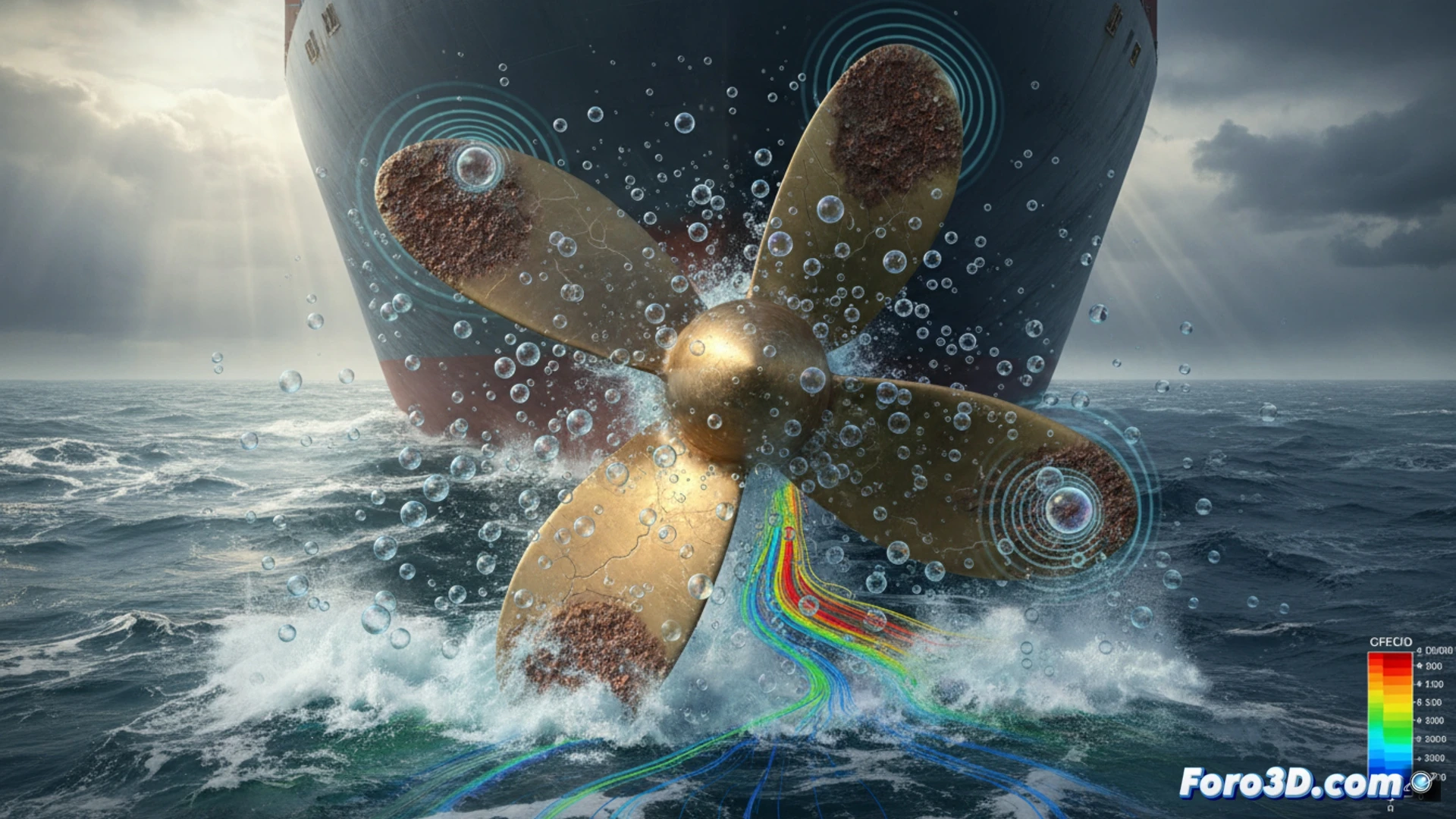
Cavitation damage in the propellers of mega-container ships represents one of the most critical challenges for modern naval engineering. When these vessels operate outside their optimal design regime, vapor bubbles collapse violently on the metal surface, generating micro-impacts that erode the material. This phenomenon not only reduces propulsive efficiency but also triggers an accelerated fatigue process that can compromise the structural integrity of the component.
Technical analysis of flow and damage inspection ⚙️
To address this problem, engineers rely on an integrated workflow with specialized tools. Orca3D allows modeling the exact geometry of the propeller, including variations in pitch and curvature that influence pressure distribution. SolidWorks CFD simulates water flow around the blade, identifying low-pressure zones where cavitation initiates. Once damage occurs, GOM Inspect performs high-precision three-dimensional scanning to quantify material loss and surface roughness. This data is fed into fatigue models to predict the remaining life of the component under real operating conditions, enabling more precise inspection intervals to be established.
The hidden cost of operational efficiency 💰
The commercial pressure to maintain tight routes and schedules forces these ocean giants to frequently operate under suboptimal load or speed conditions. Each cavitation cycle not only removes metal particles but also introduces microcracks that propagate silently. Material fatigue simulation reminds us that degradation is not a sudden event but an accumulation of invisible damage. Investing in early simulations and periodic inspections with tools like GOM Inspect is not an expense but a strategy to avoid catastrophic failures and extend the service life of these critical components.
How to numerically model the interaction between propeller cavitation phenomena and the off-design loading conditions typical of mega-container ships to predict fatigue crack propagation in complex geometry blades?
(PS: Material fatigue is like yours after 10 hours of simulation.)