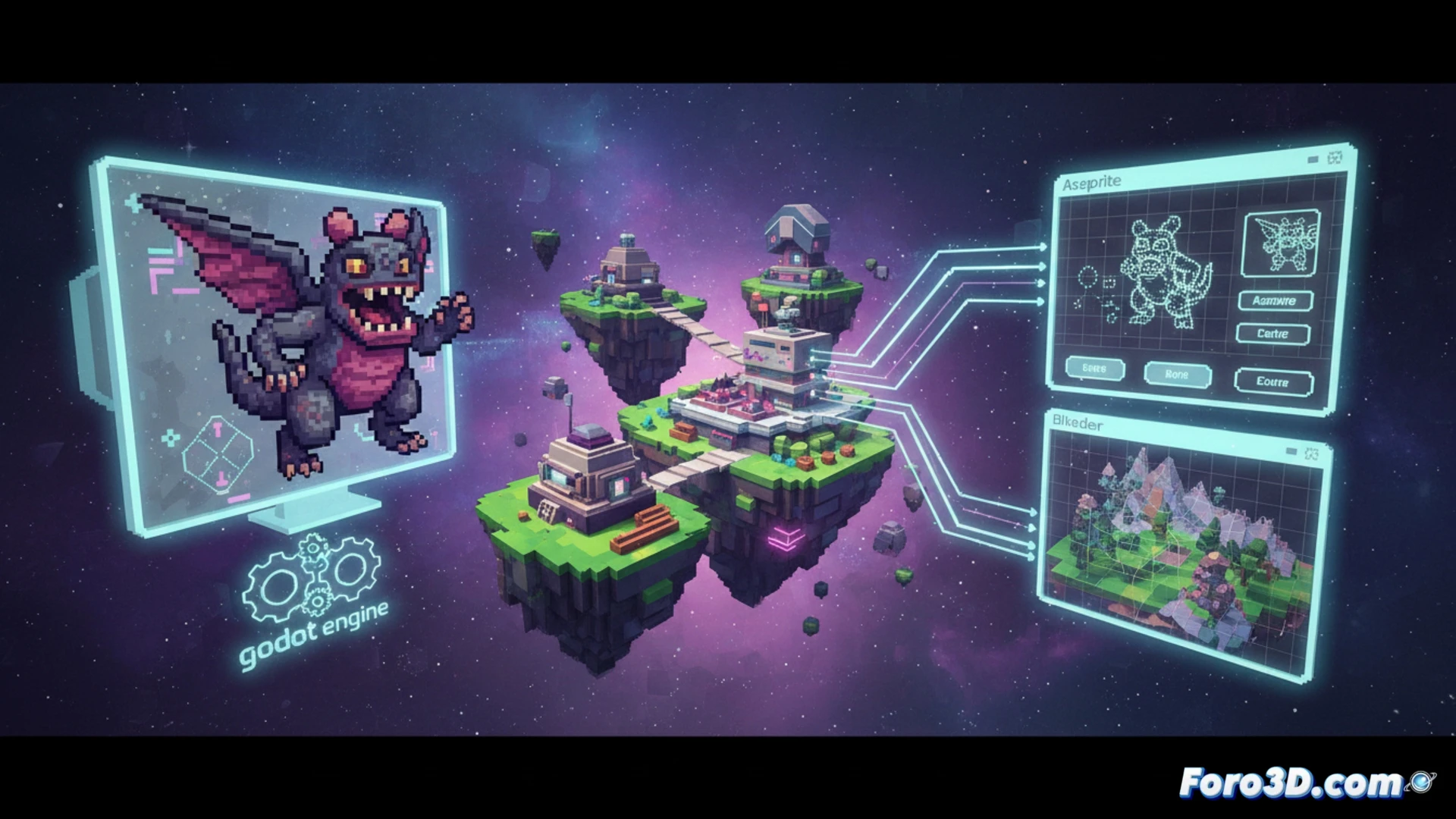
Cassette Beasts is a clear example of how Godot Engine can handle a 2.5D style without breaking a sweat. The game combines high-quality 2D sprites with a fully three-dimensional world, achieving a modern pixel art aesthetic reminiscent of classic pocket monsters, but with the freedom of a 3D camera. What's interesting here is not just the visual result, but the technical workflow behind it, using Aseprite for the sprites and Blender for environment models and cinematics.
Technical Workflow: 2D Sprites in a 3D Engine 🎨
The trick for Cassette Beasts to work visually lies in the use of Sprite3D nodes within Godot. Instead of sculpting polygonal models for the characters, the team rendered each animation angle in Aseprite and imported them as flat textures that always face the camera, a technique known as billboarding. For the environments, they used Blender to model simple 3D geometry and then textured everything with pixel art palettes. A key tip for optimizing this workflow is to keep the sprite resolution uniform and use Godot's mesh system to apply dynamic shadows over these 2D planes, avoiding visual flickering.
The Tape Effect: Retro Shaders for Modern Immersion 📼
The distinctive touch of Cassette Beasts is its retro cassette tape aesthetic. Instead of being a simple post-processing filter, they achieved this effect with custom shaders in Godot. It can be easily replicated using a ShaderMaterial that manipulates the color channel, introducing a slight RGB shift (chromatic aberration) and adding horizontal scanlines with low-frequency noise. For the magnetic tape effect, you can use a shader that displaces pixels on the Y axis randomly but smoothly, simulating the instability of a physical tape. This demonstrates that Godot is not just for simple games, but for projects that require a complex and unique visual identity.
How does Godot Engine achieve the integration of dynamic lighting and shadows with 2D sprites in Cassette Beasts to create the characteristic depth of 2.5D pixel art without sacrificing performance?
(PS: a game developer is someone who spends 1000 hours making a game that people complete in 2)