When a consumer sees a milk carton or a Tetra Brik, they automatically associate cardboard with nature and sustainability. However, from a packaging design perspective, this perception clashes with a complex technical reality. While a PET bottle is a relatively simple monomaterial, beverage carton is a sandwich of up to six different layers. At Foro3D, we analyze this structure as if it were a sectioned 3D model, revealing why recycling cardboard is a logistical and economic headache.
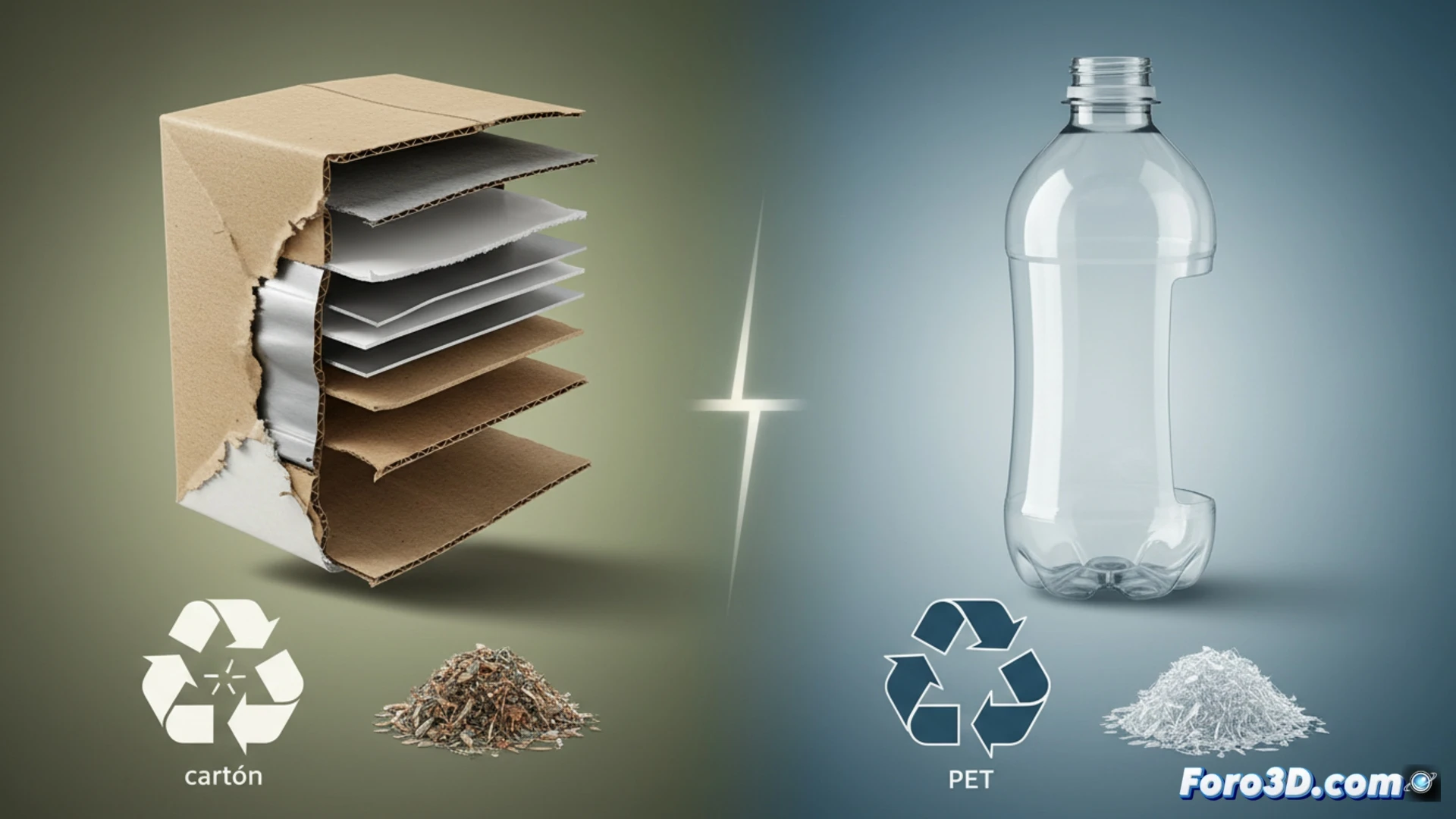
Anatomy of a Tetra Brik: the impossible sandwich to recycle ♻️
If we model a cross-section of a beverage carton, we will see a sequence of materials that no simulation software could easily simplify. The outer layer is cardboard (approximately 75% of the weight), which provides rigidity and printability. Immediately after, we find a layer of low-density polyethylene (LDPE) that acts as a moisture barrier. Then comes the critical layer: a very thin sheet of aluminum (approx. 6 microns), essential for protecting the product from light and oxygen. Finally, another layer of LDPE seals the liquid. To recycle this, plants must use hydropulpers that separate the cellulose fiber, leaving a complex residue of plastic and aluminum called PolyAl, whose processing is costly and has a very limited market for revalorization.
The PET paradox: a plastic with a better recycling footprint 🧴
In contrast, a standard PET bottle is a model of structural simplicity. It is a monomaterial that, after being crushed, washed, and melted, becomes new granulate suitable for manufacturing more bottles or textile fibers. The PET recycling chain is globally standardized, with collection centers and specialized recyclers operating with sustainable margins. The next time you design a 3D package, ask yourself if you are creating an elegant one-piece solution or a multilayer puzzle that, although it looks green on the outside, hides a much greater environmental and economic cost than its label promises.
As a design or production professional, have you truly verified whether the complete life cycle of the cardboard packaging, including its plastic and aluminum barrier for liquid foods, generates a lower environmental impact than a 100% recyclable PET package?
(PS: Designing 3D packaging is like making a box for a gift you haven't bought yet.)