A patient with a pacemaker suffered a severe arrhythmia while charging their electric car. Doctors suspected electromagnetic interference, but needed proof. The digital forensics team reconstructed the incident in 3D using Ansys Maxwell, MATLAB, Mimics, and Unreal Engine 5, demonstrating that the charger coil's field induced a stray voltage directly onto the implant's electrodes.
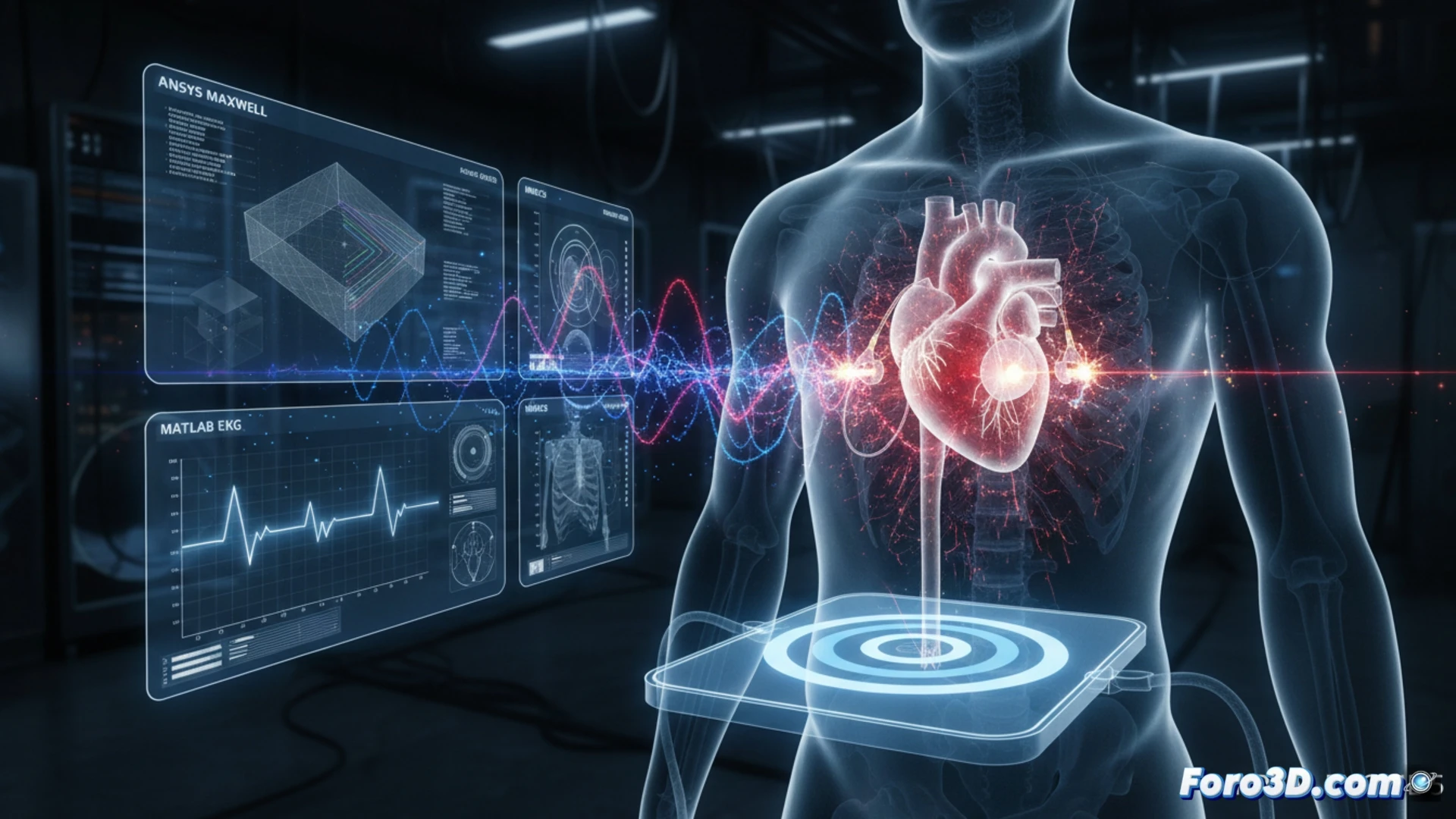
Simulation of magnetic coupling with Ansys Maxwell and MATLAB 🧲
The process began with segmentation of the patient's thorax in Mimics, generating a realistic anatomical model of ribs, lungs, and soft tissue. The EV wireless charger coil was imported onto this geometry. In Ansys Maxwell, a low-frequency (85 kHz) electromagnetic simulation was configured to calculate the B-field distribution. The results were exported to MATLAB, where a finite element analysis was performed to solve Faraday's integral. A peak induced voltage of 4.2 V was detected at the right ventricular electrode, exceeding the pacemaker's inhibition threshold. The simulation confirmed that the pulse phase shift coincided exactly with the moment of maximum charging power.
Forensic visualization in Unreal Engine and lessons for the industry 🎥
To communicate the finding to the clinical team, Unreal Engine 5 was used to render a real-time animation. The scene showed the electromagnetic field as a semi-transparent color gradient enveloping the thorax, highlighting the interference zone over the pacemaker. This forensic visualization not only validated the clinical hypothesis but also exposed a design risk: the standard position of the charger under the vehicle creates a hot spot right at the chest level of a seated driver. The case underscores the need to include 3D biomedical models in certification protocols for wireless charging systems.
Would you use this digital twin for surgical planning? 🤔