The independent studio Nerial has released Card Shark, a title that combines 18th-century cheating narratives with impeccable art direction. Developed in Unity, the game does not aim for photorealism but rather for an aesthetic of digitized historical engravings reminiscent of illustrated encyclopedias from the era. This approach demonstrates how an accessible engine like Unity can host unique visual proposals when integrated with editing tools such as Adobe Photoshop.
Optimizing 2D and 3D assets for an illustrated aesthetic 🎨
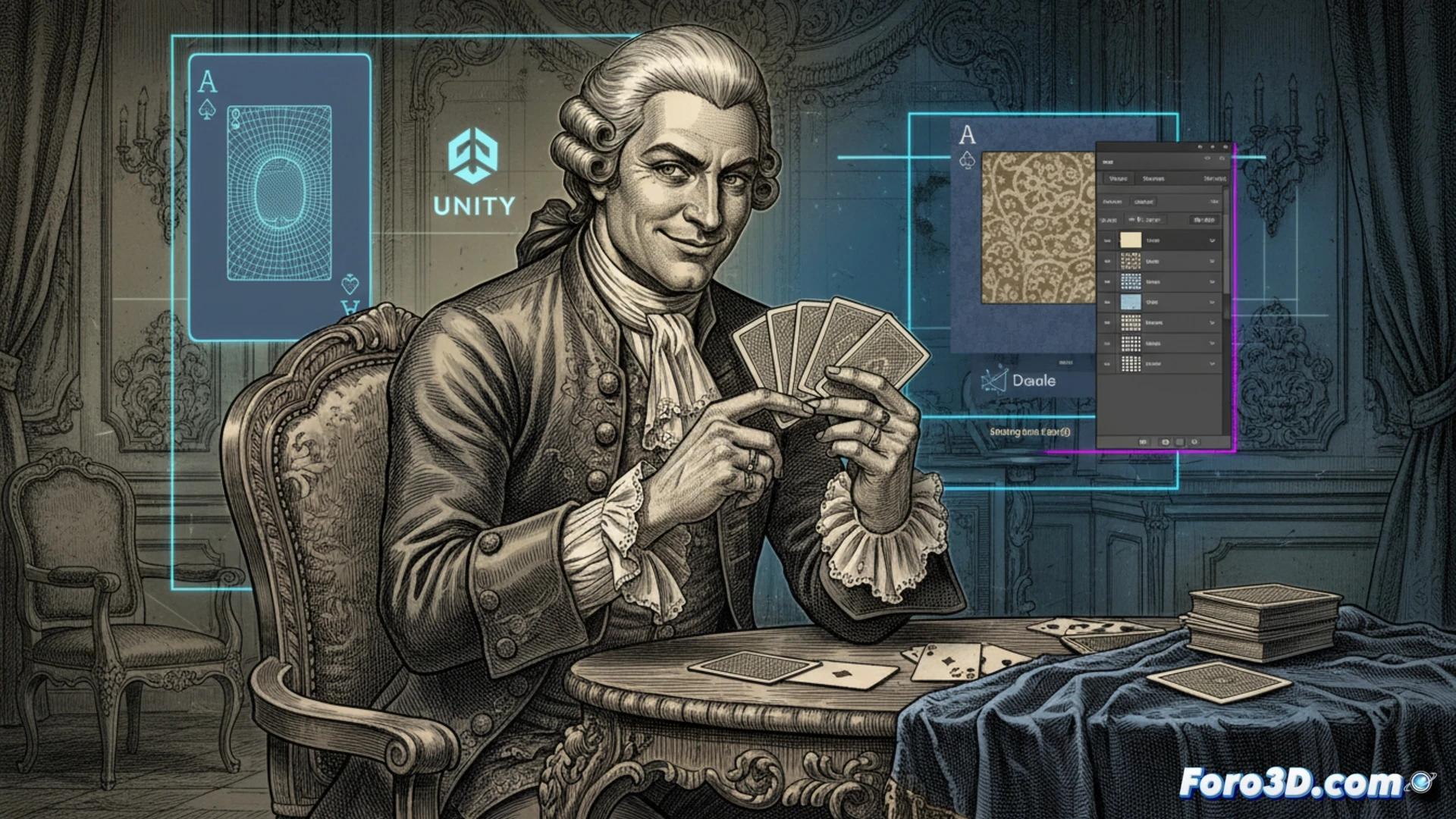
To achieve the look of an old book, the developers used textures processed in Photoshop simulating aged paper and worn ink. The characters and settings, modeled in 3D within Unity, are rendered with flat lighting and hard shadows, mimicking the stroke of a burin. The technical key lies in the use of custom shaders that apply a dithering effect and irregular edges, concealing the polygonal nature of the models. 2D assets, such as cards and playing cards, were generated as high-resolution sprites with opacity masks to recreate the texture of paper, optimizing performance by avoiding unnecessary polygons. The UI, composed of ornamental frames and serif typography, was designed as texture atlases in Photoshop to minimize draw calls in Unity.
Lessons for indies: art as a hallmark of identity 🃏
Card Shark demonstrates that a coherent and well-executed graphic style can be the biggest differentiator in a saturated market. For small studios, investing time in artistic pre-production and asset optimization from the start reduces final polish costs. Unity, combined with Photoshop, offers a viable workflow to create visually striking worlds without needing a massive team. The lesson is clear: art direction is not an ornament, but the backbone of the gaming experience.
What digital painting techniques in Photoshop and lighting configurations in Unity allow replicating the 18th-century pictorial aesthetic in a game like Card Shark without sacrificing performance?
(PS: shaders are like mayonnaise: if they break, you start all over again)